January 29, 2008

Kwame Kilpatrick: Poster Child for the Failure of Black Accountability

I lived in Metro Detroit for eight years, a time span that included Mayor Archer's second term and Kwame Kilpatrick's first. Detroit has been the nightmare scenario of white flight, ineffective black political rule, racial polarization and urban decay for better than 20 years. The city has a history and well known status as the most segregated city in America. Sadly, that racial legacy and present day context has been the excuse for a low standard of accountability when it comes to Detroit's black political leadership. The latest embarrassment is the now publicly outed sordid extramarital affair between Mayor Kilpatrick and Chief of Staff Christine Beatty.

It was an affair those in the know and among Kwame's security detail knew about and one of those open secrets the rest of the city suspected. It became public knowledge for sure when text messages were revealed which confirmed the affair. The seeds of Kwame's undoing began with a pair of police officers that sued him and the city for alleged violations of the state’s Whistleblower Protection Act. The suits were brought by Officer Harold Nelthrope, a former mayoral bodyguard, and Gary Brown, a former deputy chief who previously headed the Police Department’s Internal Affairs Unit. Brown says he was fired for letting members of his unit investigate Nelthrope’s allegations and Nelthrope said that Kwame violated whistle blower laws by outing him and slandering him in retaliation.

Nelthrope approached Internal Affairs, known as the Professional Accountability Bureau, with allegations that some members of the mayor’s security team were getting paid for overtime hours they didn’t work, as well as other alleged transgressions. He also reported rumors of a wild party at the mayoral mansion involving strippers, one of whom was allegedly assaulted by the mayor’s wife, Carlita Kilpatrick who supposedly walked in on a lap dance Kwame was enjoying. Deputy Chief Gary Brown pursued an investigation into Nelthrope's claims about the overtime as well as the party rumors, a path certain to bring him into direct conflict with the Mayor. In responding to the allegations, Kwame identified Nelthrope publicly, even though his identity by law should have been confidential. The mayor called his allegations false and publicly said he was a liar and that he hoped Nelthrope's family was listening.

Kwame's counterattack was hard core and revealing of his character. He told the then Police Chief, Jerry Oliver, ( a man universally hated by rank and file DPD) to fire Deputy Chief Brown and to say publicly that it was his decision and not the Mayor's. The hilarity of that lie was brought home to me one morning during my morning commute listening to AM760 as the scandal unfolded. On a morning show, the Mayor was interviewed and when asked who's decision was it to fire Deputy Chief Brown, he confidently stated it was Chief Oliver's call. Not more than an hour or so later, Chief Oliver, interviewed on a different show, same station, said the opposite, that the Mayor instructed him to fire Deputy Chief Brown. They clearly had not gotten their stories straight. Later that same day, Chief Oliver was interviewed again and it was clear that the Chief had been given a thorough review of the talking points memo by Kwame and now he was taking the hit and stating that it was his call to fire the Deputy Chief.

In the course of giving testimony in the case, the plaintiffs lawyers asked Kwame and Beatty both if they were romantically involved, clearly prompted by the plaintiffs inside knowledge of what was going on. Christine simply responded no. Kwame gave an indignant speech in his answer, saying angrily that it was wrong to brand Beatty as a whore. All the time, the both of them flagrantly involved in a torrid liaison that was carried on in the presence of administration insiders and was certainly known to their police detail. The case was eventually settled for about $6 million with another $3 million paid in legal fees, and the plaintiffs committed to a secrecy agreement about the deal.

Political Season's take on this sordid mess? Kwame should lose his job for a variety of reasons. First and foremost, he's a married man doing his at the time also married chief of staff employee, opening the city to potential sexual harassment liabilities from her or other men and women in the administration. That is stupendous bad judgment. Everybody in town in the know knew it was going on, and the rest of the city pretty much assumed it.

Secondly, they fired people to cover the affair up and other foolishness he was doing. They made the police chief fire the deputy police chief that initiated an investigation into goings on with Kwame's security detail and those people sued. So they axed people to cover up their mess.

Lastly, the jacked up, stone broke City of Detroit forked over $9.4 million in a settlement plus legal fees to settle the case and keep the plaintiffs quiet about what they knew, mainly his affair with Beatty, perhaps others and likely the real story about the big stripper party that supposedly never happened.

Detroit is the poster child for urban decay. Michigan's economy has been in the toilet for several years now which is why I live in Indy and not Detroit. Here in Indy, they talk about not becoming "Detroit". Detroit, a city with so many things wrong that is so badly in need of leadership and good stewardship, and they pay out $9.4 million plus legal fees to hush the Mayor's sordid affair with his chief of staff, who was also married and was cool with his wife? The man should resign. If this brother worked for you or if you or I cost our company $9.4 million because of an affair with a subordinate, would we have a job? Hell no.

Don't feel sorry for him and don't cut him an inch of slack. Black people in Detroit and in general are too often all too willing to tolerate any mess to keep "black" leadership, even if that means no accountability. And with no accountability, the city will continue to be a dump because black people are not taking responsibility for ourselves. Already the hit parade of excuses is beginning. According to the Detroit Free Press, Sharon McPhail, one of Detroit Mayor Kwame Kilpatrick’s top aides, said today that she believes Kilpatrick will not be charged with perjury despite contradictions between his testimony in court in a whistleblower case and text messages sent between him and his chief of staff.

McPhail, speaking with reporters as she entered the Coleman A. Young Municipal Center, said she doesn’t believe enough evidence exists to charge Kilpatrick, although she also said she had not read the text messages.

“When the facts are known this is just going to be a blip on the screen of all the wonderful things he’s done for the city,” she said.

McPhail said calls for the mayor to repay the city for paying his legal bills in the whistleblower suit and the $9 million judgment in that case are misplaced. The case resulted because of Kilpatrick’s official decision, justifying a taxpayer-funded legal defense, she said.

The text messages exposure of his affair with chief of staff Christine Beatty was not why three former police officers sued the city, she said. The case originated because former Deputy Police Chief Gary Brown continued to investigate a never-proven wild party at the Manoogian Mansion.

And lets not forget about the rather sexist nature of our substandard community accountability on display here with the resignation of Christine Beatty. As my wife pointed out, her career is effectively destroyed. She is now out of a job, divorced, and branded as a whore and certified home wrecker. Who is going to be willing to employ her in any position of public trust or responsibility again? What will be the quality of her professional relationships with other women and men in the future? She is out of her job right now, but Kwame's staff is going on the defense of him and I'm sure the drumbeat from the community may already have begun that he should not have to resign, that if he is, he's being held to a different standard than white politicians. I don't see anyone coming to Beatty's defense. Why shouldn't the excuses being advanced on Kwame's behalf apply to her as well? How that plays is even more interesting considering the number of other high profile black women in the orbit of this mess. The prosecutor is a Black woman. Christine Beatty is a Black woman. Carlita Kilpatrick is a Black woman, as is Kwame's mother, Carolyn Kilpatricke head of the Congressional Black Caucus. Don't be surprised if Beatty is vilified by the same black community that wants to excuse Kwame.

This is the accountability issue front and center for black people and the kind of stuff that makes us look like total jackasses. We are on a hair trigger when a white person makes a comment rightly or wrongly and will DEMAND folk be fired and punished, but we will make every excuse for black people in positions of responsibility who are guilty of egregious behavior, from taking a crack hit on camera to banking $90,000 in bribe money in the freezer. The result: underperformance in nearly every aspect of the community when it comes to implementation of effective strategies that address the interests of black people. Black Americans must call check on the poor performance of black leadership and demonstrate more maturity as a community by refusing to any longer tolerate the exercise of extremely poor judgment in positions of responsibility in order to have "black" leadership. If we effectively demand accountability and responsible leadership irrespective of the race of the person in a leadership position, we would be far better off.

January 27, 2008

Gaming Obama's Chances on Super Tuesday

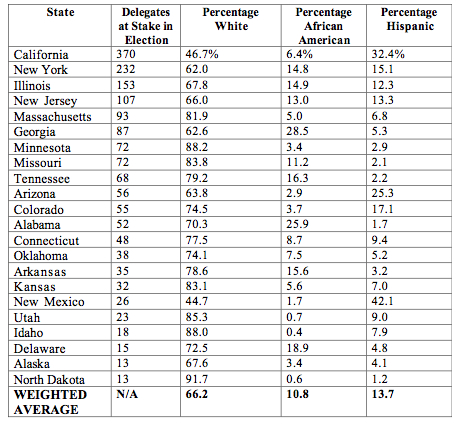
Jay Cost of the RealClearPolitics Horse Race blog tries to divine with demography Obama's chances on Super Tuesday.

"This is what we do know. Clinton has done well among Hispanics. Obama has done well among African Americans. Depending on where and when, white voters vary their support. How will that play out on Super Tuesday?....white voters make up a majority of the Super Tuesday population - but African Americans and Hispanics are important minorities. And remember that it is probable that in most states the electorate will oversample from African Americans and Hispanics, both of which tend to be Democrats.

And so, it seems to me that the key to Super Tuesday rests upon three questions:

First, will white voters follow the pattern they followed in Iowa and New Hampshire, in Nevada, or in South Carolina? And remember that viability, favorability, and vote can go go hand-in-hand. The current polling that shows Clinton with a large lead among whites could change in as a consequence of Obama's win. Remember that after Obama's victory in Iowa, Clinton's margin among white voters shrunk to just +8%, according to ABC News/WaPo.

Second, will African Americans "out perform" Hispanics? This is an interesting question. The exit poll found that African Americans and Hispanics each comprised 15% of the total electorate. But Nevada as a whole is 6.6% African American, and 19.7% Hispanic. If Super Tuesday African Americans "out perform" Hispanics as they did in Nevada - then Obama will be in a better position than what the above table suggests.

Third, what happens to Edwards' voters? It is unclear to me who they will go to if Edwards drops out. More importantly, it is unclear to me whether Edwards can sustain the level of support he has received to date. Voters can be brutal with their evaluations of viability. If they see Edwards as hopeless, it is quite possible that they will abandon his candidacy. If they do, where do they go?

January 26, 2008

The Beginning of the Defeat of Obama


I am throughly discouraged today as the voters of South Carolina head to the polls for their primary, even as the RCP average shows Obama ahead in SC 38% to 27% over Clinton, a spread that has narrowed in recent days. I believe he will win today, but his declining support among white voters and the possibility of the Clintons peeling off or even splitting the black vote could mean a margin of victory too narrow to maintain his competitiveness going into Super Tuesday.

The Clinton campaign has succeeded in two things. 1. making Obama a "black" candidate in the minds of white voters and 2. diminishing Obama's stature, bringing him down, in the eyes of voters, to the level of typical politicians, to frankly, their level. How did they do this? With a one two punch of smear tactics and the tactically effective, soullessly cynical taking advantage of the kneejerk racial reactionary tendencies of black folks.

For smear, they used his association with a long time supporter Anthony Rezko, a Chicago slumlord. Hillary played that card during the last debate and Obama was prepared with only a weak return line on the subject. She drew him onto her ground, the close combat of the politics of personal destruction, a black art of which she is a dark aficionado, and was able to sully him in the minds of voters.

For the other, the Clintons turned the overreaction of Obama supporters to some of Hillary's comments, particularly the LBJ/MLK comment into a veiled and sometimes overt accusation of racism. The Clintons drew this debate out into an acrimonious spat that began to define Obama and the race in racial terms, a tactic that began eroding his support among white voters in a process that I believe will continue.

One can argue that if Obama was so easily knocked off message by the Clintons smear tactics in the nomination fight, that he was not prepared for what was to come in the general. Perhaps there is truth in that. We may never know. What we do know is that the Clintons, in order to win, were perfectly willing to smear the most promising African American candidate to ever run for the Oval office. Furthermore, they were willing to play on the sensitivity of white americans to race and the reactionary nature of blacks on the topic to allow Obama to be branded as a "black candidate". Smear and the cynical manipulation of race. The Clinton weapons of war.

January 24, 2008

Uncertain Ground

"He has wandered into a tactical battle — over who is behind what radio ads or robocalls, or over the correct interpretation of stray quotes — with the best tactical politicians in the business."


January 22, 2008

The Mythology of the War on Drugs

For seven years, sociologist Sudhir Venkatesh studied a Chicago crack-dealing gang from the inside and found a complex, tightly organized society bound by friendship and force. His new book is Gang Leader for a Day: A Rogue Sociologist Takes to the Streets. His findings explode some popular myths that I think often go unquestioned or unanalyzed, even for many of us who have seen drug dealing or dealers up close and personal. The biggest and most massive myth to my mind is the simple fact that 95% of the dealers on the street are working for LESS than minimum wage. The money they have belongs to their bosses, the 5 percent who make more than $100k a year. Thats why so many of them live with their moms or families. They can't afford to live on their own, they make such a pittance. A common theme in discussions about drug dealing is this: "what do we expect young people to do? How can education and being a citizen compete? The drug dealers are wearing nice clothes and rolling in nice cars". Hey, guess what? Their not!

The image of the fat cat drug dealer is a myth. They don't exist. 95% are making slave wages. The Wire as a show actually gets this right, as does Charles Duttons' The Corner. Those corner boys are living hand to mouth. The War on Drugs is partly predicated on the idea that it makes sense to go after these corner boys, lock them up and throw away the keys because they are enriching themselves and destroying our neighborhoods. No doubt, the corner boys are destructive, but the reality is that if they are working for less than minimum wage, the drug trade is not the lure of riches its portrayed as. When drug dealing, a deadly and difficult line of work for less than minimum wage is the route that so many of our youth take, its clear the prevalence of dealers in the streets of many urban cities is really a reflection of the black hole of economic opportunities they have become, If thats the reality, what does that say about the strategy the War on Drugs should be pursuing versus what it is?

I had a cousin who was a drug dealer and was eventually killed in a drive by shooting. I can remember him telling me how difficult it actually was being a dealer (he sold weed). You had to stay in one place all the time so people could find you, people stuck him up for his money and as he bitterly complained once "ain't nobody buying dope every day". There were plenty of days he sold little or nothing and he lived a poverty stricken existence.

So when the candidates are talking about the War on Drugs and what they are going to do to win it, ask them what economic development strategy is in their arsenal for America's urban communities. Jobs and economic development is the real front line in the War on Drugs.

Clinton-Obama barbs dominate debate - CNN.com

By all accounts from the MSM and the blogosphere, this debate was full of personal attack and defense and I find that disheartening. More to the point, it pisses me off. I blame the Clintons for that tone. The politics of personal destruction is the playbook they are working with. Obama on the defense for votes and Rezko and whatever else they can find is only out there because they can't just win on a message about her experience and her vision for the country. Obama has now been forced onto Clinton's ground with this kind of negative campaigning. She is better at it, having had to spar with republicans for years, and frankly she relishes it. I found it interesting to watch her deadpan staredowns of Obama when he was speaking, and the smile that came to her face when it was her turn to talk and she could press her attack. I'm sorry, thats not inspiring. It doesn't make me want to follow you. It doesn't tell me what your vision is or encourage me to believe that your leadership is what we need.

I totally agree with Edwards that the BS squabbling does not do anyone any good. The MSM lays down its responsibility to be of value by encouraging this petty nonsense. I think its very clear that her attacks were aimed at Feb. 5th primary states and white voters. I think its also very clear by now that the Clintons have made a tactical decision to attack Obama and maim or destroy him as best they can, even if it means risking alienating the black vote in the short term, because they figure with the house negro support they do have, that they will be able to get blacks back in the fold by the general. I hope they find themselves being very wrong on that score.

By all accounts, Edwards had a good night. I still think his angry man politics won't carry the day and thats why he has no chance of being the nominee, but I like that he got the opportunity to be the voice of reason.
But considering that I don't think he has had a bad debate performance yet, having a good one here is not going to help him.

January 17, 2008

Bob Johnson Issues Apology to Obama


Bob Johnson issued an apology to Barack Obama for his comments attempting to smear Barack. Besides the fact that Johnson made his money as a smut peddler as owner of BET, it just says something about his character that as a billionaire he could not find any way to support his candidate other than to engage in the politics of personal destruction and was willing to do so against a respectable black american by associating him with drugs and drug dealing out of context. His entire demeanor in giving his comments is proof positive of his low intentions and the confidence with which he issued his attack says loud and clear that he felt fully sanctioned and supported by the Clintons in making the smear. Even afterwards Clinton defended the comments saying we should take him at his word about what he meant. That tells you her intent and his. The dirt will continue to fly, particularly in South Carolina, known for rough politics.

The Experience Gap: How Will it Play?

David Broder writes in the Washington Post:

“It was fascinating to watch the three top contenders for the Democratic nomination discuss their concept of the presidency during Tuesday night’s MSNBC debate in Las Vegas. But it was also stunning to realize that the three current and former senators who have survived the shakeout process — Hillary Clinton, Barack Obama and John Edwards — have not a day of chief executive experience among them.”

“By contrast, the Republican field is loaded with people who are accustomed to being in charge of large organizations. Mitt Romney and Mike Huckabee were governors of their states of Massachusetts and Arkansas, Rudy Giuliani served as the mayor of New York, and John McCain, as he likes to remind audiences, commanded the largest squadron in the Navy air wing.”

The issue of experience is relevant and certainly will play a role, but experience is not going to be the deciding factor for many voters. Furthermore, experience is not always all its cracked up to be. I can recall George Will describing the incoming Bush administration as government by grownups, because of the great experience and expertise of Bush and Cheney, as well as some of their appointees. Nevertheless, this administration has made many a misstep. While experience is an important and valuable quality, more salient to me is the issue of judgment in the next president. Experience in the chief executive is of little value if the judgments they make are poor. Furthermore, when the candidates raise the issue of experience, what will also spring to mind for voters is their assessment of that experience and how it shaped the candidate, and how it may have affected the voter or people like them.

Its instructive that while Rudy garners national favorable ratings as a great executive, many a New Yorker thinks his New York experience disqualifies him to be President and they would not vote for him. Experience is important, but judgment even more so and just like change, the question on that issue is not just experience, but the kind and quality of experience, not only for the candidate, but also for the people affected by the experience that candidate claims qualifies them for the office.

January 15, 2008

Another Clinton Surrogate Levels Harsh Attack at Obama

New York Rep. Charlie Rangel picks up the action as the designated "black attack dog" for Sen. Clinton where Bob Johnson left off, calling Obama "stupid" for suggesting that Dr. King could have signed the civil rights act;

“But for him to suggest that Dr. King could have signed that act is absolutely stupid. It's absolutely dumb to infer that Doctor King, alone, passed the legislation and signed it into law." He tortures a comment on Obama's book to again associate Obama with drugs;

"I assume that the book was not written for political purposes. It was honest….It was a big mistake for him to have done it [used drugs.] For him to be honest enough to write about it, I guess he thought it might sell books."

Rangel is a little Johnnie come lately to the party on this one, considering Hillary had already seconded Obama's call to ramp down the racial pyrotechnics in the campaign. His comments are completely dishonest.

His attack only further demonstrates the length the Black Democratic Establishment (BDE) is willing to go to help the Clintons win and restart the gravy train of patronage. Even as Hillary retreats from commenting on Obama's drug use as a youth, her black surrogates are taking every opportunity to raise it in order to smear and damage Obama in the minds of voters. Its the politics of personal destruction at its very best and I find it despicable and disgusting that African American politicians and elites are willing to engage in lowdown tactics of this sort, gleefully doing Hillary's dirty work to curry favors. It is vile behavior and those who engage in it are bereft of integrity.

Hillary joined Obama's call to ratchet it down, but with every sycophant eruption, one can only draw the conclusion that either the Clinton campaign is terribly undisciplined and can't keep their surrogates on message, or in fact this is the message.

January 14, 2008

The Strait of Hormuz Incident and U.S. Strategy

Graphic for Geopolitical Intelligence Report

By George Friedman (Honorary Political Season contributor)

Iranian speedboats reportedly menaced U.S. warships in the Strait of Hormuz on Jan. 6. Since then, the United States has gone to great lengths to emphasize the threat posed by Iran to U.S. forces in the strait — and, by extension, to the transit of oil from the Persian Gulf region. The revelation of an Iranian threat in the Strait of Hormuz was very helpful to the United States, coming as it did just before U.S. President George W. Bush’s trip to the region. Washington will use the incident to push for an anti-Iranian coalition among the Gulf Arabs, as well as to push Iran into publicly working with the United States on the Iraq problem.

According to U.S. reports and a released video, a substantial number of Iranian speedboats approached a three-ship U.S. naval convoy moving through the strait near Iranian territory Jan. 6. (Word of the incident first began emerging Jan. 7.) In addition, the United States reported receiving a threatening message from the boats.

Following the incident, the United States began to back away from the claim that the Iranians had issued threats, saying that the source of the transmission might have been hecklers who coincidentally transmitted threats as the Iranian boats maneuvered among the U.S. ships. Shore-based harassing transmissions are not uncommon in the region, or in other parts of the world for that matter, especially when internationally recognized bridge-to-bridge frequencies are used. And it is difficult if not impossible to distinguish the source of a transmission during a short, intense incident such as this. The combination of Iranian craft in close proximity to U.S. warships and the transmission, regardless of the source, undoubtedly increased the sense of danger.

Two things are interesting. First, the probability of a disciplined Iranian attack — and, by U.S. Navy accounts, the Iranian action was disciplined — being preceded by a warning is low. The Iranians were not about to give away the element of surprise, which would have been essential for an effective attack. While the commander on the scene does not have the luxury we have of dismissing the transmission out of hand — in fact, the commander must assume the worst — its existence decreases the likelihood of an attack. Attacking ships need every second they can get to execute their mission; had the Iranians been serious, they would have wanted to appear as nonthreatening as possible for as long as possible.

Second, the U.S. ships did not open fire. We do not know the classified rules of engagement issued to U.S. ship captains operating in the Strait of Hormuz, but the core guidance of those rules is that a captain must protect his ship and crew from attack at all times. Particularly given the example of the USS Cole, which was attacked by a speedboat in a Yemeni harbor, it is difficult for us to imagine a circumstance under which a ship captain in the U.S. Navy would not open fire if the Iranian boats already represented a significant threat.

Spokesmen for the 5th Fleet said Jan. 13 that the U.S. ships were going through the process of determining the threat and preparing to fire when the Iranians disengaged and disappeared. That would indicate that speed, distance and bearing were not yet at a point that required a response, and that therefore the threat level had not yet risen to the redline. Absent the transition to a threat, it is not clear that this incident would have risen above multiple encounters between U.S. warships and Iranian boats in the tight waters of Hormuz.

The New York Times carried a story Jan. 12, clearly leaked to it by the Pentagon, giving some context for U.S. concerns. According to the story, the United States had carried out war games attempting to assess the consequences of a swarming attack by large numbers of speedboats carrying explosives and suicide crews. The results of the war games were devastating. In a game carried out in 2002, the U.S. Navy lost 16 major warships, including an aircraft carrier, cruisers and amphibious ships — all in attacks lasting 5-10 minutes. Fleet defenses were overwhelmed by large numbers of small, agile speedboats, some armed with rockets and other weapons, but we assume most operated as manned torpedoes.

The decision to reveal the results of the war game clearly were intended to lend credibility to the Bush administration’s public alarm at the swarming tactics. It raises the issue of why the U.S. warships didn’t open fire, given that the war game must have resulted in some very aggressive rules of engagement against Iranian speedboats in the Strait of Hormuz. But more important, it reveals something about the administration’s thinking in the context of Bush’s trip to the region and the controversial National Intelligence Estimate (NIE) on Iran’s nuclear program.

A huge controversy has emerged over the NIE, with many arguing that it was foisted on the administration against its will. Our readers know that this was not our view, and it is still not our view. Bush’s statements on the NIE were consistent. First, he did not take issue with it. Second, he continues to regard Iran as a threat. In traveling to the Middle East, one of his purposes is to create a stronger anti-Iranian coalition among the Arab states on the Arabian Peninsula. The nuclear threat was not a sufficient glue to create this coalition. For a host of reasons ranging from U.S. intelligence failures in Iraq to the time frame of an Iranian nuclear threat, a nuclear program was simply not seen as a credible basis for fearing Iran’s actions in the region. The states of the Arabian Peninsula were much more afraid of U.S. attacks against Iran than they were of Iranian nuke s in five or 10 years.

The Strait of Hormuz is another matter. Approximately 40 percent of the region’s oil wealth flows through the strait. During the Iran-Iraq war of the 1980s, the tanker war, in which oil tankers moving through the Persian Gulf came under attack from aircraft, provided a sideshow. This not only threatened the flow of oil but also drove shipping insurance rates through the roof. The United States convoyed tankers, but the tanker war remains a frightening memory in the region.

The tanker war was trivial compared with the threat the United States rolled out last week. The Strait of Hormuz is the chokepoint through which Persian Gulf oil flows. Close the strait and it doesn’t flow. With oil near $100 a barrel, closing the Strait of Hormuz would raise the price — an understatement of the highest order. We have no idea what the price of oil would be if the strait were closed. Worse, the countries shipping through the strait would not get any of that money. At $100 a barrel, closing the Strait of Hormuz would take an economic triumph and turn it into a disaster for the very countries the United States wants to weld into an effective anti-Iranian coalition.

The revelation of a naval threat from Iran in the Strait of Hormuz just before the president got on board Air Force One for his trip to the region was fortuitous, to say the least. The Iranians insisted that there was nothing unusual about the incident, and Foreign Ministry spokesman Mohammad Ali Hosseini said that “Some political factions in the U.S. are pursuing adventurism to help Bush to spread Iran-phobia in the region. U.S. officials should apologize to Iran, regional countries and the American people.” This probably won’t happen, but he undoubtedly will be grateful that the Iranians said there was nothing out of the ordinary about the incident. If this incident was routine, and if the U.S. war games have any predictive ability, it means that the Iranians are staging routine incidents, any one of which could lead to a military confrontation in the strait. Bush undoubtedly will be distributing the Iranian statement at each of his stops.

Leaving aside the politics for a moment, the Iranian naval threat is a far more realistic, immediate and devastating threat to regional interests than the nuclear threat ever was. Building an atomic weapon was probably beyond Iran’s capabilities, while just building a device — an unwieldy and delicate system that would explode under controlled circumstances — was years away. In contrast, the naval threat in the Strait of Hormuz is within Iran’s reach right now. Success is far from a slam dunk considering the clear preponderance of power in favor of U.S. naval forces, but it is not a fantasy strategy by any means.

And its consequences are immediate and affect the Islamic states in ways that a nuclear strike against Israel doesn’t. Getting the Saudis to stand against Iran over an attack against Israel is a reach, regardless of the threat. Getting the Saudis worked up over cash flow while oil prices are near all-time highs does not need a great deal of persuading. Whatever happened in the strait Jan. 6, Bush has arrived in the region with a theme of widespread regional interest: keeping the Strait of Hormuz open in the face of a real threat. We are not certain that a Nimitz-class aircraft carrier could be sunk using small swarming ships. But we are certain that the strait could be closed or made too dangerous for tankers for at least a short period. And we know that, as in land warfare, finding the bases that are launching ships as small as speedboats would be tough. This threat had substance.

By dropping the Iranian nuclear threat and shifting to the threat to the strait, Bush moves the Iran issue from being one involving the United States and Israel to being one that excludes Israel but involves every oil producer in the region. None of them wants this to happen, and all of them must take the threat seriously. If it can establish the threat, the United States goes from being an advocate against Iran to being the guarantor of very real Arab interests. And if the price Arabs must pay for the United States to keep the strait open is helping shut down the jihadist threat in Iraq, that is a small price indeed.

This puts Iran in a tough position. Prior to the issuance of the NIE, the Iranians had shifted some of their policies on Iraq. The decline in violence in Iraq is partly because of the surge, but it also is because Iran has cut back on some of the things it used to do, particularly supporting Shiite militias with weapons and money and urging them to attack Sunnis. It also is clear that the limits it had imposed on some of the Iraqi Shiite politicians in the latter’s dealings with their Sunni counterparts have shifted. The new law allowing Baath Party members to return to public life could not possibly have been passed without Iranian acquiescence.

Clearly, Iran has changed its actions in Iraq as the United States has changed its stance on Iranian nuclear weapons. But Iran shied away from reaching an open accommodation with the United States over Iraq following the NIE. Factional splits in Iran are opening up as elections approach, and while the Iranians have shifted their behavior, they have not shifted their public position. The United States sees a shift of Iran’s public position as crucial in order to convince Iraqi factions, particularly all of the Shiite parties, to move toward a political conclusion. Reining in militias is great, but Washington wants and needs the final step. The NIE shift, which took the nuclear issue off the table, was not enough to do it. By raising the level of tension over a real threat — and one that has undebatable regional consequences — the United States is hoping to shape the internal political discussion in Iran toward an open participation in reshaping Iraq.

Iran doesn’t want to take this step for three good reasons. First, it wants to keep its options open. It does not trust the United States not to use a public accord over Iraq as a platform to increase U.S. influence in Iraq and increase the threat to Iran. Second, Tehran has a domestic political problem. In the same way that Bush saw an avalanche of protest from his supporters over the NIE, the Iranians will see resistance to open collaboration. Finally, the Iranians are not sure they need a public agreement. From their point of view, they have delivered on Iraq, the United States has delivered on the NIE and things are moving in a satisfactory direction. Why go public? The American desire to show the Iraqi Shia that Iran has publicly abandoned the quest for a Shiite Iraq doesn’t do Iran a bit of good.

The Iranians have used the construction of what we might call a guerrilla navy as a lever with the United States and as a means to divide the United States from the Arabs. The Iranians’ argument to the Arabs has been, “If the United States pushes us too far, we will close the strait. Therefore, keep the Americans from pushing us too far.” The Americans have responded by saying that the Iranians now have the ability to close the Strait of Hormuz, potentially regardless of what the U.S. Navy does. Therefore, unless the Arabs want to be at the mercy of Iran, they must join the United States in an anti-Iranian coalition that brings Iran under control. In its wooing of the Arabs, Washington will emphasize just how out of control the Iranians are, pointing out that Tehran is admitting that the kind of harassment seen Jan. 6 is routine. One day — and the day will be chosen by Iran — this will all get really out of hand.

The Iranians have a great deal to gain from having the ability to close the strait, but very little from actually closing it. The United States is putting Iran in a position such that the Gulf Arabs will be asking Tehran for assurances that Iran will not take any action. The Iranians will give assurances, setting the stage for a regional demand that the Iranians disperse their speedboats, which are purely offensive weapons of little defensive purpose.

The United States, having simplified the situation for the Iranians with the NIE and not gotten the response it wanted, now is complicating the situation again with a completely new framework — a much more effective framework than the previous one it used.

In the end, this isn’t about the Strait of Hormuz. Iran isn’t going to take on the U.S. Navy, and the Navy isn’t quite as vulnerable as it claims — and therefore, the United States obviously is not nearly as trigger-happy as it would like to project. Washington has played a strong card. The issue now is whether it can get Iran into a public resolution over Iraq.

The Iranians appear on board with the private solution. They don’t seem eager for a public one. The anti-Iranian coalition might strengthen, but as clever as this U.S. maneuver is, it will not bring the Iranians public. For that, more concessions in Iraq are necessary. More to the point, for a public accommodation, the “Great Satan” and the charter member of the “Axis of Evil” need to make political adjustments in their public portrayal of one another — hard to do in two countries facing election years.

January 13, 2008

Clintonian Sin: Arrogance

The Clinton campaign has made a mistake, one which may be fatal to their hopes in South Carolina and perhaps beyond. In order to counter the Obama challenge, they have engaged in an aggressive attack strategy, attempting to hammer at Obama's perceived weakness in experience and to swiftboat his strengths by attacking his integrity. The Clinton machine learned the tactics of political victory in the decade long battle against rapacious republicans. They invented or refined the political warfare tactics of rapid response and triangulation, using them to effectively confound republicans for a decade.

The problem they have now is twofold. One, they are fighting Obama as though he were the republicans, which basically means anything is fair game if you can get away with it. Its how republicans play. Democrats had to learn to fight with as much savagery, and the Clintons and their advisors such as Carville wrote that playbook. But they are not fighting the republicans for the White House, they are fighting Obama for the nomination. The strong arm tactics are overkill and the more they ramp them up, the more shrill and mercenary they appear. They were doing better trying to sell their vision and why they are the best to lead. But instead, they are focusing on telling us why Obama is not the best candidate. They are giving reasons not to vote for Obama, rather than reasons for us to vote for Hillary. Its a negative campaign.

Two, their campaign is beginning to ooze arrogance. Bill has been hailed as the so called "first black president" so often, he apparently has begun to believe it. Hillary references her years fighting for civil rights ad nauseam to assert that their is no way that her racial bona fides can be questioned. They have clearly taken for granted their vaunted position in democratic circles and among blacks, assuming that they would be free to attack the first credible African American candidate for president in any way they saw fit with impunity. They have also assumed that they don't have to be careful in what they say, since no one can question their racial goodwill. Wrong on both counts.

Hence, the emails about Obama's muslim middle name and innuendo that he was raised in a madrassa. The references to admitted past drug use and even raising the idea that perhaps he was a drug dealer. Bill regularly using the word "kid' in references to the 46 year old Obama. Hillarly's ill-advised comment about LBJ and the Civil Rights Act. The recent deployment of Bob Johnson to attempt to smear Obama again with past drug use and the subsequent statement issued by Johnson through the Clinton campaign (which means they wrote it, not him) saying he was referring to Obama's community organizing years, an insulting lie because it is so patently transparent.

In their arrogance and for all they supposedly understand black people so much, they have failed to understand that blacks will quickly withdraw their support if they attack Obama with unfair, hardball tactics that include smears, lying, misdirection and disrespectful attacks. He is the first credible candidate to make a run. Blacks, many of whom are supporting the Clintons, won't balk if the Clintons beat him fair and square. But the Clintons are clearly using anything they can get away with now that they perceive him to be a real threat. For that, blacks are likely to make them pay with a withdrawal of support, both now and in the general should they win the nomination. A shot across the bow as already come from Rep. Clyburn of SC, who has publicly stated his disappointment with recent comments from the Clinton campaign. Its a warning the Clintons would do well to heed.

Should this prove to be their downfall, the Clintons will have no one to blame but themselves. More than any one, they should have understood the delicate balance they would have to strike. In their arrogance, they are proceeding as though they can do or say or behave in any way they wish. They are sadly mistaken.

Race Sniping A Deadly Trap for Democratic Frontrunners

Hillary Clinton's campaign has drawn fire for statements she or her surrogates have made that have been poorly received by african american voters. Her comment regarding Lyndon Johnson and MLK seems to have drawn the most ire, suggesting that it was Johnson's presidential powers rather than the commitment and life risking political resistance of MLK and the movement that brought about the passage of the Civil Rights Act. Sen. Clinton is accusing the Obama camp of stirring the pot. Sen. Obama has called her remarks ill-advised, an accurate comment to say the least.

There is a deadly trap in this increasingly vitriolic confrontation for both candidates. For Clinton, she runs the risk of alienating in droves black voters and driving them right into the arms of Obama to lose the nomination. Or, she could win the nomination and lose the election because blacks vote republican or stay home in the general out of anger for the hardball tactics. For Obama, the focus on race could make that the dominant focus of his run, despite his best efforts to prevent race from becoming the sole prism by which his run is evaluated, with the result that non black voters are turned off, draining necessary vitality from his nomination run and his chances in the general.

The race issue carries within it the seeds of destruction for both campaigns. If they are not careful, they will reap what they sow.

January 11, 2008

Stop Whining and Stand Tall - Like Obama. This is Political Warfare


As I noted in my New Hampshire primary predictions, I decided to drink the kool-aid and predict a landslide Obama victory in the NH primary. I was not alone in this. Pundits, the media, news anchors, bloggers, all were swept up in irrational exuberance over the prospect of an inspiring, historical moment. Swept away with the idea that America would nominate a black man to run for president and were he to win, give America a shining moment to believe that as a nation we have come far enough to deliver on Martin Luther King's dream, that we judged Obama by the content of his character, not the color of his skin.

I, like many other black people I'm sure, was captivated by the idea that I might actually see a black man become President of the United States in my lifetime. Something I never thought possible. Something I thought my children might see, but not me. As Obama says on his website "I'm asking you to believe". So I did.

Hillary cried, Bill lied. And then, after all of the hype and exuberance and high expectations, came the NH numbers and Obama narrowly lost to Clinton, by a mere 3%. Pundits, media, bloggers and Obama supporters were all befuddled, asking themselves "WTH happened"? The postmortems of the primary result have come fast and thick. Where did Obama come up short? With women primarily. The polling stopped 3 days before the voting, and didn't catch the movement that might have signaled the tightening of the race. The black blogosphere has been full of its own theories and one that has made its appearance repeatedly is the "Bradley Effect" theory. Across the Afrosphere, blogs like the field negro, Jack and Jill Politics, Electronic Village, Pam's House Blend and many others have opined that the Bradley Effect, a phenomenon where white voters give inaccurate responses to polling questions about support for a non-white candidate out of a fear that they might appear to others to be racially prejudiced, was to blame for the NH result. In other words, white voters were not going to vote for Obama because of his race, even if they said they were.

With much respect to these and other bloggers, ENOUGH. Obama is competing for the job of leader of the free world. This is political warfare of the highest order. You don't play for stakes higher than this and in addition, his life and the lives of his family are literally on the line. If he wins the nomination and ultimately the election, he ascends to a position that makes him arguably the single most powerful man on the planet. His opposition are the highly capable and well financed leaders of the one of the most formidable political machines ever seen in democratic politics. The road to the nomination is going to be a dogfight, there will be blood and lots of it. There will be victories and as in NH, defeats in this war for the nomination.

Do not cheapen the significance of his effort, win or lose, by naming racism and prejudice as the cause when he is unsuccessful or suffers a setback. Racism and prejudice are a fact of life. Colin Powell once said "you must outperform racism". The same way the market factors political instability in the Middle East into the price of oil, African Americans must factor prejudice and racism into our calculations and plans, and so must Obama. He must outperform prejudice where it is in evidence and more importantly he must outperform his opponents. He fought the good fight in NH and he lost. He congratulated his opponent, declared and demonstrated that he was unbowed and forged on to the battles in Nevada, South Carolina and the Super Tuesday states. No mention of racism or prejudice. None. He got beat. It ain't over.

We should follow his leadership. Barack did not give any credence in defeat to the idea that racism had held him back. Neither should we.

January 10, 2008

CNN Puts Media Hit on Ron Paul

The CNN website is running a story on Ron Paul highlighting a series of newsletters authored under his name in the 90's that include prejudiced and insulting statements about blacks and gays. Bloggers and their readers have of course known about them for quite some time. This story is far from new, its been out there for quite a while. This clearly represents the MSM deciding that its time for Ron Paul to make his exit and they look to speed him on his way with a racist character assassination job. However, it will have little effect on Ron Paul's campaign. His die hard supporters won't be swayed and in fact may be in complete agreement with the sentiments in the newsletters and since he is already such a fringe figure, there's not much there.

Kerry to Endorse Obama

January 9, 2008

Beyond the Jihadist War - Introduction

Graphic for Geopolitical Intelligence Report

By George Friedman (honorary Political Season contributor)

There are three major global processes under way that will continue to work themselves out in 2008. First, the U.S.-jihadist war is entering its final phase; the destruction of al Qaeda’s strategic capabilities now allows the United States to shift its posture — which includes leveraging the Sunni world to finish the job begun in Iraq — and enables Washington to begin drawing down its Middle Eastern forces. Second, an assertive Russia is re-emerging and taking advantage of the imbalance in U.S. power resulting from the war. Third, oil at historical highs and continued Asian — particularly Chinese — exports have created a massive redistribution of financial might that is reshaping the international financial architecture. These processes intersect with each other, as well as with a fourth phenomenon: It is a presidential election year in the United States, which remains the center of gravity of the international system. These are the trends tha t shape our global forecast.

Normally in an election year, U.S. attention on global affairs dwindles precipitously, allowing other powers to set the agenda. That will not be the case, however, in 2008. U.S. President George W. Bush is not up for re-election, and there is no would-be successor from the administration in the race; this frees up all of the administration’s bandwidth for whatever activities it wishes. Additionally, Bush’s unpopularity means that each of the White House’s domestic initiatives essentially will be dead on arrival in Congress. All of the Bush administration’s energy will instead be focused on foreign affairs, since such activities do not require public or congressional approval. Contrary to the conventional wisdom, 2008 will see the United States acting with the most energy and purpose it has had since the months directly after the 9/11 attack.

Such energy is not simply a result of this odd hiccup in the American political system but of a major shift in circumstance on the issue that has monopolized American foreign policy efforts since 2003: Iraq. The Iraq war was an outgrowth of the jihadist war. After the 2001 invasion of Afghanistan, the United States realized it lacked the military wherewithal to simultaneously deal with the four powers that made al Qaeda possible: Saudi Arabia, Syria, Iran and Pakistan. The first phase of the Bush solution was to procure an anchor against Afghanistan by forcing Pakistan into an alliance. The second was to invade the state that bordered the other three — Iraq — in order to intimidate the remaining trio into cooperating against al Qaeda. The final stage was to press both wars until al Qaeda — the core organization that launched the 9/11 attack and sought the creation of a pan-Islamic caliphate, not the myriad local extremists who later adopted its name &#821 2; broke.

As 2008 dawns, it has become apparent that though this strategy engendered many unforeseen costs, it has proven successful at grinding al Qaeda into nonfunctionality. Put simply, the jihadist war is all but over; the United States not only is winning but also has an alliance with the entire constellation of Sunni powers that made al Qaeda possible in the first place. The United States will attempt to use this alliance to pressure the remnants of al Qaeda and its allies, as well as those in the region who are not in the alliance.

This leaves Iran, the region’s only non-Sunni power, in the uncomfortable position of needing to seek an arrangement with the United States. The year 2008 will still be about Iraq — but in a different way. Iran cares deeply about the final status of Iraq, since every united Mesopotamian government has at some point in its history attempted a Persian invasion. Yet for the United States, the details of intra-Iraqi negotiations and security in Iraqi cities now are irrelevant to its geopolitical concerns. Washington does not care what Iraq looks like, so long as the Sunni jihadists or Tehran do not attain ultimate control — and evolutions in 2007 have made both scenarios impossible in 2008.

Iran recognizes this, and as a result Washington and Tehran are ever less tentatively edging toward a deal. It is in this context — as an element of talks with Iran — that Iraq still matters to Washington, and this is now the primary rationale for continued involvement in Iraq. The United States will not completely withdraw from Iraq in 2008 — indeed, it likely will have 100,000 troops on the ground when Bush leaves office — but this will be the year in which the mission evolves from tactical overwatch to strategic overwatch. (Roughly translated from military lingo, this means shifting from patrolling the cities in order to enforce the peace to hunkering in the desert in order to ensure that Iran does not try to seize Iraq and the Arabian Peninsula beyond.)

In the aftermath of the November 2007 Annapolis, Md., conference and the declassification of a National Intelligence Estimate on the nonexistence of the Iranian nuclear program, the ball is in the Iranians’ court. A U.S.-Iranian deal — no matter how beneficial it would be for both states — is not inevitable. But Stratfor finds it unlikely that Tehran would choose strategic confrontation with both the United States and the Arab world when the benefits of cooperation — and the penalties for hostility — are so potent. A framework for future relations, as well as for co-dominion of Iraq, is likely to emerge in 2008.

Still, frameworks come slowly, and crafting such a framework will require the bulk of American forces currently in Iraq to remain there for most of the year. The United States will draw forces down and eventually regain its bandwidth for other operations, but 2008 will not be the year that the United States returns to policing the world on a global scale. And considering the still-mounting costs of regenerating military capabilities after six years of conflict, manpower expansion and acquisitions, such force recovery might not even occur in 2009. The United States could have more energy and political freedom to act, but military realities will anchor the lion’s share of Washington’s attention on the Middle East for — at the very least — the year to come. And Afghanistan, and therefore Pakistan, will have to be dealt with, regardless of what happens in Iraq.

This means 2008 will be similar to 2007 in many ways: It will be a year of opportunity for those powers that would take advantage of the United States’ ongoing distraction. However, they will face a complication that was absent in 2007: a deadline. The Iraqi logjam is broken. Unlike in 2007, when Iraq appeared to be a quagmire and other powers therefore sensed endless opportunity, those hostile to U.S. interests realize that they only have a limited window in which to reshape their regions. Granted, this window will not close in 2008, since the United States will need to not only withdraw from Iraq but also rest and restructure its forces; but the United States no longer is mired in an open-ended conflict.

The state with the greatest need to take advantage of this U.S. occupation, bar none, is the Russian Federation. Moscow knows full well that when the Americans are finished with their efforts in the Middle East, the bulk of their attention will return to the former Soviet Union. When that happens, Russia will face a resurgent United States that commands alliances in Asia, Europe and the Middle East. Russia must use the ongoing U.S. entanglement in the Middle East to redefine its immediate neighborhood or risk a developing geopolitic far less benign to Russian interests than Washington’s Cold War policy of containment. Russia needs to move — and it needs to move now.

And there are a host of secondary powers that will be interacting within the matrix of American actions in 2008. Some — such as Syria and Saudi Arabia — want to be included in the U.S. Iraqi calculus and will have their chance. Others — namely South Korea, Taiwan, Australia and Japan — are looking for new ways to work with Washington as they adapt to their own domestic government transitions. All of Europe is shifting back to a power structure that has been absent for two generations: the concert of powers, with all of the instability and mistrust that implies.

Others will be pursuing bold agendas, not because of the United States’ distraction but because they are rising to prominence in their own right. Angola will rise as a major African power to rival South Africa and Nigeria. Brazil will lay the groundwork for reasserting its long-dormant role as a South American superpower. Turkey — now the strongest it has been in a century — will re-emerge as a major geopolitical weight in the eastern Mediterranean, albeit one that is somewhat confused about its priorities.

Quietly developing in the background, the global economy is undergoing a no less dramatic transformation. While we expect oil prices to retreat somewhat in 2008 after years of surges, their sustained strength continues to shove a great deal of cash into the hands of the world’s oil exporters — cash that these countries cannot process internally and that therefore will either be stored in dollars or invested in the only country with deep enough capital pools to handle it: the United States. Add in the torrent of exports from the Asian states, which generates nearly identical cash-management problems, and the result is a deep dollarization of the global system even as the U.S. dollar gives ground. The talk on the financial pages will be of dollar (implying American) weakness, even as the currency steadily shifts from the one of first resort to the true foundation of the entire system.

This will be a year in which the United States achieves more success in its foreign policies than it has since the ousting of the Taliban from Afghanistan in late 2001. But the actions of others — most notably a rising Russia — rather than U.S. achievements will determine the tenor and fury of the next major global clash.

January 8, 2008

The Oprah Effect Revisited

In light of Obama's victory in Iowa and his strong showing in New Hampshire, its worth quickly revisiting Oprah's involvement for a moment. The MSM is so simple that they often miss the boat on whats really going on. In the case of Oprah's endorsement, people, including Dr. Laura, are also missing the boat.

The Obama campaign was very smart in obtaining Oprah's support and they were genius in how they used her. They went on a three state tour, before the IA caucus and NH and SC primaries and used her celebrity to the get the names, phone numbers and email of 60,000 potential voters. You had to give up your info for tickets, you got better seats if you volunteered, it was genius. They have been working those 60,000 voters ever since, and turned them into victory in IA, a very strong performance in NH and potentially a victory in South Carolina. Oprah was the sizzle and they provided the steak. She made the pitch and they moved in to close the sale. Very smart. It was not about a celebrity endorsement, it was about getting a shot at 60,000 voters and they totally succeeded.

That success is an intriguing predicate to a discussion about what else is possible in impacting public policy if the black elite and the political class joined forces to press for change on other public policy issues facing black America.

Dr. Laura Comes to Hillary's Defense

I'm a faithful listener to Dr. Laura's radio show which I enjoy immensely. My jaw almost hit the floor about 5 minutes ago when she came to Hillary's defense on the crying thing. In the course of a quick micro rant on the paucity of real, substantive thinking going on in the primary process by the candidates and presumably the voters as well, she criticized people going ape over Clinton's emotional moment yesterday, pointing out that the woman was talking about her passion and that she was exhausted. I was thoroughly surprised which is one of the reasons why I continue to listen to her show because every time I think I have her pegged down and I know what she'll say, she surprises me, which in my book is evidence of authenticity.

She also said she didn't think that any one of the candidates, Democrat or Republican was competent to assume the office. I'm not sure what planet she's living on there.

An Opportunity for the Clinton Counterattack?

I'm going to be completely mischievous for a moment and indulge in a little left wing fringe conspiracy theorizing. South Carolina officials have signaled their intention to utilize voting machines that have been banned as unfit by Ohio and Colarado. The SC League of Women Voters is renewing a call for the state to use paper ballots to record the vote to enable accuracy checks.

How Clinton Could Make a Comeback

From RealClearPolitics HorseRaceBlog

There are two features of the Democratic nomination process that could help Hillary.

First, Democratic primaries and caucuses allocate delegates proportionally. Candidates win "pledged" delegates based not on whether they win a state - but on how many voters support them. So, for instance, even though Clinton and Edwards lost Iowa, they still won a few delegates.

Second, about 20% of all delegates to the Democratic convention are "super" or "unpledged" delegates. This quirky provision - which does not have a corollary on the Republican side - has its origins in Chicago, 1968. In the wake of that disastrous convention, the DNC formed the McGovern-Fraser Commission to recommend improvements for the nomination process. McGovern-Fraser suggested that the process be opened to rank-and-file Democrats on the principle of "one Democrat, one vote." The reforms contributed to George McGovern (the same McGovern from the commission) winning the nomination in 1972. The party establishment did not like this. So, it added the super delegate provision to serve as a check on the party rank-and-file.

This year, according to the indispensable Green Papers, there will be 798 super delegates at the convention in Denver. They include all elected members of the Democratic National Committee, all current Democratic members of Congress (including non-voting delegates), all sitting Democratic governors, and past party luminaries (e.g. former presidents). Unlike pledged delegates, who are bound to particular candidates, super delegates are free to vote their consciences.

Here is how these rules could help Clinton.

Suppose that Clinton stumbles early, but rebounds later. By the end of the nomination period - she draws even with Obama in the primaries. She wins 45% of the aggregate vote. He wins 45%. Edwards, who in this scenario dropped out some time before the end of the season, wins 10%. That could yield the following count among pledged delegates:

Obama: 1,464 delegates
Clinton: 1,464 delegates
Edwards: 325 delegates

This leaves the 798 super delegates, who can support whomever they choose. Let us suppose, in this scenario, they divvy up the way the Hill reports declared members of Congress have so far split their support between the three major candidates: 62% for Clinton, 25% for Obama, and 13% for Edwards. That would change the delegate count to:

Clinton: 1,967 Delegates
Obama: 1,664 Delegates
Edwards: 420 Delegates

A candidate needs 2,026 delegates to win the nomination. In this scenario, Clinton goes from being tied for first to having a solid lead, and just 58 delegates short of the nomination. If she could persuade about three-fifths of the Edwards' super delegates to back her, she would win.

Now, this is not a prediction about what will happen. It is simply meant to illustrate that the rules of the nomination process give Clinton two advantages.

First, the proportional allocation rule buys Clinton time to get her campaign back on track. This is critically important. Most people assume that February 5th will be the end of the nominating season. Not necessarily. Remember that 44% of all pledged delegates will not be allocated until after Super Tuesday. Clinton could use the proportional allocation rules to keep the delegate count close through February 5th - and then draw even with Obama toward the end of the season. Perhaps as the press starts to examine him with the scrutiny that they give to frontrunners, Democrats will come back to "old rough and ready" Clinton.

January 6, 2008

Political Season's New Hampshire Primary Prediction

All right. After some deliberation and thought, here are Political Seasons' prediction for the New Hampshire primary.

Democrats:

Political Season has decided to drink the Obama kool-aid for the NH primary. Based on the poll data at Realclearpolitics.org, and Obama's gaffe free debate performance last night, we predict he will win the NH primary and that he will do so running away. Political Season projects Obama to be the winner with a margin of victory as big or bigger than Iowa. We predict Hillary will take second place and Edwards will come in third with a vote performance weaker than in Iowa.

Republicans:

Political Season is predicting that John McCain will be the winner of the New Hampshire primary and may win it walking away in terms of the margin of victory. Romney appears to be fading and trending downwards in the polls. Although post debate focus groups in New Hampshire seemed to respond well to his performance, we do not think it will be enough to turn the tide for him in the time remaining against McCain. Huckabee will make a third place showing. While he appears to be achieving some upward movement, we believe his identification as an evangelical in the minds of NH voters will cap the extent of upward movement and that he will not benefit from an Iowa bump anywhere near what his democratic counterpart, Obama, has experienced from his Iowa win.

January 5, 2008

Debate Warfare - Real Time Commentary

I'll be issuing my New Hampshire predictions after the debate

Unfortunately I was out at a going away party for a dear friend and started my debate coverage late. So I only caught the end of the republican slugfest as they were asked about Obama. Clearly they were consistently talking about Clinton as thought she would be the nominee and the moderators interjected, wait a sec, what if Obama is the nominee? Another body blow to the idea of the inevitable Hillary nomination.

8:30 pm - I caught the tail end of the republican debate where the republican candidates were talking about Obama. Their responses were a good preview of the major attack points against a potential Obama nominee - tax and spend liberal, wants to create welfare state, no executive experience, no national security experience, wrong on life, wrong on same sex marriage.

These are areas where I do have differences of opinion with Obama and the issues he will have to defend against if he becomes the nominee and faces off against the eventual republican nominee.

9:15 pm - Clinton and Richardson in particular sound like foreign policy geopolitical neophytes. Richardson's idea that the US can ask Musharraf to step aside is idiotic (see the cross post from Stratfor for the reasons why). Clinton's thought that we can ask Musharraf to share control of Pakistan's nuclear weapons is equally silly. Obama so far has not stepped in it, but all of them are foolish to answer so specifically a hypothetical and then expound on that. Obama did the best because he was able to give the most focused answer because he got the most focused hypothetical. None of them sound as though they have a hard geopolitical analysis.

9:35 pm - The moderator question on healthcare touched off a discussion that clearly highlights the tactical approach of Edwards tonight, which is to augment and amplify Obama's attacks on Clinton and defend his flank to some extent. Damaging Hillary is to his benefit. And he plays attack dog to Obama's statesman and I wonder if he's looking down the road to be a possible veep to Obama? Richards is highlighting his experience and calling for civility, and further seals his doom after the dumb answers on foreign policy, because as a tactical matter, his campaign benefits if Hillary is damaged too. Highlighting his experience draws out a plus for him, but I think only reinforces Hillary as a choice over him since you could argue hers is better and if you are going with experience, then go Hillary would go that line of argument. Playing for a veep spot under Hillary?

9:47 pm - The best answer on Iraq came from Obama. However, it did not contain any recognition of the geopolitical reality and role of Iran in our decision making there, or of the need to prevent Iranian hegemony in the region detrimental to our interests. Hillary's answer of starting withdrawal in 60 days is again a too tactical answer, as is Edwards answer about withdrawing and giving a number! Richardson continues with that by saying he will get them out in a year. Obama gave a better conceptual answer about what principles or assumptions he would use in making his decision and avoiding these specific answers about how he would end the war. I think its a mistake to lock themselves in now, before they know everything they will know on day 2 of the presidency.

10:04 pm - Richardson does not have sufficient killer instinct. He's asked if executive experience is necessary for a president, and he doesn't say yes! Then he goes on to tout his resume. Edwards is a better attack dog for Obama's change point than Richardson is for Clinton's experience point. Then he follows up by saying that youth is no detriment, which is a nod to Edwards and Obama. His debate warfare skills are not good. Edwards is talking about how this fight is deep inside him. He is being as one blogger called him "the angry white man". I'm not sure thats any better a political positioning on him than it would be on Obama.

Hillary demonstrates political killer instinct one second and ineptness the next. When asked if she can do things the others can't, she says a firm yes, then when asked again, she equivocates and says she is only making her case. I liked the first answer better, and why are you scared to say you can do something they can't? She does score points right after by referencing how Bill Clinton made major change to reduce the deficit, raise taxes and improve the economy. Obama makes a nice rhetorical counterpoint about the power of words to inspire and engage to counter Hillary's point that that is meaningless. Bill gets after Edwards about his anger and how you need a coalition, that his anger is not helpful. Richardsons tactics tonight don't make a lot of sense to me. He's not really differentiating himself at all, since talking experience does not really help him, but helps Hillary and if Hillary is dominant, he is out.

Obama and Hillary are talking craziness about carbon taxes and cap and trade initiatives. I don't know much about that, but what I do know is that I don't want to pay any more taxes! Curse their tax and spend ways!

10:38 pm - the democratic debate wraps and here's my take; Edwards further demonstrates his unelectability as he continues what is now beginning to sound like a strident, angry ranting against evil multinational corporations. Richardson's debate performance has done nothing to break him from the pack or distinguish him in my mind in anyway. He was a complete non entity, doing very little for himself and actually providing tepid support for Hillary. He tried to be above the fray with the consequence that he never got in it. Barack had a confident mistake free performance, no gaffes, though I found his carbon tax enthusiasm frightening. Hillary's performance was defensive. Mildly pointed attacks, frustrated entreaties that she's been making change for years, that she is a change candidate. It was the performance of someone not entirely on sure footing. In earlier debates, she was more confident and spoke with a more commanding assurance about the issues and she took more risks. Now, she's being careful. She wants to go to the body on Obama, but she has not quite figured out how to do it in a substantive way and not a negative one. If she doesn't figure that out soon, she may find her prospects eroding even further.

January 4, 2008

The Audacity of Hope Indeed

Barack has won Iowa and he poses a challenge to black americans as surely as he does to Hillary Clinton. His win last night challenges us to embrace a potential reality that while intellectually plausible, has I suspect for most of us, been purposely kept at an emotional distance. The potential reality that we might perhaps see the first African American president of the United States in... our.... lifetime.

Do we dare imagine it? Hope for it? Wish it? Obama is daring us to do so. His commanding defeat of his rivals in a state that is 94% white and largely rural is like Obama screaming at us "Come on! I can do this!".

Eminently qualified, credible and bonus, he's black. A black president in our lifetime. I've always believed that one day there would be a black president. But if you had asked me if it would occur in my lifetime, I think my answer would have been no. I would have been more likely to say that it would be in my children's lifetime. In fact, I would often say to and about my middle son, Noah (age5, feature video of the day), that he would be the first black president. After Obama's win in Iowa, a small, quiet voice in my spirit is whispering "maybe, just maybe". First Lady Michelle Obama. What about that? An accomplished, classy, intelligent and attractive black woman as First Lady. A woman who's grace, intellect and character is imminently respectable. I so want the opportunity to say to my 8 year old daughter, "thats Michelle Obama, the First Lady".

I want to believe. This blog issued its caucus prediction 5 days in advance and we said that Clinton would edge Obama out to win Iowa. That prediction was 40% analysis and 60% self defense against disappointment. Because as much as I was rooting for him, I couldn't quite bring myself to BELIEVE he could defeat the Clinton machine in Iowa.

Iowa is the end of the beginning. In 5 days comes New Hampshire, Clinton's next opportunity to blunt Obama's growing momentum. The compressed and lightning round nature of the primaries to come may very well favor Obama now. Having bloodied Clinton badly in Iowa, I have every expectation that the Clinton machine will unload everything they have against Obama now. But five days is not a lot of time to drive up Obama's negatives before New Hampshire votes. It remains to be seen what if any type of bump Obama receives in NH from his Iowa win. But if he manages another win there, his momentum going into SC will be massive. A win in NH will fire up black voters in SC who will respond to evidence of electability by Obama, which we now have tasted with this Iowa win. His challenge to Clinton is real, a clear and present danger to their dynastic dream of a convention coronation.

This battle is not over, not by a long shot. In fact, Iowa was the opening bell of this heavyweight fight. Obama scored a knockdown, but not a knockout. I and the rest of America, will be watching and hoping that Obama has the staying power, the resilience and the killer instinct necessary to survive and win the bloodsport of nomination politics and eventually to become the leader of the free world.

The audacity of hope indeed.

January 3, 2008

The Force is Strong In This One....

At 9:30 pm, ABC News and CNN are calling the Democratic Iowa caucus for Obama. As one of his senior aides put it to ABC's Stephanopolis, "this isn't a caucus, its a primary". Political Season is pleased to have our Democratic caucus prognostications proved wrong. With this victory, Obama shatters Clinton's aura of the inevitable nomination and derails the Clinton dynastic dream of an unchallenged convention coronation.

Huckabee Homers on Leno

Huckabee just finished on the Tonight Show with Jay Leno and I'm telling you the guy is personable as all get out. He cracked jokes that were funny, jammed on the guitar with the band, talked up the fair tax (which I like) and just generally did a great job of coming across as somebody you would want to have in leadership in the oval office. He absolutely did not hurt himself with that performance one bit. Personality doesn't equal political success, but if it did, the Huckster would be a national favorite. Did you catch his appearance on Leno? How do you think he did?

January 2, 2008

Pakistan, Bhutto and the U.S.-Jihadist Endgame

By Dr. George Friedman @ Friedman Writes Back (honorary Political Season contributor)

The endgame of the U.S.-jihadist war always had to be played out in Pakistan. There are two reasons that could account for this. The first is simple: Osama bin Laden and the al Qaeda command cell are located in Pakistan. The war cannot end while the command cell functions or has a chance of regenerating. The second reason is more complicated. The United States and NATO are engaged in a war in Afghanistan. Where the Soviets lost with 300,000 troops, the Americans and NATO are fighting with less than 50,000. Any hope of defeating the Taliban, or of reaching some sort of accommodation, depends on isolating them from Pakistan. So long as the Taliban have sanctuary and logistical support from Pakistan, transferring all coalition troops in Iraq to Afghanistan would have no effect. And withdrawing from Afghanistan would return the situation to the status quo before Sept. 11. If dealing with the Taliban and destroying al Qaeda are part of any endgame, the key lies in Pakistan.

U.S. strategy in Pakistan has been to support Pakistani President Pervez Musharraf and rely on him to purge and shape his country’s army to the extent possible to gain its support in attacking al Qaeda in the North, contain Islamist radicals in the rest of the country and interdict supplies and reinforcements flowing to the Taliban from Pakistan. It was always understood that this strategy was triply flawed.

First, under the best of circumstances, a completely united and motivated Pakistani army’s ability to carry out this mission effectively was doubtful. And second, the Pakistani army was — and is — not completely united and motivated. Not only was it divided, one of its major divisions lay between Taliban supporters sympathetic to al Qaeda and a mixed bag of factions with other competing interests. Distinguishing between who was on which side in a complex and shifting constellation of relationships was just about impossible. That meant the army the United States was relying on to support the U.S. mission was, from the American viewpoint, inherently flawed.

It must be remembered that the mujahideen’s war against the Soviets in Afghanistan shaped the current Pakistani army. Allied with the Americans and Saudis, the Pakistani army — and particularly its intelligence apparatus, the Inter-Services Intelligence (ISI) — had as its mission the creation of a jihadist force in Afghanistan to fight the Soviets. The United States lost interest in Afghanistan after the fall of the Soviet Union, but the Pakistanis did not have that option. Afghanistan was right next door. An interesting thing happened at that point. Having helped forge the mujahideen and its successor, the Taliban, the Pakistani army and ISI in turn were heavily influenced by their Afghan clients’ values. Patron and client became allies. And this created a military force that was extremely unreliable from the U.S. viewpoint.

Third, Musharraf’s intentions were inherently unpredictable. As a creature of the Pakistani army, Musharraf reflects all of the ambivalences and tensions of that institution. His primary interest was in holding on to power. To do that, he needed to avoid American military action in Pakistan while simultaneously reassuring radical Islamists he was not a mere tool of the United States. Given the complexity of his position, no one could ever be certain of where Musharraf stood. His position was entirely tactical, shifting as political necessity required. He was constantly placating the various parties, but since the process of placation for the Americans meant that he take action against the jihadists, constant ineffective action by Musharraf resulted. He took enough action to keep the Americans at bay, not enough to force his Islamist enemies to take effective action against him.

Ever since Sept. 11, Musharraf has walked this tightrope, shifting his balance from one side to the other, with the primary aim of not falling off the rope. This proved unsatisfactory to the United States, as well as to Musharraf’s Islamist opponents. While he irritated everybody, the view from all factions — inside and outside Pakistan — was that, given the circumstances, Musharraf was better than the alternative. Indeed, that could have been his campaign slogan: “Vote for Musharraf: Everything Else is Worse.”

From the U.S. point of view, Musharraf and the Pakistani army might have been unreliable, but any alternative imaginable would be even worse. Even if their actions were ineffective, some actions were taken. At the very least, they were not acting openly and consistently against the United States. Were Musharraf and the Pakistani army to act consistently against U.S. interests as Russian logistical support for U.S. operations in Afghanistan waned, the U.S./NATO position in Afghanistan could simply crack.

Therefore, the U.S. policy in Pakistan was to do everything possible to make certain Musharraf didn’t fall or, more precisely, to make sure the Pakistani army didn’t fragment and its leadership didn’t move into direct and open opposition to the United States. The United States understood that the more it pressed Musharraf and the more he gave, the less likely he was to survive and the less certain became the Pakistani army’s cohesion. Thus, the U.S. strategy was to press for action, but not to the point of destabilizing Pakistan beyond its natural instability. The priority was to maintain Musharraf in power, and failing that, to maintain the Pakistani army as a cohesive, non-Islamist force.

In all of this, there was one institution that, on the whole, had to support him. That was the Pakistani army. The Pakistani army was the one functioning national institution in Pakistan. For the senior leaders, it was a vehicle to maintain their own power and position. For the lowest enlisted man, the army was a means for upward mobility, an escape from the grinding poverty of the slums and villages. The Pakistani army obviously was factionalized, but no faction had an interest in seeing the army fragment. Their own futures were at stake. And therefore, so long as Musharraf kept the army together, they would live with him. Even the less radical Islamists took that view.

A single personality cannot maintain a balancing act like this indefinitely; one of three things will happen. First, he can fall off the rope and become the prisoner of one of the factions. Second, he can lose credibility with all factions — with the basic political configuration remaining intact but with the system putting forth a new personality to preside. Third, he can build up his power, crush the factions and start calling the shots. This last is the hardest strategy, because in this case, it would be converting a role held due to the lack of alternatives into a position of power. That is a long reach.

Nevertheless, that is why Musharraf decided to declare a state of emergency. No one was satisfied with him any longer, and pressure was building for him to “take off his uniform” — in other words, to turn the army over to someone else and rule as a civilian. Musharraf understood that it was only a matter of time before his personal position collapsed and the army realized that, given the circumstances, the collapse of Musharraf could mean the fragmentation of the army. Musharraf therefore tried to get control of the situation by declaring a state of emergency and getting the military backing for it. His goal was to convert the state of emergency — and taking off his uniform — into a position from which to consolidate his power.

It worked to an extent. The army backed the state of emergency. No senior leader challenged him. There were no mutinies among the troops. There was no general uprising. He was condemned by everyone from the jihadists to the Americans, but no one took any significant action against him. The situation was precarious, but it appeared he might well emerge from the state of emergency in a politically enhanced position. Enhanced was the best he could hope for. He would not be able to get off the tightrope, but at the same time, simply calling a state of emergency and not triggering a massive response would enhance his position.

Parliamentary elections were scheduled for Jan. 8 and are now delayed until Feb. 18. Given the fragmentation of Pakistani society, the most likely outcome was a highly fragmented parliament, one that would be hard-pressed to legislate, let alone to serve as a powerbase. In the likely event of gridlock, Musharraf’s position as the indispensable — if disliked — man would be strengthened. By last week, Musharraf must have been looking forward to the elections. Elections would confirm his position, which was that the civil institutions could not function and that the army, with or without him as official head, had to remain the center of the Pakistani polity.

Then someone killed Benazir Bhutto and changed the entire dynamic of Pakistan. Though Bhutto’s Pakistan People’s Party probably would have gained a substantial number of seats, it was unlikely to sweep the election and seriously threaten the military’s hold on power. Bhutto was simply one of the many forces competing for power. As a woman, representing an essentially secular party, she was unlikely to be a decisive winner. In many ways, she reminds us of Mikhail Gorbachev, who was much more admired by Westerners than he ever was by Russians. She was highly visible and a factor in Pakistani politics, but if Musharraf were threatened, the threat would not come from her.

Therefore, her murder is a mystery. It is actually a mystery on two levels. First, it is not clear who did it. Second, it is not clear how the deed was done. The murder of a major political leader is always hard to unravel. Confusion reigns from the first bullet fired in a crowd. The first account of events always turns out to be wrong, as do the second through fifth accounts, too. That is how conspiracy theories are spawned. Getting the facts straight in any murder is tough. Getting them straight in a political assassination is even harder. Paradoxically, more people witnessing such incidents translates into greater confusion, since everyone has a different perspective and a different tale. Conspiracy theorists can have a field day picking and choosing among confused reports by shocked and untrained observers.

Nevertheless, the confusion in this case appears to be way beyond the norm. Was there a bomber and a separate shooter with a pistol next to her car? If this were indeed a professional job, why was the shooter inappropriately armed with a pistol? Was Bhutto killed by the pistol-wielding shooter, shrapnel from the bomb, a bullet from a third assassin on a nearby building or even inside her car, or by falling after the bomb detonated? How did the killer or killers know Bhutto would stand up and expose herself through her armored vehicle’s sunroof? Very few of the details so far make sense.

And that reflects the fact that nothing about the assassination makes sense. Who would want Bhutto dead? Musharraf had little motivation. He had enemies, and she was one of them, but she was far from the most dangerous of them. And killing her would threaten an election that did not threaten him or his transition to a new status. Ordering her death thus would not have made a great deal of sense for Musharraf.

Whoever ordered her death would have had one of two motives. First, they wanted to destabilize Pakistan, or second, they wanted to kill her in such a way as to weaken Musharraf’s position by showing that the state of emergency had failed. The jihadists certainly had every reason to want to kill her — along with a long list of Pakistani politicians, including Musharraf. They want to destabilize Pakistan, but if they can do so and implicate Musharraf at the same time, so much the sweeter.

The loser in the assassination was Musharraf. He is probably too canny a politician to have planned the killing without anticipating this outcome. Whoever did this wanted to do more than kill Bhutto. They wanted to derail Musharraf’s attempt to retain his control over the government. This was a complex operation designed to create confusion.

Our first suspect is al Qaeda sympathizers who would benefit from the confusion spawned by the killing of an important political leader. The more allegations of complicity in the killing are thrown against the regime, the more the military regime is destabilized — thus expanding opportunities for jihadists to sow even more instability. Our second suspects are elements in the army wanting to use the assassination to force Musharraf out, replace him with a new personality and justify a massive crackdown.

Two parties we cannot imagine as suspects in the killing are the United States and Musharraf; neither benefited from the killing. Musharraf now faces the political abyss and the United States faces the destabilization of Pakistan as the Taliban is splintering and various jihadist leaders are fragmenting. This is the last moment the United States would choose to destabilize Pakistan. Our best guess is that the killing was al Qaeda doing what it does best. The theory that it was anti-Musharraf elements in the army comes in at a very distant second.

But the United States now faces its endgame under far less than ideal conditions. Iraq is stabilizing. That might reverse, but for now it is stabilizing. The Taliban is strong, but it is under pressure and has serious internal problems. The endgame always was supposed to come in Pakistan, but this is far from how the Americans wanted to play it out. The United States is not going to get an aggressive, anti-Islamist military in Pakistan, but it badly needs more than a Pakistani military that is half-heartedly and tenuously committed to the fight. Salvaging Musharraf is getting harder with each passing day. So that means that a new personality, such as Pakistani military chief Gen. Ashfaq Kayani, must become Washington’s new man in Pakistan. In this endgame, all that the Americans want is the status quo in Pakistan. It is all they can get. And given the way U.S. luck is running, they might not even get that.