February 29, 2008

Detroit, your choice is clear. Do you have the courage to make it?

Pressure seems to be mounting for Kwame Kilpatrick to resign as Mayor of Detroit. The Detroit City Council will vote next week on a resolution calling for his resignation. Under the city charter, the council cannot oust the mayor. However, the council can request that the governor remove him based on a showing of neglect of duties or abuse of power, all amply demonstrated in this case.

The momentum is not overwhelming at this point for two primary reasons. One, the people of Detroit are not demanding Kwame's ouster. More specifically, the black citizens of Detroit are not demanding accountability for this man's actions. It does not seem to matter to black Detroiters that Kwame and his staff have repeatedly lied in the most outlandish, brazen way imaginable at every turn, as though if they told the same lie enough, it would magically become true. Its an extreme insult and it tells you volumes about Kwame's arrogance and his contempt for Detroit's citizens, an arrogance and contempt which it appears his entire staff are infected with as well. He pees in your face and tells you its rain. Literally. His lying is that bold, and black Detroiters are lying down for it. This is not the first time either. He's a serial offender in this regard.

Secondly, the corporate community of Detroit has not turned on him. They are keeping silent. Why is that? Because they bought and paid for Kwame when the corporate community got together and coughed up over $100,000 to prop up his re-election campaign when it was in deep doo doo. Their investment has been paying off well in the form of projects in the pipeline and real estate and development deals in downtown and elsewhere that Kwame is greasing the skids for, in return for their continued support politically and their patronage and contributions to his campaign war chest and his pet foundations employing his friends and family. Now these business leaders are keeping mum, and its outrageous. For the sake of their business deals, they are willing to maintain this liar in office and perpetuate the pathetic and unaccountable manner in which Detroit city government is being run into the ground. It tells you plenty about the integrity of these corporate honchos. They care nothing for the people of this city and their indifference is manifest.

The corporate community's silence highlights a nasty little fact for Detroit citizens as well. Kwame is little more than a corporate puppet. Why else would they keep silent? Kwame is bought and paid for. He is in the pockets of Detroit's corporate leadership and from deals like Watermark to the Cobo revitalization, they want him around to keep the people in line, keep the money flowing. As long as he does that, they appear willing to give him cover. But the reality here is that Detroit's citizens have been betrayed by Kwame. He is selling out Detroit in the name of influence peddling.

This debacle of failed accountability has cost the city $10 million in the settlement and legal fees. The legal bills continue to pile up, since as long as Kwame is mayor, the city foots the bills and with Council running their own investigation with their own lawyer and "advisers" to him, the expenses keep coming in. Now, word comes that the National Conference of Black Mayors convention set to meet in Detroit in April is planning to go to New Orleans instead due to the scandal.

Detroiters, the choice is clear. And if Detroiters are unwilling to make it, then you will have no basis for complaint and you will have earned the inept and corrupt city government you deserve.

February 28, 2008

TimeTravel is Painful


Rep. John Lewis has now publicly endorsed Barack Obama for the democratic nomination, a switch from his previous support for Hillary Clinton. In a recent interview, he said that making the decision to switch was the most difficult he had made in his life. He said that it was more difficult than his decision to march across the Edmund Pettus bridge on Sunday March 7, 1965, a march where he and the other marchers were brutally beaten. More difficult than that!

I love science fiction movies and if you do too, you probably saw the movie, The One, starring Jet Li. He played a multiverse criminal traveling between parallel earths killing versions of himself. In the movie, the process of multiverse travel was a painful ripping apart of the traveler out of one universe and reconstruction of them in another. This painful process that John Lewis has gone through to come to his decision to back Obama apparently must have hurt like that to hear him tell it. Having to be ripped out of the past into the future by your own constituents and a wake up call in the form of a primary challenge can hurt like that I guess.

McCain, Clinton & Obama: Strategically Inept on Iraq & Afghanistan

Neither Clinton, nor Obama, nor even McCain I would argue, is demonstrating a thorough strategic understanding of the conflicts in Iraq or Afghanistan. Clinton's rhetoric on troop withdrawal starting in 60 days from Day one is simply foolish talk which she could only accomplish by making token withdrawals to stay within the letter of her promise. She says nothing of Iran and little about Afghanistan.

McCain's rhetoric betrays no strategic understanding that I can see either. His insistence on staying the course assumes that continued application of military force will bring about the political changes needed. This is by no means clear and he does not appear to have any coherent response to a basic question, which is, how long do you think it is sustainable to keep 100,000+ troops in Iraq? 1 year? 10 years? 100 years? The military acknowledges that this pace of operations will break the force at some point. Further, our diplomatic and military options around the globe are severely limited because we are using so much military bandwidth in Iraq. Political coherence in Iraq will require security guarantees for some time to come. The president was today talking about a status of forces agreement with Iraq, clearly making plans for a long term troop presence there. That certainly relies on the idea that the Iraqi military will become strong enough to permit drawdown of troops to some level the American people can tolerate and the force can actually maintain. Clearly they are not worried about whether we can pay for it. McCain is essentially arguing to continue this, but he is as inept, awkward and demagogic as the administration in making the case for this beyond the fear mongering about Al Queda. The problem with the argument about Al Queda is that, although the command cell still lives in Pakistan, their ability to make strategic, 911 level attacks on the United States homeland has been broken. McCain can't make a real argument for what the endgame is and thats going to be his problem, if the democratic nominee successfully defines the issue.

Obama has put forward a more sane idea of withdrawal over an 18 month period, the absolute minimum amount of time to remove roughly 110,000 plus soldiers and their equipment. That time frame does not address the embassy (the US's largest), the civilians, the contractors or the collaborating Iraqi's. Nor does it speak to the concerns regarding Iranian dominance of the region if we withdraw. So its not real either and is a course of action constrained by the behavior of other countries and other imperatives that Barack does not know now, but will know on Day 2 if he is elected.

Barack made a point in the last debate about getting refocused on Afghanistan. I support him, but I expect him to get boned up on this stuff mighty quick. He is extremely smart, so thats not a problem, but he needs really good advisers on military matters, and methinks, better than whoever he has right now. To understand where McCain, Clinton and Barack are missing the boat on Afghanistan read on.

By George Friedman (Honorary Political Season contributor)

There has been tremendous controversy over the U.S. invasion of Iraq, which consistently has been contrasted with Afghanistan. Many of those who opposed the Iraq war have supported the war in Afghanistan; indeed, they have argued that among the problems with Iraq is that it diverts resources from Afghanistan. Afghanistan has been seen as an obvious haven for terrorism. This has meant the war in Afghanistan often has been perceived as having a direct effect on al Qaeda and on the ability of radical Islamists to threaten the United States, while Iraq has been seen as unrelated to the main war. Supporters of the war in Iraq support the war in Afghanistan. Opponents of the war in Iraq also support Afghanistan. If there is a good war in our time, Afghanistan is it.

It is also a war that is in trouble. In the eyes of many, one of the Afghan war’s virtues has been that NATO has participated as an entity. But NATO has come under heavy criticism from U.S. Defense Secretary Robert Gates for its performance. Some, like the Canadians, are threatening to withdraw their troops if other alliance members do not contribute more heavily to the mission. More important, the Taliban have been fighting an effective and intensive insurgency. Further complicating the situation, the roots of many of the military and political issues in Afghanistan are found across the border in Pakistan.

If the endgame in Iraq is murky, the endgame if Afghanistan is invisible. The United States, its allies and the Kabul government are fighting a holding action strategically. They do not have the force to destroy the Taliban — and in counterinsurgency, the longer the insurgents maintain their operational capability, the more likely they are to win. Further stiffening the Taliban resolve is the fact that, while insurgents have nowhere to go, foreigners can always decide to go home.

To understand the status of the war in Afghanistan, we must begin with what happened between 9/11 and early 2002. Al Qaeda had its primary command and training facilities in Afghanistan. The Taliban had come to power in a civil war among Afghans that broke out after the Soviet withdrawal. The Taliban had close links to the Pakistani Inter-Services Intelligence (ISI). While there was an ideological affinity between the two, there was also a geopolitical attraction. The Soviet invasion of Afghanistan concerned Pakistan gravely. India and the Soviets were aligned, and the Pakistanis feared being caught in a vise. The Pakistanis thus were eager to cooperate with the Americans and Saudis in supporting Islamist fighters against the Soviets. After the Soviets left and the United States lost interest in Afghanistan, the Pakistanis wanted to fill the vacuum. Their support of the Taliban served Pakistani national security interests and the religious proclivities of a large segment o f the ISI.

After 9/11, the United States saw Afghanistan as its main problem. Al Qaeda, which was not Afghan but an international Islamist group, had received sanctuary from the Taliban. If the United States was to have any chance of defeating al Qaeda, it would be in Afghanistan. A means toward that end was destroying the Taliban government. This was not because the Taliban itself represented a direct threat to the United States but because al Qaeda’s presence in Afghanistan did.

The United States wanted to act quickly and decisively in order to disrupt al Qaeda. A direct invasion of Afghanistan was therefore not an option. First, it would take many months to deploy U.S. forces. Second, there was no practical place to deploy them. The Iranians wouldn’t accept U.S. forces on their soil and the Pakistanis were far from eager to see the Taliban toppled. Basing troops in Tajikistan, Uzbekistan and Turkmenistan along the northern border of Afghanistan was an option but also a logistical nightmare. It would be well into the spring of 2002 before any invasion was possible, and the fear of al Qaeda’s actions in the meantime was intense.

The United States therefore decided not to invade Afghanistan. Instead, it made deals with groups that opposed the Taliban. In the North, Washington allied with the Northern Alliance, a group with close ties to the Russians. In the West, the United States allied with Persian groups under the influence of Iran. The United States made political arrangements with Moscow and Tehran to allow access to their Afghan allies. The Russians and Iranians both disliked the Taliban and were quite content to help. The mobilized Afghan groups also opposed the Taliban and loved the large sums of money U.S. intelligence operatives provided them.

These groups provided the force for the mission. The primary U.S. presence consisted of several hundred troops from U.S. Special Operations Command, along with CIA personnel. The United States also brought a great deal of air power, both Navy and Air Force, into the battle. The small U.S. ground force was to serve as a political liaison with the Afghan groups attacking the Taliban, to provide access to what weapons were available for the Afghan forces and, above all, to coordinate air support for the Afghans against concentrations of Taliban fighters. Airstrikes began a month after 9/11.

While Washington turned out an extraordinary political and covert performance, the United States did not invade. Rather, it acquired armies in Afghanistan prepared to carry out the mission and provided them with support and air power. The operation did not defeat the Taliban. Instead, it forced them to make a political and military decision.

Political power in Afghanistan does not come from the cities. It comes from the countryside, while the cities are the prize. The Taliban could defend the cities only by massing forces to block attacks by other Afghan factions. But when they massed their forces, the Taliban were vulnerable to air attacks. After experiencing the consequences of U.S. air power, the Taliban made a strategic decision. In the absence of U.S. airstrikes, they could defeat their adversaries and had done so before. While they might have made a fight of it, given U.S. air power, the Taliban selected a different long-term strategy.

Rather than attempt to defend the cities, the Taliban withdrew, dispersed and made plans to regroup. Their goal was to hold enough of the countryside to maintain their political influence. As in their campaign against the Soviets, the Taliban understood that their Afghan enemies would not pursue them, and that over time, their ability to conduct small-scale operations would negate the value of U.S. airpower and draw the Americans into a difficult fight on unfavorable terms.

The United States was not particularly disturbed by the outcome. It was not after the Taliban but al Qaeda. It appears — and much of this remains murky — that the command cell of al Qaeda escaped from Afghan forces and U.S. Special Operations personnel at Tora Bora and slipped across the border into Pakistan. Exactly what happened is unclear, but it is clear that al Qaeda’s command cell was not destroyed. The fight against al Qaeda produced a partial victory. Al Qaeda clearly was disrupted and relocated — and was denied its sanctuary. A number of its operatives were captured, further degrading its operational capability.

The Afghan campaign therefore had these outcomes:

  • Al Qaeda was degraded but not eliminated.
  • The Taliban remained an intact fighting force, but the United States never really expected them to commit suicide by massing for U.S. B-52 strikes.
  • The United States had never invaded Afghanistan and had made no plans to occupy it.
  • Afghanistan was never the issue, and the Taliban were a subordinate matter.
  • After much of al Qaeda’s base lost its sanctuary in Afghanistan and had to relocate to Pakistan, the war in Afghanistan became a sideshow for the U.S. military.

Over time, the United States and NATO brought about 50,000 troops to Afghanistan. Their hope was that Hamid Karzai’s government would build a force that could defeat the Taliban. But the problem was that, absent U.S. and NATO forces, the Taliban had managed to defeat the forces now arrayed against them once before, in the Afghan civil war. The U.S. commitment of troops was enough to hold the major cities and conduct offensive operations that kept the Taliban off balance, but the United States could not possibly defeat them. The Soviets had deployed 300,000 troops in Afghanistan and could not defeat the mujahideen. NATO, with 50,000 troops and facing the same shifting alliance of factions and tribes that the Soviets couldn’t pull together, could not pacify Afghanistan.

But vanquishing the Taliban simply was not the goal. The goal was to maintain a presence that could conduct covert operations in Pakistan looking for al Qaeda and keep al Qaeda from returning to Afghanistan. Part of this goal could be achieved by keeping a pro-American government in Kabul under Karzai. The strategy was to keep al Qaeda off balance, preserve Karzai and launch operations against the Taliban designed to prevent them from becoming too effective and aggressive. The entire U.S. military would have been insufficient to defeat the Taliban; the war in Afghanistan thus was simply a holding action.

The holding action was made all the more difficult in that the Taliban could not be isolated from their sources of supply or sanctuary; Pakistan provided both. It really didn’t matter whether this was because President Pervez Musharraf’s government intended to play both sides, whether factions inside the Pakistani military maintained close affinities with the Taliban or whether the Pakistani government and army simply couldn’t control tribal elements loyal to al Qaeda. What did matter was that all along the Afghan border — particularly in southern Afghanistan — supplies flowed in from Pakistan, and the Taliban moved into sanctuaries in Pakistan for rest and regrouping.

The Taliban was and is operating on their own terrain. They have excellent intelligence about the movements of NATO forces and a flexible and sufficient supply line allowing them to maintain and increase operations and control of the countryside. Having retreated in 2001, the Taliban systematically regrouped, rearmed and began operating as a traditional guerrilla force with an increased penchant for suicide attacks.

As in Vietnam, the challenge in fighting a guerrilla force is to cut it off from its supplies. The United States failed to interdict the Ho Chi Minh Trail, and that allowed men and materiel to move into South Vietnam until the United States lost the appetite for war. In Afghanistan, it is the same problem compounded. First, the lines of supply into Pakistan are even more complex than the Ho Chi Minh trail was. Second, the country that provides the supplies is formally allied with the United States. Pakistan is committed both to cutting those lines of supply and aiding the United States in capturing al Qaeda in its Northwest. That is the primary mission, but the subsidiary mission remains keeping the Taliban within tolerable levels of activity and preventing them from posing a threat to more and more of the Afghan countryside and cities. There has been a great deal of focus on Pakistan’s assistance in northwestern Afghanistan against al Qaeda, but much less on the lin e of supply maintaining the Taliban in southern Afghanistan. And as Pakistan has attempted to pursue a policy of balancing its relations with the Taliban and with the United States, the Pakistani government now faces a major jihadist insurgency on its own turf.

Afghanistan therefore is not — and in some ways never has been — the center of gravity of the challenge facing the United States. Occupying Afghanistan is inconceivable without a fundamental shift in Pakistan’s policies or capabilities. But forcing Pakistan to change its policies in southern Afghanistan really is pointless, since the United States doesn’t have enough forces there to take advantage of a Pakistani shift, and Washington doesn’t care about the Taliban in the long run.

The real issue is the hardest to determine. Is al Qaeda prime — not al Qaeda enthusiasts or sympathizers who are able to carry out local suicide bombings, but the capable covert operatives we saw on 9/11 — still operational? And even if it is degraded, given enough time, will al Qaeda be able to regroup and ramp up its operational capability? If so, then the United States must maintain its posture in Afghanistan, as limited and unbalanced as it is. The United States might even need to consider extending the war to Pakistan in an attempt to seal the border if the Taliban continue to strengthen. But if al Qaeda is not operational, then the rationale for guarding Kabul and Karzai becomes questionable.

We have no way of determining whether al Qaeda remains operational; we are not sure anyone can assess that with certainty. Certainly, we have not seen significant operations for a long time, and U.S. covert capabilities should have been able to weaken al Qaeda over the past seven years. But if al Qaeda remains active, capable and in northwestern Pakistan, then the U.S. presence in Afghanistan will continue.

As the situation in Iraq settles down — and it appears to be doing so — more focus will be drawn to Afghanistan, the war that even opponents of Iraq have acknowledged as appropriate and important. But it is important to understand what this war consists of: It is a holding action against an enemy that cannot be defeated (absent greater force than is available) with open lines of supply into a country allied with the United States. It is a holding action waiting for certain knowledge of the status of al Qaeda, knowledge that likely will not come. Afghanistan is a war without exit and a war without victory. The politics are impenetrable, and it is even difficult to figure out whether allies like Pakistan are intending to help or are capable of helping.

Thus, while it may be a better war than Iraq in some sense, it is not a war that can be won or even ended. It just goes on.

February 25, 2008

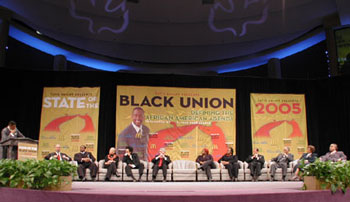
State of the Black Union... Awesome: But Something Is Missing

I listened with great interest, amusement and political junkie enthusiasm to the State of the Black Union event hosted by Tavis Smiley this past Saturday. As a forum of political thinkers, commentators, intellectuals and activists, it was marvelous. To have an opportunity to hear so many very articulate and lucid thinkers on the black condition in American was very thought provoking. I loved hearing Dyson drop science about Obama and accountability (see the Featured Video). Farrakhan called on people to reconnect to God, quoting the Bible the whole time, which I found intriguing. Perhaps he was just making allowances for the audience before him, but I found it curious that the spiritual leader of the NOI did not once in his remarks acknowledge his own God, Allah, but rather punctuated his comments entirely with the scripture of Jehovah (for the record, I do not believe Muslims and Christians worship the same God, but thats another post). I was interested in the comments of Sheila Jackson Lee and her impassioned, if slightly defensive, championing of Hillary. I was entertained and then a little appalled at the commentary of Dick Gregory. I enjoyed Sharpton being the fly in the ointment, violating the seemingly tacit agreement that the participants would not rhetorically set at each others throats over the Obama/Clinton nomination conflict. And I found much of interest in what many of the people had to say about the state of our black union.

But in as much as the commentary and critique was inspirational, I find fault with SOBU as it is put forward on two grounds. For one, as much diversity as there may have been in the panels ideological viewpoints, it is largely the case that those panelists are almost exclusively to the political left, in several cases, the far left. So there is a great deal of sameness in their thoughts. Its a lot of preaching to the choir and celebration of victimhood. Whether its being laid out in Sharpton's hood certified straight talk or Cornel West's incomprehensible and impenetrable intellectual speechification, it all shares a similar premise: the idea that we are the eternal victims of a relentless and unending white supremacist onslaught encoded in the DNA of this nation's every institution. To listen to the SOBU panelists, this victim status is and will always be the defining characteristic of our existence. Its a perspective I reject as self limiting and self defeating. But it is the operative world view of nearly all the SOBU panelists to my mind. Which leads me to the second fault I find with this august gathering, which is that that they are all talk and insufficient, non strategic action. This talented tenth epitomizes, for all the talk of accountability and agenda, the crisis of black leadership. There is a crisis of effective black leadership in America. Simply put, we have too little of it. Across the board, black led organizations are almost incapable of exercising principled, effective, strategic leadership. This phenomenon holds true across the spectrum of black organizations, from churches, to national service organizations to community development corporations. Whether you're talking about homeowners associations, civic organizations, local chapters of national organizations, greeks, or political organizations, effective, accountable, strategic leadership is few and far between.

What happened? There was a time when the black community had more capable leadership. But it seems as though somewhere between the end of the civil rights movement and the beginning of the 21st century, we lost our strategic leadership skills. An older post civil rights generation has remained stuck in the strategies of an era that is long gone, while blocking a younger generation from leadership. The new generation, focused on "getting mine" isn't applying critical thinking or strategic leadership skills to the intertwined political, social and economic challenges we face.

The result: underperformance in nearly every aspect of the community when it comes to implementation of effective strategies that address the interests of the black community. For all the prescriptions of the SOBU panelists, none of them individually or collectively, has an organization articulating AND implementing in a strategic, disciplined way an agenda of rational political and economic action. Where's the beef? Do any of you know how to articulate and implement a vision and strategy for black progress that does not rely on government response or calls to free our minds? Who is articulating a national policy on economic development, social response and political development of the black community that is worth the paper its printed on? Not anybody on those panels.

The State of the Black Union? Perhaps as troubled as it has ever been. Our talented tenth have a variety of answers to our problems, answers which themselves are problematic, shortsighted and grounded in victimhood. But that aside, I don't think any of them has the first clue about how to strategically, on a national level, implement solutions to the problems we face. Unacceptable.
.

February 22, 2008

Kosovar Independence and the Russian Reaction

By George Friedman (honorary Political Season contributor)

Kosovo declared independence from Serbia on Sunday. The United States and many, but not all, European countries recognized it. The Serbian government did not impose an economic blockade on — or take any military action against — Kosovo, although it declared the Albanian leadership of Kosovo traitors to Serbia. The Russians vehemently repeated their objection to an independent Kosovo but did not take any overt action. An informal summit of the Commonwealth of Independent States (CIS) was announced last week; it will take place in Moscow on Feb. 21. With Kosovo’s declaration, a river was crossed. We will now see whether that river was the Rubicon.

Kosovo’s independence declaration is an important event for two main reasons. First, it potentially creates a precedent that could lead to redrawn borders in Europe and around the world. Second, it puts the United States, the United Kingdom, France and Germany in the position of challenging what Russia has defined as a fundamental national interest — and this at a time when the Russians have been seeking to assert their power and authority. Taken together, each of these makes this a geopolitically significant event.

Begin with the precedent. Kosovo historically has been part of Serbia; indeed, Serbs consider it the cradle of their country. Over the course of the 20th century, it has become predominantly Albanian and Muslim (though the Albanian version of Islam is about as secular as one can get). The Serbian Orthodox Christian community has become a minority. During the 1990s, Serbia — then the heart of the now-defunct Yugoslavia — carried out a program of repression against the Albanians. Whether the repression rose to the level of genocide has been debated. In any case, the United States and other members of NATO conducted an air campaign against Yugoslavia in 1999 until the Yugoslavians capitulated, allowing the entry of NATO troops into the province of Kosovo. Since then, Kosovo, for all practical purposes, has been a protectorate of a consortium of NATO countries but has formally remained a province of Serbia. After the Kosovo war, wartime Yugoslavian leader Slobodan Milosevic died in The Hague in the course of his trial for war crimes; a new leadership took over; and the Federal Republic of Yugoslavia itself ultimately dissolved, giving way to a new Republic of Serbia.

The United Nations did not sanction the war in Kosovo. Russian opposition in the U.N. Security Council prevented any U.N. diplomatic cover for the Western military action. Following the war — in a similar process to what happened with regard to Iraq — the Security Council authorized the administration of Kosovo by the occupying powers, but it never clearly authorized independence for Kosovo. The powers administering Kosovo included the United States, United Kingdom, France, Germany and other European states, organized as the Kosovo Force (KFOR).

While the logic of the situation pointed toward an independent Kosovo, the mechanism envisioned for the province’s independence was a negotiated agreement with Serbia. The general view was that the new government and personalities in Belgrade would be far more interested in the benefits of EU membership than they would be in retaining control of Kosovo. Over nearly a decade, the expectation therefore was that the Serbian government would accede to an independent Kosovo in exchange for being put on a course for EU membership. As frequently happens — and amazes people for reasons we have never understood — nationalism trumped economic interests. The majority of Serbs never accepted secession. The United States and the Europeans, therefore, decided to create an independent Kosovo without Serbian acquiescence. The military and ethnic reality thus was converted into a political reality.

Those recognizing Kosovo’s independence have gone out of their way specifically to argue that this decision in no way constitutes a precedent. They argue that the Serbian oppression of the late 1990s, which necessitated intervention by outside military forces to protect the Kosovars, made returning Kosovo to Serbian rule impossible. The argument therefore goes that Kosovo’s independence must be viewed as an idiosyncratic event related to the behavior of the Serbs, not as a model for the future.

Other European countries, including Spain, Romania, Slovakia and Cyprus, have expressly rejected this reasoning. So have Russia and China. Each of these countries has a specific, well-defined area dominated by a specific ethnic minority group. In these countries and others like them, these ethnic groups have demanded, are demanding or potentially will demand autonomy, secession or integration with a neighboring country. Such ethnic groups could claim, and have claimed, oppression by the majority group. And each country facing this scenario fears that if Kosovo can be taken from Serbia, a precedent for secession will be created.

The Spanish have Basque separatists. Romania and Slovakia each contain large numbers of Hungarians concentrated in certain areas. The Cypriots — backed by the Greeks — are worried that the Turkish region of Cyprus, which already is under a separate government, might proclaim formal independence. The Chinese are concerned about potential separatist movements in Muslim Xinjiang and, above all, fear potential Taiwanese independence. And the Russians are concerned about independence movements in Chechnya and elsewhere. All of these countries see the Kosovo decision as setting a precedent, and they therefore oppose it.

Europe is a case in point. Prior to World War II, Europe’s borders constantly remained in violent flux. One of the principles of a stable Europe has been the inviolability of borders from outside interference, as well as the principle that borders cannot be redefined except with mutual agreement. This principle repeatedly was reinforced by international consensus, most notably at Yalta in 1945 and Helsinki in 1973.

Thus, the Czech Republic and Slovakia could agree to separate, and the Soviet Union could dissolve itself into its component republics, but the Germans cannot demand the return of Silesia from Poland; outsiders cannot demand a British withdrawal from Northern Ireland; and the Russians cannot be forced to give up Chechnya. The principle that outside powers can’t redefine boundaries, and that secessionist movements can’t create new nations unilaterally, has been a pillar of European stability.

The critics of Kosovo’s independence believe that larger powers can’t redraw the boundaries of smaller ones without recourse to the United Nations. They view the claim that Yugoslavia’s crimes in Kosovo justify doing so as unreasonable; Yugoslavia has dissolved, and the Serbian state is run by different people. The Russians view the major European powers and the Americans as arrogating rights that international law does not grant them, and they see the West as setting itself up as judge and jury without right of appeal.

This debate is not trivial. But there is a more immediate geopolitical issue that we have discussed before: the Russian response. The Russians have turned Kosovo into a significant issue. Moscow has objected to Kosovo’s independence on all of the diplomatic and legal grounds discussed. But behind that is a significant challenge to Russia’s strategic position. Russia wants to be seen as a great power and the dominant power in the former Soviet Union (FSU). Serbia is a Russian ally. Russia is trying to convince countries in the FSU, such as Ukraine, that looking to the West for help is futile because Russian power can block Western power. It wants to make the Russian return to great power status seem irresistible.

The decision to recognize Kosovo’s independence in the face of Russian opposition undermines Russian credibility. That is doubly the case because Russia can make a credible argument that the Western decision flies in the face of international law — and certainly of the conventions that have governed Europe for decades. Moscow also is asking for something that would not be difficult for the Americans and Europeans to give. The resources being devoted to Kosovo are not going to decline dramatically because of independence. Putting off independence until the last possible moment — which is to say forever, considering the utter inability of Kosovo to care for itself — thus certainly would have been something the West could have done with little effort.

But it didn’t. The reason for this is unclear. It does not appear that anyone was intent on challenging the Russians. The Kosovo situation was embedded in a process in which the endgame was going to be independence, and all of the military force and the bureaucratic inertia of the European Union was committed to this process. Russian displeasure was noted, but in the end, it was not taken seriously. This was simply because no one believed the Russians could or would do anything about Kosovar independence beyond issuing impotent protestations. Simply put, the nations that decided to recognize Kosovo were aware of Russian objections but viewed Moscow as they did in 1999: a weak power whose wishes are heard but discarded as irrelevant. Serbia was an ally of Russia. Russia intervened diplomatically on its behalf. Russia was ignored.

If Russia simply walks away from this, its growing reputation as a great power will be badly hurt in the one arena that matters to Moscow the most: the FSU. A Europe that dismisses Russian power is one that has little compunction about working with the Americans to whittle away at Russian power in Russia’s own backyard. Belarusian President Aleksandr Lukashenko — who, in many ways, is more anti-Western than Russian President Vladimir Putin and is highly critical of Putin as well — has said it is too late to “sing songs” about Kosovo. He maintains that the time to stop the partition of Kosovo was in 1999, in effect arguing that Putin’s attempts to stop it were ineffective because it was a lost cause. Translation: Putin and Russia are not the powers they pretend to be.

That is not something that Putin in particular can easily tolerate. Russian grand strategy calls for Russia to base its economy on the export of primary commodities. To succeed at this, Russia must align its production and exports with those of other FSU countries. For reasons of both national security and economics, being the regional hegemon in the FSU is crucial to Russia’s strategy and to Putin’s personal credibility. He is giving up the presidency on the assumption that his personal power will remain intact. That assumption is based on his effectiveness and decisiveness. The way he deals with the West — and the way the West deals with him — is a measure of his personal power. Being completely disregarded by the West will cost him. He needs to react.

The Russians are therefore hosting an “informal” CIS summit in Moscow on Friday. This is not the first such summit, by any means, and one was supposed to be held before this but was postponed. On Feb. 11, however, after it became clear that Kosovo would declare independence, the decision to hold the summit was announced. If Putin has a response to the West on Kosovo, it should reveal itself at the summit.

There are three basic strategies the Russians can pursue. One is to try to create a coalition of CIS countries to aid Serbia. This is complex in that Serbia may have no appetite for this move, and the other CIS countries may not even symbolically want to play.

The second option is opening the wider issue of altering borders. This could be aimed at sticking it to the Europeans by backing Serbian secessionist efforts in bifurcated Bosnia-Herzegovina. It also could involve announcing Russia’s plans to annex Russian-friendly separatist regions on its borders — most notably the Georgian regions of Abkhazia and South Ossetia, and perhaps even eastern Ukraine and the Crimea. (Annexation would be preferred over recognizing independence, since it would reduce the chances of Russia’s own separatist regions agitating for secession.) Russia thus would argue that Kosovo’s independence opens the door for Russia to shift its borders, too. That would make the summit exciting, particularly with regard to the Georgians, who are allied with the United States and at odds with Russia on Abkhazia and other issues.

The third option involves creating problems for the West elsewhere. An Iranian delegation will be attending the summit as “observers.” That creates the option for Russia to signal to Washington that the price it will pay for Kosovo will be extracted elsewhere. Apart from increased Russian support for Iran — which would complicate matters in Iraq for Washington — there are issues concerning Azerbaijan, which is sandwiched between Russia and Iran. In the course of discussions with Iranians, the Russians could create problems for Azerbaijan. The Russians also could increase pressure on the Baltic states, which recognized Kosovo and whose NATO membership is a challenge to the Russians. During the Cold War, the Russians were masters of linkage. They responded not where they were weak but where the West was weak. There are many venues for that.

What is the hardest to believe — but is, of course, possible — is that Putin simply will allow the Kosovo issue to pass. He clearly knew this was coming. He maintained vocal opposition to it beforehand and reiterated his opposition afterward. The more he talks and the less he does, the weaker he appears to be. He personally can’t afford that, and neither can Russia. He had opportunities to cut his losses before Kosovo’s independence was declared. He didn’t. That means either he has blundered badly or he has something on his mind. Our experience with Putin is that the latter is more likely, and this suddenly called summit may be where we see his plans play out.

February 20, 2008

The Race to the Bottom Has Begun

The great race to the bottom of the gutter has begun in earnest. As Obama surges, Clinton fights for her political life and McCain moves to secure his flank and range on the democratic frontrunner, the smearfest, negative gutter politics is starting to come thick and fast.

We got it kicked off with silly plagiarism charges against Obama. Next, Michelle Obama makes a rookie mistake with her language at a campaign event and ends up in the crosshairs of a Michelle hates America narrative. Then comes word that mega buck Clinton supporters are creating a 527 organization to support Clinton and attack Obama in TX, OH, and PA, essentially democrats swiftboating themselves. And before we can even catch our breath, the NYT issues a hit job on John McCain alleging marital infidelity and favors traded with an alleged lobbyist paramour with NO proof, hard facts, soft facts or indeed any facts at all.

These are the gutter politics Americans are sick and tired of.

February 19, 2008

Kwame's NC Massage Partner Revealed: Survey Says....

Christine Beatty - Yes good people, thats right and you heard it here first. The Mayor shared his $504 dollar massage package with his now former Chief of Staff Ms. Beatty. How does the Season know? The same way everybody in Detroit knows about the dirt getting done in the Mayor's inner circle. Somebody we know, who knows somebody else we know, who's relative shared a flight with Ms. Beatty on a plane headed down to Asheville the weekend of Jan. 19th and ID'd her. Kwame was there Jan. 19th to the 21st. We will stipulate to the fact that her lawyer has publicly denied that it was Beatty;

"Absolutely not," Morganroth said. Beatty bought gas for her vehicle in Detroit on Jan. 19, had lunch at a downtown restaurant and made at least one other Metro Detroit purchase on her credit cards that weekend, Morganroth said. "I have the receipts to prove it," he said.

Its not hard to have someone use your credit card to produce receipts for you and help you cover your tracks. Someone who could corroborate her presence at the gas station, or the lunch or at the store where she made this purchase would be more convincing. Bear in mind that this assignation occurred before the text message scandal broke in the papers. Political Season makes a call for corroboration from any one that can confirm our friend's friends's relatives' report of Beatty on a plane to Asheville from Detroit that weekend. Probably not hard to track it down. If you've got the goods, send us an email here at Political Season.

And because the Detroit Mayor's office scandal is the gift that just keeps on giving, or really in this case, taking from the citizens of Detroit, the Detroit Free Press reports that Detroit city council today approved a $25,000 settlement to the two police officers who pulled Beatty over for a traffic stop.

The officers said they pulled Beatty over for speeding June 21, 2004 and she told them: “Do you know who the (expletive) I am?”

The officers sued after Bully-Cummings publicly said they harassed Beatty, and Kilpatrick told a radio station: “It sounds like a setup to me.”

Because the Mayor has zero credibility due to this scandal, city council had little choice but to pay $25,000 to bring another of the Mayor's messes to a close. This may not be the last of such episodes either. How many other lawsuits may materialize based on retaliation or slander by the Mayor or his surrogates? Those that do will have a lower bar to overcome when it comes to pitting their credibility against the Mayor's, because what he has is gone. It is yet more confirmation for the premise that Black America must practice accountability when it comes to its elected political leadership. Detroit is a city in desperate need of revival and restoration and it requires leadership. This is not it. Detroiters will only get the leadership they demand and if not some will say that they deserve. If Black Americans are unwilling to call to account a Mayor who has been so contemptuous of the taxpaying voters who put him in office, it is will be another public example of the self destructive tendency of blacks to ask for accountability from every other quarter but our own.

Wisconsin Chooses Obama

Political Season predicted a close loss for Obama to Hillary Clinton in Wisconsin tonight. News organizations called it for Barack soon after the polls closed and it appears so far from the returns that not only has he won it, but is doing so commandingly. His success tonight is clearly grounded in the fact that he has eaten into core demographic groups typically thought to belong to HRC. Political Season is happy to report that our prediction was way wrong. Obama wins and wins big.

February 17, 2008

Tavis, Stop Drinking Your Own Koolaid

The Black Blogosphere has lit up with reaction to Tavis' hissy fit due to Obama's decision not to attend Tavis' State of the Black Union event (check out Boyce Watkins in the feature video section above). Tavis called the decision a "miscalculation and a missed opportunity". Please, get over yourself. Some people supporting Smiley's position that Obama should attend say he is not coming in order
to maintain favor with white voters by not appearing too black, or advance the notion he is straddling the fence of white and black opinion. These silly arguments are little more than a rehash of the "is Obama really black?" question that the vast majority of black people have already put to bed, as evidenced by the 80+ percent of them voting for him in caucuses and primaries.

There are excellent reasons why Obama should not attend Tavis's event. In the heat of a campaign like this, every minute of his time is gold and he can't afford to spend it unwisely. He already won in Louisiana, Texas and Ohio are coming up and he is trying to gain ground in those states and close out his rival for the nomination. Its about winning and going to the big dance, but Tavis is suggesting he take his eye off the ball to help Tavis' gig be big success. What for? Tavis is not delivering some audience that Obama is not or has not already reached. Furthermore, this idea that Tavis advances of Obama taking an opportunity to address the "real" issues of black america is nonsense. The themes of his campaign and the issues he is raising of jobs, the war, healthcare, all that stuff is important to blacks. We are so busy demanding people speak to our grievances, complaints and victim identity, we take our eye off the ball.

I can hear some now saying "well Hillary is coming, she made time". Of course. She is low on cash, any free media is good and if Obama came she would get a ton. Further, she needs face time with black folk after she and Bill totally blew their longstanding most favored Caucasian status with smear tactics, clumsy rhetoric and a clear attempt to connect Barack to white voter discomfort on the subject of race. The result? Obama is taking 80% and more of the black vote in every contest. She badly needs to rebuild some ground with us. She needs Tavis, Obama does not.

Lastly, Tavis' event is not the only place for the definitive word on black peoples issues to be revealed to the masses. Nor does Barack have to show up at a "black" event to speak to black issues. Tavis' elitist notion that it is only in the presence of he and his black intellectual friends that light may be shed upon the issues of Black America is just that, a notion. Anybody says they don't know what Obama stands for don't want to know. Now, some say, well I haven't heard from him on this specific issue I got. Well, the list of specific issues you have not heard him speak on directly will likely not get any shorter. But to suggest that Obama is somehow suspect or disregarding black folk because in the middle of the most important political battle of his life, at a point where his every move counts and he is playing for a place in the history books, that he should break from a winning game plan because Tavis throws a hissy fit when he gets reminded that the black universe does not revolve around him and his event is extremely stupid.

We Republicans Decry Big Government....Except for Warrantless Wiretapping?

Let me get this straight. As republicans and conservatives, part of our principle set is the idea that big government, more government, is not the solution to the pressing social and economic ills we face. We distrust government solutions to problems. We don't like government on poverty, on the economy, for any serious issue and rightly so. But.....we do seem to like untrammeled, unfettered government power for things like warrantless surveillance? We republicans seem to trust government with this kind of power? The issue is two fold. The administration wants two things: they want a near effortless capability to initiate wiretaps without warrant and they want immunity for the private sector who's help is required in order to make that stuff happen, an immunity which allows them to protect their complicit telco partners particularly given that they have likely broken the law in pursuing wiretaps.

Republican leadership and the President are frothing that Congress must pass what they want as though this government power is not subject to abuse, is somehow exempt from the issues that make big government a bad solution for so many others things. It shows clearly that republican leadership is bankrupt and devoid of true conservative principles.

February 15, 2008

Obama v. Clinton: Momentum is Bulls*#@t

Between the imperatives of work and family and the super fast pace of developments on the campaign trail, blogging has been an exhausting draw for my time. But with a free moment handy, I've got some thoughts and predictions.

The contests ahead: Wisconsin, Hawaii.
Presumably, Hawaii is a slam dunk being Obama's boyhood stomping grounds, though I hear the state is pretty much a political machine dominated state. The Clinton strategy has been built to a degree around piggybacking on the backs of pre-existing political networks favorable to them. Its why they have gotten their clocks cleaned in caucus states, no organization on the ground. But machine politics provides a good environment for HRC's campaign, so its possible she might do better than expected, but I predict Obama wins it. As for Wisconsin, I'm calling it for Clinton. The polls have Obama ahead, but the demographics perhaps favor HRC, but then again, Obama has already won a state just like it (Missouri) demographically. But being a northern state, I think the dynamic is different. I don't think momentum counts for anything in this campaign. The talking heads on cable say that word like its going out of style, but if nobody has figured out that people are taking a lot of time with this and getting right down to the wire to make their decisions, they are not paying attention yet.

Texas & Ohio - I predict Obama loses both. He may close the gap, but I don't think he gets all the way there because momentum is bullshit. Best case scenario, he splits them with her. Again, the demographics seems to favor her and her back is to the wall. Underestimating her would be a mistake, especially since they have made it clear that they will do whatever is necessary to win it at the convention up to and including any strategy necessary to secure superdelegate votes. Furthermore, his tentative frontrunner status I predict means he will begin to face more withering fire from the so far fawning media. That honeymoon is going to end at some point soon. He's set for an old fashioned showdown with Clinton in Texas with a Feb. 21st debate and he had better be loaded for bear. The "where's the beef critique" has dogged Obama throughout the campaign. I predict he will be pressed hard to demonstrate policy chops in that debate and he better eat his Wheaties. His prep team needs to make sure he is ready. I suggest a few screenings of the Great Debaters to get up for it. He does not have to be, nor should he try to be a policy wonk. Thats Bill and Hillary. What I want to hear from him, and what I think he needs to do is to capably lay out his philosophic and conceptual approach to the big issues and be able to defend them against the primary counter arguments. If he can do that and demonstrate that his understanding of issues is not merely superficial, I believe he will do fine. In all other respects, he needs to clean her clock in that debate. A performance on Feb. 21 like his performance at the last debate will not close the deal. Texas and Ohio are Obama's opportunity to put his eye of the tiger on display. Its killer instinct time baby. The rhetoric and oratory has been great. Now, he's got to bring it.

I predict a close loss in Wisconsin coupled with losses in Texas and Ohio will blunt Obama's momentum and prevent him from drawing out a lead, and we will witness the political equivalent of Ragnarök and Armageddon at the convention.

The U.S.-Iranian Negotiations: Beyond the Rhetoric

By George Friedman (honorary Political Season contributor)

Tehran has announced that Iran and the United States will hold a new round of talks on the future of Iraq at some point next week. The Iranians said that the “structure of the discussions have been finalized but the level of participation has not yet been agreed.” Meanwhile, Iranian Foreign Minister Manouchehr Mottaki said that President Mahmoud Ahmadinejad is expected to visit Iraq before March 20, the Iranian New Year. The United States has not denied either of these reports. There thus appears to be some public movement occurring in the U.S.-Iranian talks over Iraq.

These talks are not new. This would be the fourth in a series of meetings; the most recent meeting happened last August. These meetings have been scheduled and canceled before, and because who will attend this go-round remains unsettled, these talks may never get off the ground. More significant, no Iranian president has visited Iraq since the Khomeini revolution. If this visit took place, it would represent a substantial evolution. It also is not something that would happen unopposed if the United States did not want it to; by contrast, the Iraqi government lacks much of a say in the matter because it does not have that much room for maneuver. So we can say this much: Nothing has happened yet, but the Iranians have repositioned themselves as favoring some sort of diplomatic initiative from their side and the Americans so far have not done anything to discourage them.

U.S.-Iranian negotiations are always opaque because they are ideologically difficult to justify by both sides. For Iran, the United States is the Great Satan. For the United States, Iran is part of the Axis of Evil. It is difficult for Iran to talk to the devil or for the United States to negotiate with evil. Therefore, U.S.-Iranian discussions always take place in a strange way. The public rhetoric between the countries is always poisonous. If you simply looked at what each country says about the other, you would assume that no discussions are possible. But if you treat the public rhetoric as simply designed to manage domestic public opinion, and then note the shifts in policy outside of the rhetorical context, a more complex picture emerges. Public and private talks have taken place, and more are planned. If you go beyond the talks to actions, things become even more interesting.

We have discussed this before, but it is important to understand the strategic interests of the two countries at this point to understand what is going on. Ever since the birth of the Islamic Republic of Iran, Iraq has been the buffer between the Iranians and the Arabian Peninsula. The United States expected to create a viable pro-American government quickly after the 2003 invasion of Iraq, and therefore expected that Iraq would continue to serve as a buffer. That did not happen for a number of reasons, and therefore the strategic situation has evolved.

The primary American interest in Iraq at this point is a negative one — namely, that Iraq not become an Iranian satellite. If that were to happen and Iranian forces entered Iraq, the entire balance of power in the Arabian Peninsula would collapse. Whatever the future of Iraq, U.S. policy since the surge and before has been to prevent a vacuum into which Iran can move. The primary Iranian interest in Iraq also is negative. Tehran must make sure that no Iraqi government is formed that is dominated by Sunnis, as happened under the Baathists, and that the Iraqi military never becomes powerful enough to represent an offensive threat to Iran. In other words, above all else, Iran’s interest is to avoid a repeat of the 1980-88 Iran-Iraq war.

Obviously, each side has positive goals. The United States would love to see a powerful, pro-American Iraqi government that could threaten Iran on its own. The Iranians would love to see a pro-Iranian government in Baghdad and the withdrawal of U.S. forces from Iraq. Neither side is in a position to achieve these goals. The United States cannot create a pro-U.S. government because the Iranians, through their influence in the Shiite community, can create sufficient chaos to make that impossible. Through the surge, the United States has demonstrated to the Iranians that it is not withdrawing from Iraq, and the Iranians do not have the ability to force an American withdrawal. So long as the Americans are there and moving closer to the Sunnis, the Iranians cannot achieve their positive goals and also must harbor concerns about the long-term future of Iraq. Each side has blocked the other’s strategic positive goal. Each side now wants to nail down its respective negative goal: avoiding the thing it fears the most.

Ever since the 2006 U.S. congressional midterm elections, when President George W. Bush confounded Iranian expectations by actually increasing forces in Iraq rather than beginning a phased withdrawal, the two countries have been going through a complex process of talks and negotiations designed to achieve their negative ends: the creation of an Iraq that cannot threaten Iran but can be a buffer against Iranian expansion. Neither side trusts the other, and each would love to take advantage of the situation to achieve its own more ambitious goals. But the reality on the ground is that each side would be happy if it avoided the worst-case scenario.

Again, ignoring the rhetoric, there has been a fairly clear sequence of events. Casualties in Iraq have declined — not only U.S. military casualties but also civilian casualties. The civil war between Sunni and Shia has declined dramatically, although it did not disappear. Sunnis and Shia both were able to actively project force into more distant areas, so the decline did not simply take place because neighborhoods became more homogeneous, nor did it take place because of the addition of 30,000 troops. Though the United States created a psychological shift, even if it uses its troops more effectively, Washington cannot impose its will on the population. A change in tactics or an increase of troops to 150,000 cannot control a country of 25 million bent on civil war.

The decline in intracommunal violence is attributable to two facts. The first is the alliance between the United States and Sunni leaders against al Qaeda, which limited the jihadists’ ability to strike at the Shia. The second is the decision by the Iranians to control the actions of Iranian-dominated militias. The return of Muqtada al-Sadr — the most radical of the Shiite leaders — to ayatollah school and his decision to order his followers to cease fire dramatically reduced Shiite-on-Sunni violence. That would not, and could not, have happened without Iranian concurrence. If the Iranians had wanted the civil war to continue unabated, it would have. The Iranians cannot eliminate all violence, nor do they want to. They want the Americans to understand that they can resume the violence at will. Nevertheless, without the Iranian decision to limit the violence, the surge would not have worked.

If the prime Iranian threat against the United States was civil war in Iraq, the prime American threat against Iran was an air campaign against Iranian infrastructure. Such a campaign was publicly justified by the U.S. claim that Iran was developing nuclear weapons. With the Iranians having removed the threat of overwhelming civil war in Iraq, the United States responded by removing the threat of an air campaign. The publication of the National Intelligence Estimate (NIE) stating that Iran does not have a nuclear program at present effectively signaled the Iranians that there would be no campaign.

There was intense speculation that the NIE was a “coup” by the intelligence community against the president. Though an interesting theory, not a single author of the NIE has been fired, none of the intelligence community leaders has been removed, and the president has very comfortably lived with the report’s findings. He has lowered the threat of war against Iran while holding open the possibility — as the NIE suggests — that the Iranians might still be a threat, and that a new NIE might require airstrikes.

The Iranians reduced Shiite violence. The United States reduced the threat of airstrikes. At various points, each side has tested and signaled to the other. The Iranians have encouraged small-scale attacks by Shia in recent weeks, but nothing like what was going on a year or two ago. During Bush’s trip to the region, the United States triggered a crisis in the Strait of Hormuz to signal the Iranians that the United States retains its options. The rhetoric remains apocalyptic, but the reality is that, without admitting it, each side has moved to lower the temperature.

Clearly, secret negotiations are under way. The announcement that an agreement was reached on the structure and subject of a public meeting this week by definition means that unpublicized conversations have been taking place. Similarly, the announcement that Ahmadinejad will be visiting Iraq could not have come without extensive back-channel discussions. We would suspect that these discussions actually have been quite substantial.

The Iranians have made clear what they want in these negotiations. Mottaki was quoted in the Iranian media as saying, “We did express our readiness for entering into negotiations with the U.S. when the talks were held by the five Security Council permanent members plus Germany over Iran’s nuclear program.” He also said that, “Revising its policies toward Iran, the U.S. can pave the way for us to consider the circumstances needed for such talks to be held.” Since talks are being held, it must indicate some movement on the American part.

It all comes down to this: The United States, at the very least, wants a coalition government in Iraq not controlled by Iran, which can govern Iraq and allow the United States to draw down its forces. The Iranians want an Iraqi government not controlled by the United States or the Sunnis, which can control Iraq but not be strong enough to threaten Iran. Iran also wants the United States to end sanctions against Iran, while the United States wants Iran to end all aspects of its nuclear program.

Ending sanctions is politically difficult for the United States. Ending all aspects of the nuclear program is difficult for Iran. The United States can finesse the sanctions issue by turning a blind eye to third powers trading with Iran and allowing U.S. companies to set up foreign subsidiaries to conduct trade with Iran. The Iranians can finesse the nuclear issue, maintaining limited aspects of the program but not pursuing all the technologies needed to build a weapon.

Rhetoric aside, we are therefore in a phase where there are ways for each side to get what it wants. Obviously, the political process is under way in both countries, with Iranian parliamentary elections on March 14 and the U.S. presidential race in full swing. Much domestic opposition is building up against Ahmadinejad, and an intensifying power struggle in Iran could be a fairly large distraction for the country in the short term. The Iranians also could wait a bit more to see how the U.S. presidential campaign shapes up before making any major decisions.

But then, a political process is always under way. That means the rhetoric will remain torrid; the public meetings few and low-key; the private discussions ongoing; and actions by each side sometimes inexplicable, keyed as they are to private discussions.

But it is clear from this week’s announcements by the Iranians that there is movement under way. If the Iranian president does visit Iraq and the United States makes no effort to block him, that will be the signal that some sort of accommodation has been reached. The United States and Iran will not recognize each other and will continue to condemn and even threaten each other. But this is truly a case where their rhetoric does not begin to reflect the reality.

February 13, 2008

Obama is an Uppity Negro: McCain's subliminal message?

Here at Political Season, we eschew kneejerk or overdone reactions to statements by various and sundry figures in the public eye that can be interpreted as racially inflammatory or controversial. That said, we are sensitive to language, tone and context and so could not help but take note of a portion of John McCain's victory speech last night, where he said the following in a portion of his prepared remarks clearly referring to Barack Obama:

I do not seek the presidency on the presumption that I am blessed with such personal greatness that history has anointed me to save my country in its hour of need. I seek the presidency with the humility of a man who cannot forget that my country saved me.

Is this the under the surface narrative that McCain will weave into his campaign? The insinuation that Obama is an arrogant megalomaniac who views himself as a savior? In the context of an election campaign against a black candidate vying for the presidency and history, subtext is important and McCain is a wily and skilled political campaigner. This is a considered and deliberate statement in his speech and it certainly raised our antennae. Is McCain, perhaps deliberately, suggesting that Obama is an uppity negro?

February 9, 2008

An Accomplished and Facile Liar

Detroit Free Press February 9, 2008

During a Friday radio appearance on WMXD-FM (92.3), Detroit Mayor Kwame Kilpatrick spoke with host Frankie Darcell about the text message scandal that has rocked his administration. The following are excerpts of his comments versus what court records show or what people had to say in response to the mayor.

What the mayor said: "This case was about a wrongful termination and neither person was fired. It was about me, Kwame Kilpatrick, and the relationship that that jury and this region has with me."

What the records show: Former Deputy Chief Gary Brown, who filed a whistle-blower lawsuit against the mayor and city, claimed he was forced out of his job -- and the jury unanimously found he was telling the truth. The jury delivered a $6.5-million verdict last September for Brown and former officer Harold Nelthrope, who also sued.

What the mayor said: "We had a private engagement to exchange private information [a reference to a confidentiality agreement that he and former chief of staff Christine Beatty signed with the cops' attorney after settling the case for $8.4 million]. They were never city documents."

What the records show: The settlement agreement and the confidential agreement were linked and negotiated by lawyers paid with city funds. Wayne County Circuit Judge Robert Colombo Jr., who is presiding over the Free Press' Freedom of Information Act lawsuit to obtain the secret documents, rejected arguments the documents are private, saying, "Nothing could be further from the truth."

What the mayor said: "I mean, you name them -- Roger Penske, Dan Gilbert, Doug Rothwell, you know, the GM family -- everybody has contacted me and told me we're with you, let's continue to move forward, let's keep doing projects. They're all trying to think of things to change the conversation as well."

What the business leaders had to say: Rothwell, president of the Detroit Renaissance group of CEOs, said Friday afternoon he has not spoken with Kilpatrick since the controversy erupted but has spoken with Deputy Mayor Anthony Adams. Rothwell said, as he did last week, that Detroit Renaissance "will continue to stay engaged in the redevelopment of the city." A spokesman for Penske, who led the Super Bowl XL host committee, said Penske had no comment. A General Motors Corp. spokesman declined to comment. A spokeswoman for Quicken Loans Chairman Gilbert wouldn't comment on whether Gilbert has talked to the mayor.

What the mayor said: "The recent things is the text messages, which were, you know, illegally obtained [by] the Free Press and, you know, now the whole paper now is covering up their illegal act with a lot of criminal activity and collusion in writing these reports."

What the Free Press said: Executive Editor Caesar Andrews said the Free Press did not obtain the records illegally.

What the mayor said: "I didn't know this was coming out, I've never seen these messages."

What the records show: He wrote and received the messages, literally hundreds exchanged between the mayor and Beatty and reviewed by the Free Press. The newspaper sued for their release on Jan. 3, subpoenaed them and -- after obtaining the records outside of the lawsuit efforts -- asked Kilpatrick for an interview more than 24 hours in advance of publishing a report about them.

What the mayor said: "There was a trial. You know, first of all, all of the things that you're hearing about now were never a part of the trial, never discussed."

What the records show: Wayne County Circuit Judge Michael Callahan, who presided over the whistle-blower trial, ruled that Kilpatrick's alleged philandering was relevant and admissible in court because the former cops claimed the mayor retaliated against them for an investigation that might have uncovered affairs with Beatty and other women. Mike Stefani, the former cops' lawyer, mentioned the text messages several times at trial and asked Beatty extensively about them. The messages, which were the basis of the Free Press report last month, showed the mayor and Beatty lied under oath about their affair.

What the mayor said: "Confidentiality happens in divorce cases, lawsuits, where at the end of the case there's an exchange of documents between one party and another. At the end of this case, because the documents were never obtained by the city, because they weren't city documents, we had a private engagement to exchange private information."

What the records show: The Free Press sought the confidentiality agreement through its Freedom of Information Act lawsuit after the city refused to turn over records that the paper believed were being withheld with the settlement documents. The act was created to allow public access to government business and records. The paging devices used by the mayor and Beatty were paid for with city funds, and the $8.4-million settlement came from city tax dollars.

What the mayor said: "The council voted on the settlement. ... We presented all that information to them. They voted on the number. They knew what the number was. They had all that information."

What the records show: Several council members have said they had no clue there was a confidential agreement connected to the settlement, and that the confidential deal was aimed at concealing the text messages and other matters.

What the mayor said: "Those [settlement] checks were sent before the Dec. 5 date of the confidentiality agreement signing, so let me just tell you why that's so interesting. That means that they already had their money when we signed the confidentiality agreement."

What the records show: The confidentiality agreement was signed Nov. 1. Stefani and his clients didn't begin receiving checks until Nov. 16. They received their last payments Dec. 4.

What the mayor said: The mayor's office was "audited in '04, '05 and '06. I stand behind all the hard numbers. The way we managed our finances is good."

What the records show: Joseph Harris, the city's auditor general at the time, found Kilpatrick had spent more than $50,000 on personal items on the city's credit card. Kilpatrick eventually paid back nearly $9,000 for what he described as disputed charges, but did not detail what the check covered. Harris also said there were missing receipts and purchases that circumvented city spending limits. In 2004, three former aides to Kilpatrick -- including two of his former high school classmates -- agreed to repay about $46,000 they embezzled from the mayor's petty cash account.

What the mayor said: "There was no secret deal. As indicated in the lawsuit. The only other thing was the confidentiality agreement. Which we say was confidential. Because this is what we did, Frankie, we volunteered to release the confidentiality agreement."

What the records show: Judge Colombo ordered the release of the confidentiality agreement as a result of the Free Press suit. Kilpatrick's lawyers argued to keep all the settlement-related records secret until deciding, on appeal, to release the confidentiality agreement.

February 8, 2008

Black Man Turns Lone Wolf Shooter

Charles Lee "Cookie" Thornton gunned down and killed five people at a City Council meeting and critically wounded the Mayor before police shot him to death on Thursday evening. Previously banned from council meetings for being disruptive, Thorton was apparently angry because of having received nearly 150 tickets for illegally parking vehicles used in his asphalt and paving business. He had disrupted council meetings numerous times to complain that he was being harassed by city officials. When he was banned from the council meetings, he sued in federal court alleging his First Amendment rights had been violated. His lawsuit was dismissed. Thornton apparently believed he was being singled out because of his race for these tickets. He sought redress by disrupting council meetings repeatedly. His brother, Gerald Thornton, repeatedly declined to say that his brother had done anything wrong. He said his brother felt his

"constitutional protection was not guaranteed. The only way that I can put it in a context that you might understand is that my brother went to war tonight with the people that were of the government that was putting torment and strife into his life, and he had spoke on it as best he could in the courts, and they denied him all access to the rights of protection, and therefore he took it upon himself to go to war and end the issue."

I think I would lock his brother up on GP, because if he can't see the problem here, he sounds like he might be the next one to go shoot five or six people dead. I mean, the police shot his brother dead and he doesn't think he did anything wrong, s0 maybe he figures the cops should get taken out. The brother went to war because he was being tormented and his constiutional rights trampled on because he got some tickets? Brother man, why don't you PARK IN A DIFFERENT SPOT! Truly ridiculous and tragic. Meanwhile, five families have lost loved ones, while the sixth is fighting for his life, because you couldn't get a clue about where to park. I used to think this kind of lone wolf killing was not part of the black lexicon of self destruction. I guess I was wrong.

February 7, 2008

Other Shoe Dropping on Kwame's Hot Mess

Further proof that Mayor Kilpatrick considers the coffers and resources of Detroit to be synonymous with his own is on display in the Detroit Free Press today. The Freep reports

On Tuesday, Wayne County Circuit Judge Robert Colombo Jr. granted a Free Press request to release secret settlement documents under the Freedom of Information Act. City officials initially claimed no such records existed, and now argue they should remain private.

The judge also unsealed the transcript of a five-hour deposition Stefani gave to newspaper lawyers last week in which he detailed negotiations between him and the mayor's lawyers last October and November.

The judge said the records in question were clearly public property.

Now you know that last statement means nothing to this corrupt administration. Kwame has directed city attorneys to appeal the unsealing of the documents. Reached for comment by reporters in Washington, Kwame "Playa" Kilpatrick responded

"We want the public to have all the information the public wants to have,"

We also want to make sure that we understand what the FOIA is all about -- that it's about private issues that go on in a lawsuit,"

Is that priceless or what? What private issues? Oh, you mean like you screwing your chief of staff, the wife of a personal friend you went to high school with? Or the $9.5 million the city has paid to cover it up? One of those was private, I'll give you that much. But it ceased to be so when you paid out $9.5 million in Detroit taxpayer money to hush it up. Now, the citizens of Detroit own the rights to that story Pla--, er I mean Mayor.

Its just another data point proving the corruptness of this administration in Detroit and the foolishness of black folks if its tolerated. It ain't just Kwame. He has partners in foolishness. Apologist in chief for this sorry mess is Detroit Corporate Counsel Sharon McPhail. She was busy on the radio today accusing the Free Press of a vendetta and the attorney for the cops, Mike Stefani, of extortion. Well, now the shoes are dropping. Tommorow Judge Columbo releases the documents but the Freep is already reporting their content: the mayor signed the $9 million settlement to cover up his affair. But the BS train is coming to a stop. Whats in the secret agreement? The key record is a Nov. 1 document, marked “Confidential Agreement,” which Kilpatrick and Beatty personally signed, along with the cops’ lawyer, Mike Stefani, to conceal the text messages. The messages remained secret until January, when the Free Press published excerpts from nearly 14,000 texts received and sent from Beatty’s pager. The agreement requires Stefani, and his clients, former police officers Gary Brown, Harold Nelthrope and Walter Harris, to never speak of the messages again.
A violation of the confidential agreement required that the former cops would pay back the money. This document, which city officials repeatedly said did not exist, was withheld from the Free Press and perhaps as well from City Council when they gave their approval to the settlement. McPhail insists "No secret deals exist or have ever existed. The possibility that personal documents...might become public would have a chilling affect on any mediation," she said" Personal documents? Because you see, Kwame has given up fighting the release of the confidential agreement, but he is fighting release of other docs, so clearly there is some more mess thats being hidden.

The plots getting thicker too. Council President Ken Cockrel, the new mayor if Kwame is turned out of office, may have decided that he'd like to have the job. Today, he introduced a resolution calling on City Council to hire a special counsel to represent the city’s interest in any potential appeal of the judge’s order to release secret settlement documents in the whistle-blower lawsuit. "Our attorney would more or less be filing a court pleading on council's behalf saying we do not believe an appeal is in the best interest of the city of Detroit and that an appeal should not be granted,” Cockrel said of the special counsel. “It gives us a certain legal standing." "I think the law department has a clear conflict of interest," he said. "On paper, they represent the city of Detroit, which means council and the mayor. But on this issue, I don't believe the law department can serve two masters."

So its dropping like its hot in Detroit. Ken Cockrel is making his move, the settlement papers will be released soon, and we have not yet heard anything further from prosecutor Kim Worthy about perjury or other matters. As more of Kwame's outrageous behavior and that of his corrupt cronies surfaces, lets hope that the citizens of Detroit will turn him out of office.

February 6, 2008

Foreign Policy and the President's Irrelevance

Graphic for Geopolitical Intelligence Report

By George Friedman (honorary Political Season Contributor)

We are now a year away from the inauguration of a new president, and Super Tuesday has arrived, when it seems likely that the Democratic and Republican nominees will start to become obvious. At the moment, there is a toss-up between Barack Obama and Hillary Clinton among the Democrats, while John McCain appears to be moving in front of Mitt Romney and Mike Huckabee among the Republicans. It seems an opportune time to ask whether it matters who gets the nomination and who ultimately wins the November election, at least from the standpoint of foreign policy.

The candidates’ discussion of foreign policy has focused on one issue: Iraq. Virtually all other major foreign policy issues, from the future of U.S.-Russian relations to the function of NATO to the structure of the U.S. armed forces in the next generation, have been ignored in the public discussions.

The discussion of Iraq has been shaped and reshaped by events. The apparent improvement in the U.S. position in Iraq has quieted that debate as well. At one extreme, Obama has said he favors a rapid U.S. withdrawal, although he has been vague as to the timing. At the other extreme, McCain has endorsed the Bush administration’s handling of the war. This means that even though he has been quite pro-surge, he does not oppose withdrawal in principle but does insist on not setting a timeline for one. The others’ views are less clear.

The consensus on foreign policy is the most interesting feature of the election, especially regarding Iraq. We don’t mean the posturing or the shouting or the attempt to position one candidate against the others. We mean two things: first, what the candidates are saying after the passion is boiled away, and second, what they are likely to do if they become president.

There is, of course, a great deal of discussion about who supported or opposed what and when. That is not a trivial discussion, but it doesn’t really point to what anyone will do. On a second level, there is the discussion about whether the United States should withdraw from Iraq. Even here, there is actually little that divides the candidates. The real question is when that withdrawal should take place, over what period of time and whether the timeline should be announced.

There is no candidate arguing for the permanent stationing of more than 100,000 U.S. troops in Iraq. There are those who believe that political ends can and should be achieved in Iraq, and that the drawdown of forces should be keyed to achieving those ends. That is essentially the Bush policy. Then there are those who believe that the United States not only has failed to achieve its political goals but also, in fact, is not going to achieve them. Under this reasoning, the United States ought to be prepared to withdraw from Iraq on a timetable that is indifferent to the situation on the ground.

This has been Obama’s position to this point, and it distinguishes him from other candidates — including Clinton, who has been much less clear on what her policy going forward would be. But even Obama’s emphasis, if not his outright position, has shifted as a political resolution in Iraq has appeared more achievable. He remains committed to a withdrawal from Iraq, but he is not clear on the timeline. He calls for having all U.S. combat brigades out of Iraq within 16 months, but qualifies his statement by saying that if al Qaeda attempts to build a base within Iraq, he will keep troops in Iraq or elsewhere in the region to carry out targeted strikes against the group. Since al Qaeda is in fact building a base within Iraq, Obama’s commitment to having troops in Iraq is open-ended.

The shift in Obama’s emphasis — and this is the important point — means his position on Iraq is not really different from that of McCain, the most pro-Bush candidate. Events have bypassed the stance that the situation on the ground is hopeless, so even Obama’s position has tacked toward a phased withdrawal based on political evolutions.

It has long been said that presidential candidates make promises but do what they want if elected. In foreign policy, presidential candidates make promises and, if elected, do what they must to get re-elected. Assume that the situation in Iraq does not deteriorate dramatically, which is always a possibility, and assume a president is elected who would simply withdraw troops from Iraq. The withdrawal from Iraq obviously would increase Iranian power and presence in Iraq. That, in turn, would precipitate a crisis between Iran and Saudi Arabia, two powers with substantial differences dividing them. The United States would then face the question of whether to support the Saudis against Iran. Placing forces in Saudi Arabia is the last thing the Americans or the Saudis want. But there is one thing that the Americans want less: Iranian dominance of the Arabian Peninsula.

Any president who simply withdrew forces from Iraq without a political settlement would find himself or herself in an enormously difficult position. Indeed, such a president would find himself or herself in a politically untenable position. The consequences of a withdrawal are as substantial as the consequences of remaining. The decline in violence and the emergence of some semblance of a political process tilts the politics of decision-making toward a phased withdrawal based on improvements on the ground and away from a phased withdrawal based on the premise that the situation on the ground will not improve. Therefore, even assuming Obama wins the nomination and the presidency, the likelihood of a rapid, unilateral withdrawal is minimal. The political cost of the consequences would be too high, and he wouldn’t be able to afford it.

Though Obama is the one outrider from the general consensus on Iraq, we would argue that the relative rhetorical consensus among the candidates extends to a practical consensus. It is not that presidents simply lie. It is that presidents frequently find themselves in situations where the things they want to do and the things they can do — and must do — diverge. We have written previously about situations in which policymakers are not really free to make policy. The consequences of policy choices constrain the policymaker. A president could choose a range of policies. But most have unacceptable outcomes, so geopolitical realities herd presidents in certain directions.

At least at this point in its cycle, Iraq is such a situation. The debate over Iraq thus mostly has focused on whether a candidate supported the war in the beginning. The debate over what is to be done now was more a matter of perception than reality in the past, and it certainly is much more muted today. To the extent they ever existed, the policy choices have evaporated.

The candidates’ consensus is even more intense regarding the rest of the world. The major geopolitical evolutions — such as the re-emergence of an assertive Russia, Chinese power growing beyond the economic realm and the future of the European Union — are simply nonissues.

When you drill down into position papers that are written but not meant to be read — and which certainly are not devised by the candidates — you find some interesting thoughts. But for the most part, the positions are clear. The candidates are concerned about Russia’s growing internal authoritarianism and hope it ends. The candidates are concerned about the impact of China on American jobs but generally are committed to variations on free trade. They are also concerned about growing authoritarianism in China and hope it ends. On the unification of Europe, they have no objections.

This might appear vapid, but we would argue that it really isn’t. In spite of the constitutional power of the U.S. president in foreign policy, in most cases, the president really doesn’t have a choice. Policies have institutionalized themselves over the decades, and shifting those policies has costs that presidents can’t absorb. There is a reason the United States behaves as it does toward Russia, China and Europe, and these reasons usually are powerful. Presidents do not simply make policy. Rather, they align themselves with existing reality. For example, since the American public doesn’t care about European unification, there is no point in debating the subject. There are no decisions to be made on such issues. There is only the illusion of decisions.

There is a deeper reason as well. The United States does not simply decide on policies. It responds to a world that is setting America’s agenda. During the 2000 campaign, the most important issue that would dominate the American presidency regardless of who was elected never was discussed: 9/11. Whatever the presidential candidates thought would or wouldn’t be important, someone else was going to set the agenda.

The issue of policies versus character has been discussed many times. One school of thought holds that the foreign policies advocated by a presidential candidate are the things to look at. In fact, the candidate can advocate whatever he or she wants, but foreign policy is frequently defined by the world and not by the president. In many cases, it is impossible to know what the issue is going to be, meaning the candidates’ positions on various topics are irrelevant. The decisions that are going to matter are going to force the president’s hand, not the other way around.