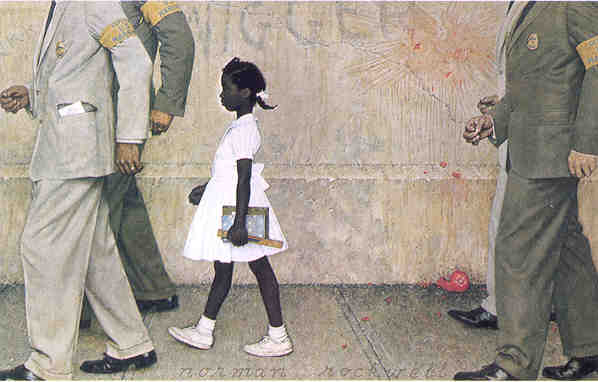
 Brother KMyles at the Wichita NAACP blog sends out an impassioned plea to resist the movement back to neighborhood schools in Wichita without concurrent redistricting.
"Saying that neighborhood schools "may not be as diverse as we'd like", but they will be "equitable" is essentially no different than saying that the races of children will be "separated" into different, "but equal" schools. That battle has already been fought and the very notion discredited."
In his view, permitting resegregation into neighborhood schools again will produce a host of enumerated bad outcomes;
- a return to practically single race schools
- a gradual migration of highly qualified and experienced teachers from the predominantly African American Schools to the predominantly White and suburban schools (which is a feature of teachers union contracts that allow them to move with seniority)
- the replacement of those highly qualified and experienced teachers with newly minted and inexperienced teachers
- a precipitous decline in test scores
- adapted curriculums (more block hours on NCLB testable disciplines to the exclusion of civics, the humanities, and some science courses)
- increased focus on basic proficiency and a decreased focus on high achievement
- a 'hardening' of the achievement gap
It is indeed sad and distressing to watch these tests that seem to indicate a crushing lack of self worth or esteem on the part of these children. But for the love of Mike, will someone explain to me how the remedy for that is ensuring they are educated in a classroom with white children!!? How does doing that cure this? More to the point, why is a desegregation strategy pursued to address things such as migration of experienced teachers or deficiencies in curriculum? Why not attack those problems directly, which are not caused by a lack of diversity, but by the deficiencies of centralized, bureaucratic school systems.
Diversity has now become an end in and of itself, ferociously pursued on the faulty assumption that it is an appropriate proxy for educational quality. It....is....not. Its quite ironic that local chapters of the NAACP of 2009 continue to pursue this strategy. Ironic because I do not for one second believe that the architects of the legal strategy that over turned segregation pursued a desegregation course because they believed being educated in a diverse classroom was the route to better educational outcomes. They pursued that course to break out of a separate but equal regime that was only separate. In order to gain the equal part of the equation, they knew they had to be able to send black children to the schools white children went to, because those schools were better resourced and provided for. It wasn't about diversity or being educated with white children, it was about escaping the shoddy conditions of the schools black children were confined to.
Look at the history of the cases which were consolidated and argued before the Supreme Court by the NAACP's legal team. Every one of them was about getting black kids out of crap schools that were purposely maintained that way. This is the historical backdrop against which KMyles makes his argument for resisting movement back towards neighborhood schools without redistricting that would presumably ensure substantial numbers of white and black children would be educated together. What is the theory here, that the presence of white children equates to a better school? If the school is all black, by default its children will recieve an inferior education? If thats our approach to education for our children, is it any wonder that a 2007 replication of the Kenneth Clark doll tests produces such horrific results? We are telling the kids that they are less when we behave this way.
Diversity does not equal quality education and should not be pursued as a primary, secondary or tertiary strategy for delivering better schools to black children, but it has become an end in itself. It doesn't appear that anyone is really being critical about the issue and recognizing that the integration strategy pursued in Brown vs. Board of Education was really about getting black kids out of inferior schools and into the better schools whites maintained for themselves. This was the real point of the battle. Black kids were forced to attend poorly supplied and resourced schools and denied access to the well resourced and supplied schools of whites. I'm quite certain that Thurgood Marshall didn't think we needed to attend white schools because diversity was so wonderful and necessary for black children. He fought to reverse the forced denial of education to our kids and get them better schools. The doll tests and the self esteem arguments were simply emotional sweetners for their arguments, essentially filling the same role that WMD did in making the case for the war in Iraq. That was the point then and it should be the point now. To deliver better schools to our kids.
But its not. We fight tooth and nail for integration as an end in itself. But we are missing the forest for the trees. We should be fighting to get our kids educated well, not whether or not they can attend a school with white students and achieving the latter does not assure the former. Its not a necessary fight in the modern age, because we can attend most any school if we can afford it or if we live in its attendance zone if its a public school.
But we are wasting time with diversity while our kids are falling further and further behind, refusing to face facts, one of them being that centralized public school systems lack the management and educational fire power to address the educational needs of urban populations stressed by a variety of socioeconomic conditions. Like the auto companies, they are saddled with legacy labor costs they cannot shed and union structures that are part of the problem, not the solution. These centralized bureaucratic systems are not nimble enough to deal with whats happening to our kids in and out of school. Furthermore, they are expensive and inefficient. We are spending two or three times what we should because these systems allocate their resources for education poorly and our money is not doing the work it should.
I'd also argue that far from being a detriment, neighborhood schools, properly implemented, are a benefit not only to the educational outcomes of black children, but also to the value of our neighborhoods. Anybody who's left the hood to live in the suburbs knows that quality of schools has a material impact on the value of homes in a given area and its a major attractor for people to invest in a home in a particular locale. If we pursued excellence in neighborhood schools, we would have not only better educational outcomes, but the value of home assets owned by the people in that neighborhood would rise because the presence of a high quality neighborhood school makes that neighborhood more desirable.
Lots of places in the US have charter schools, but there are only a few that get it right. The one that has the best system in place in my view is Indianapolis
 . The mayor of Indianapolis is the only mayor in the country currently with the power to charter schools. In nearly all big cities, Mayors are confronted with failing public school systems, but since they don't hire the superintendent and they are not on the school board, they have little ability to actually affect how school systems run. However, they have to deal with the consequences of a failing system such as aversion to homeownership investment in the city and poor workforce preparation.
Why are charters better? In my view, all of the accountability for performance is right at the school level. You don't have to mediate accountability for performance through superintendents, school boards or teachers unions. Charters must exercise care to serve the needs of their students and their families or lose their enrollment to another. Secondly, the charter approach permits tremendous variation in educational approach and philosophy. It is far more flexible in responding to the needs of students.
Sadly though, the charter approach is often hotly protested in the cities where its needed the most. We fight tooth and nail to preserve a public school system that consistently under performs for our kids, that promises to improve and rarely if ever does. We fight to preserve centralized bureaucratic school systems as though they have a right to exist, as though they are the only way to do education. I have conversations with people about education and they argue strenuously for more propping up of centralized bureaucratic education systems, but they are never very clear about why it can't be or should not be done any other way. Case in point Detroit. In 2003, Michigan millionaire and philanthropist Robert Thompson offered the city $200 million to build 15 Detroit charter high schools. His offer started a full scale war by the teachers unions on the Mayor and the Governor and when the dust had cleared, Thompson was run out of town along with his $200 million. Lest you think I'm just harshing on Detroit, I lived there for 8 years and I was around for that particular fiasco.
Education is an imperative for the African American community, but we are going to continue to lag in this area if we do not divorce ourselves from dependence on centralized bureaucratic public education systems in our urban centers. They don't work, have not worked for decades now. The charter approach, as exemplified by the Indianapolis model (which won a Harvard Innovation in Government award) should be speedily adopted by mayors of urban centers across the country. The black activists for education who fight to preserve these poor performing systems need to start championing what works, rather than what doesn't.
Hello Aaron... First off, let me thank you for commenting. But let me also say that I don't think you understand our position. We've been engaged with our district on this issue for a number of years now, and perhaps by reading that post, you were not afforded the benefit of hearing all of the conversation that had taken place before. Understandable...
ReplyDeleteI wrote a rather lenghty post about a year ago that specifically speaks to the idea you raised in your comment; that by arguing against re-segregation, we were advancing some romantic notion of black children magically benefitting from proximity to white children. You are correct in your assertion that proximity has no inherent value and that the goal should be a quality education for all children. We share those sentiments completely. The $64,000,000 question is, how do we realistically achieve that. Bearing in mind of course, that there are millions of children in school now, who can not wait for a national shift in consciousness, the erection of hundreds of thousands of accredited and financed charter schools, the rewriting of several major tenets in teacher contracts, demographic and/or cultural shifts in thinking regarding education, or any other abstract notions. We have to soberly address the questions: "What do out children need?" & "What can we change?"
When you have a few minutes, click on the Education tab in the right sidebar of our page... I've written more than 40 articles on Education. Check this one out when you have a chance.
http://www.wichitanaacpblog.com/2007/09/diversity-and-achievement-post-deseg.html
I would tend to agree with you that diversity for diversity's sake lacks substance. (In fact, a few years ago, I very Publicly argued against busing for deseg and for neighborhood schools) but that's not our point. Since then, we have reviewed a TON of research and literally hundreds of data points which point to succesful evidence-based education strategies. We've met and/or spoken with Nationally recognized experts and pioneers in the field of education and education research. Since then I have changed my position; not based on any fanciful notions and/or historic ties between civil rights and integration (and Certainly not because of any lack of critical thinking), but precisely because we want the same things you called for. And Ironically Aaron, this is a necessary part of the strategy to get us there.
You've seen it, haven't you? If I'm not mistaken, you're from Indianapolis right? My old company (Ryan Intl Airlines) used to have an office in Indy, so I've spent quite a bit of time there... But Aaron, you've seen what happened since IPS (Indianapolis Public Schools) went to the "select Schools" plan back in 93. You've seen what happened to the education system and performance outcomes. The National Center for Education Statistics listed Indianapolis as having only a 30.5% graduation rate which was an Aggregated number. IPS "defended itself" by saying the number should actually be around 40%.
A successful strategy will require that several key components be assembled together. I can assure you, the post you commented on is NOT our "strategy", it is only one leg of a 15-legged stool; a single piece of a much larger puzzle... :)
But the one area where I think we DO disagree is on the substance of the doll tests. To think of them merely as 'emotional sweeteners' is to miss the real point and the brilliance of the legal argument in Brown v Board.
The Strategy of the movement was to end legalized segregation. (At this point you have to separate the strategy from the vision) The actual 'case' of Brown V Board was far more philosophical than concrete.
The Brown's weren't suing to move their child from a poorly supplied, underfunded school into a 'better' school. In fact, the case was elevated 'because' the schools in question were equal, and only then could the philosophical argument be made. The argument in Brown V Board was NOT that black children should not be segregated into poorly attended or inferior facilities. That had already been established in Plessy V Fergussen which called for facilities to be separate BUT EQUAL. Had the Brown's come from an inferior school, the courts could simply have ruled that the Topeka District increase spending to achieve "Equity".
The legal argument was far deeper than that. The NAACP argued that there was a genuine and demonstrable harm imposed upon a black child by creating entire institutions just so others would not be burdened by their presence. The psychological effects (which would manifest as self-hatred, anti-social behavior, defeatist attitudes, pessimistic outlooks, etc) could be demonstrated and assessed, and had been in Dr. Clark's 1950's doll tests. The Doll tests were not 'sweeteners', they were absolutely foundational to the case and are still applicable today in an even Larger context. We are now witnessing the manifestation of the inevitable outcomes of the Doll tests, but our Educational system has fallen so far that we no longer have the historical information or context necessary to make the correct diagnosis. We treat Brown V Board as just an old court case from a by-gone era with little relevance for us today. And in so doing, we disregard the hundreds of hours of psychological, sociological, legal, and educational research laid out for us by some of the most gifted minds we have yet to produce. The fact that the doll tests could be randomly replicated in 2007 means that for all that we have accomplished, we have yet to dismantle the psychological engine that powers many of our community's dysfunctions. When many of our children look at academic achievement and english mastery as "white", how in the world could we disregard the doll tests? As those children with those sentiments enter the work force without the educational resume or language skills to compete, how in the world can we afford to ignore the doll tests? The doll tests are a symptom; they are pointing us towards something, they are trying to tell us about a larger and far more fundamental problem. THAT'S what Thurgood was saying. That's why Brown V Board is one of the most significant cases ever heard by the Supreme Court. And that's why the Doll tests matter. We shouldn't trivialize them; we do so at our own peril. But I really do Thank you for the dialogue!