You heard it here first: Palin will not run. Our rationale? Ultimately, she is more a poseur than the real deal and she lacks not only the fire in the belly to compete tooth and claw for the highest position in the land, she also lacks the ego necessary to scale this highest of political mountains. I'm taking bets on that prediction. Anybody want a piece of that action?
Relentlessly Real. If it weren't for physics and law enforcement, I'd be unstoppable.
January 28, 2011
Bold Predictions: Palin Will Not Run
You heard it here first: Palin will not run. Our rationale? Ultimately, she is more a poseur than the real deal and she lacks not only the fire in the belly to compete tooth and claw for the highest position in the land, she also lacks the ego necessary to scale this highest of political mountains. I'm taking bets on that prediction. Anybody want a piece of that action?
August 31, 2010
Public discussion of potential attacks on Iran’s nuclear development sites is surging again. This has happened before. On several occasions, leaks about potential airstrikes have created an atmosphere of impending war. These leaks normally coincided with diplomatic initiatives and were designed to intimidate the Iranians and facilitate a settlement favorable to the United States and Israel. These initiatives have failed in the past. It is therefore reasonable to associate the current avalanche of reports with the imposition of sanctions and view it as an attempt to increase the pressure on Iran and either force a policy shift or take advantage of divisions within the regime.
My first instinct is to dismiss the war talk as simply another round of psychological warfare against Iran, this time originating with Israel. Most of the reports indicate that Israel is on the verge of attacking Iran. From a psychological-warfare standpoint, this sets up the good-cop/bad-cop routine. The Israelis play the mad dog barely restrained by the more sober Americans, who urge the Iranians through intermediaries to make concessions and head off a war. As I said, we have been here before several times, and this hasn’t worked.
The worst sin of intelligence is complacency, the belief that simply because something has happened (or has not happened) several times before it is not going to happen this time. But each episode must be considered carefully in its own light and preconceptions from previous episodes must be banished. Indeed, the previous episodes might well have been intended to lull the Iranians into complacency themselves. Paradoxically, the very existence of another round of war talk could be intended to convince the Iranians that war is distant while covert war preparations take place. An attack may be in the offing, but the public displays neither confirm nor deny that possibility.
The Evolving Iranian Assessment
STRATFOR has gone through three phases in its evaluation of the possibility of war. The first, which was in place until July 2009, held that while Iran was working toward a nuclear weapon, its progress could not be judged by its accumulation of enriched uranium. While that would give you an underground explosion, the creation of a weapon required sophisticated technologies for ruggedizing and miniaturizing the device, along with a very reliable delivery system. In our view, Iran might be nearing a testable device but it was far from a deliverable weapon. Therefore, we dismissed war talk and argued that there was no meaningful pressure for an attack on Iran.We modified this view somewhat in July 2009, after the Iranian elections and the demonstrations. While we dismissed the significance of the demonstrations, we noted close collaboration developing between Russia and Iran. That meant there could be no effective sanctions against Iran, so stalling for time in order for sanctions to work had no value. Therefore, the possibility of a strike increased.
But then Russian support stalled as well, and we turned back to our analysis, adding to it an evaluation of potential Iranian responses to any air attack. We noted three potential counters: activating Shiite militant groups (most notably Hezbollah), creating chaos in Iraq and blocking the Strait of Hormuz, through which 45 percent of global oil exports travel. Of the three Iranian counters, the last was the real “nuclear option.” Interfering with the supply of oil from the Persian Gulf would raise oil prices stunningly and would certainly abort the tepid global economic recovery. Iran would have the option of plunging the world into a global recession or worse.
There has been debate over whether Iran would choose to do the latter or whether the U.S. Navy could rapidly clear mines. It is hard to imagine how an Iranian government could survive air attacks without countering them in some way. It is also a painful lesson of history that the confidence of any military force cannot be a guide to its performance. At the very least, there is a possibility that the Iranians could block the Strait of Hormuz, and that means the possibility of devastating global economic consequences. That is a massive risk for the United States to take, against an unknown probability of successful Iranian action. In our mind, it was not a risk that the United States could take, especially when added to the other Iranian counters. Therefore, we did not think the United States would strike.
Certainly, we did not believe that the Israelis would strike Iran alone. First, the Israelis are much less likely to succeed than the Americans would be, given the size of their force and their distance from Iran (not to mention the fact that they would have to traverse either Turkish, Iraqi or Saudi airspace). More important, Israel lacks the ability to mitigate any consequences. Any Israeli attack would have to be coordinated with the United States so that the United States could alert and deploy its counter-mine, anti-submarine and missile-suppression assets. For Israel to act without giving the United States time to mitigate the Hormuz option would put Israel in the position of triggering a global economic crisis. The political consequences of that would not be manageable by Israel. Therefore, we found an Israeli strike against Iran without U.S. involvement difficult to imagine.
The Current Evaluation
Our current view is that the accumulation of enough enriched uranium to build a weapon does not mean that the Iranians are anywhere close to having a weapon. Moreover, the risks inherent in an airstrike on its nuclear facilities outstrip the benefits (and even that assumes that the entire nuclear industry is destroyed in one fell swoop — an unsure outcome at best). It also assumes the absence of other necessary technologies. Assumptions of U.S. prowess against mines might be faulty, and so, too, could my assumption about weapon development. The calculus becomes murky, and one would expect all governments involved to be waffling.There is, of course, a massive additional issue. Apart from the direct actions that Iran might make, there is the fact that the destruction of its nuclear capability would not solve the underlying strategic challenge that Iran poses. It has the largest military force in the Persian Gulf, absent the United States. The United States is in the process of withdrawing from Iraq, which would further diminish the ability of the United States to contain Iran. Therefore, a surgical strike on Iran’s nuclear capability combined with the continuing withdrawal of U.S. forces from Iraq would create a profound strategic crisis in the Persian Gulf.
The country most concerned about Iran is not Israel, but Saudi Arabia. The Saudis recall the result of the last strategic imbalance in the region, when Iraq, following its armistice with Iran, proceeded to invade Kuwait, opening the possibility that its next intention was to seize the northeastern oil fields of Saudi Arabia. In that case, the United States intervened. Given that the United States is now withdrawing from Iraq, intervention following withdrawal would be politically difficult unless the threat to the United States was clear. More important, the Iranians might not give the Saudis the present Saddam Hussein gave them by seizing Kuwait and then halting. They might continue. They certainly have the military capacity to try.
In a real sense, the Iranians would not have to execute such a military operation in order to gain the benefits. The simple imbalance of forces would compel the Saudis and others in the Persian Gulf to seek a political accommodation with the Iranians. Strategic domination of the Persian Gulf does not necessarily require military occupation — as the Americans have abundantly demonstrated over the past 40 years. It merely requires the ability to carry out those operations.
The Saudis, therefore, have been far quieter — and far more urgent — than the Israelis in asking the United States to do something about the Iranians. The Saudis certainly do not want the United States to leave Iraq. They want the Americans there as a blocking force protecting Saudi Arabia but not positioned on Saudi soil. They obviously are not happy about Iran’s nuclear efforts, but the Saudis see the conventional and nuclear threat as a single entity. The collapse of the Iran-Iraq balance of power has left the Arabian Peninsula in a precarious position.
King Abdullah of Saudi Arabia did an interesting thing a few weeks ago. He visited Lebanon personally and in the company of the president of Syria. The Syrian and Saudi regimes are not normally friendly, given different ideologies, Syria’s close relationship with Iran and their divergent interests in Lebanon. But there they were together, meeting with the Lebanese government and giving not very subtle warnings to Hezbollah. Saudi influence and money and the threat of Iran jeopardizing the Saudi regime by excessive adventurism seems to have created an anti-Hezbollah dynamic in Lebanon. Hezbollah is suddenly finding many of its supposed allies cooperating with some of its certain enemies. The threat of a Hezbollah response to an airstrike on Iran seems to be mitigated somewhat.
Eliminating Iranian Leverage In Hormuz
I said that there were three counters. One was Hezbollah, which is the least potent of the three from the American perspective. The other two are Iraq and Hormuz. If the Iraqis were able to form a government that boxed in pro-Iranian factions in a manner similar to how Hezbollah is being tentatively contained, then the second Iranian counter would be weakened. That would “just” leave the major issue — Hormuz.The problem with Hormuz is that the United States cannot tolerate any risk there. The only way to control that risk is to destroy Iranian naval capability before airstrikes on nuclear targets take place. Since many of the Iranian mine layers would be small boats, this would mean an extensive air campaign and special operations forces raids against Iranian ports designed to destroy anything that could lay mines, along with any and all potential mine-storage facilities, anti-ship missile emplacements, submarines and aircraft. Put simply, any piece of infrastructure within a few miles of any port would need to be eliminated. The risk to Hormuz cannot be eliminated after the attack on nuclear sites. It must be eliminated before an attack on the nuclear sites. And the damage must be overwhelming.
There are two benefits to this strategy. First, the nuclear facilities aren’t going anywhere. It is the facilities that are producing the enriched uranium and other parts of the weapon that must be destroyed more than any uranium that has already been enriched. And the vast bulk of those facilities will remain where they are even if there is an attack on Iran’s maritime capabilities. Key personnel would undoubtedly escape, but considering that within minutes of the first American strike anywhere in Iran a mass evacuation of key scientists would be under way anyway, there is little appreciable difference between a first strike against nuclear sites and a first strike against maritime targets. (U.S. air assets are good, but even the United States cannot strike 100-plus targets simultaneously.)
Second, the counter-nuclear strategy wouldn’t deal with the more fundamental problem of Iran’s conventional military power. This opening gambit would necessarily attack Iran’s command-and-control, air-defense and offensive air capabilities as well as maritime capabilities. This would sequence with an attack on the nuclear capabilities and could be extended into a prolonged air campaign targeting Iran’s ground forces.
The United States is very good at gaining command of the air and attacking conventional military capabilities (see Yugoslavia in 1999). Its strategic air capability is massive and, unlike most of the U.S. military, underutilized. The United States also has substantial air forces deployed around Iran, along with special operations forces teams trained in penetration, evasion and targeting, and satellite surveillance. Far from the less-than-rewarding task of counterinsurgency in Afghanistan, going after Iran would be the kind of war the United States excels at fighting. No conventional land invasion, no boots-on-the-ground occupation, just a very thorough bombing campaign. If regime change happens as a consequence, great, but that is not the primary goal. Defanging the Iranian state is.
It is also the only type of operation that could destroy the nuclear capabilities (and then some) while preventing an Iranian response. It would devastate Iran’s conventional military forces, eliminating the near-term threat to the Arabian Peninsula. Such an attack, properly executed, would be the worst-case scenario for Iran and, in my view, the only way an extended air campaign against nuclear facilities could be safely executed.
Just as Iran’s domination of the Persian Gulf rests on its ability to conduct military operations, not on its actually conducting the operations, the reverse is also true. It is the capacity and apparent will to conduct broadened military operations against Iran that can shape Iranian calculations and decision-making. So long as the only threat is to Iran’s nuclear facilities, its conventional forces remain intact and its counter options remain viable, Iran will not shift its strategy. Once its counter options are shut down and its conventional forces are put at risk, Iran must draw up another calculus.
In this scenario, Israel is a marginal player. The United States is the only significant actor, and it might not strike Iran simply over the nuclear issue. That’s not a major U.S. problem. But the continuing withdrawal from Iraq and Iran’s conventional forces are very much an American problem. Destroying Iran’s nuclear capability is merely an added benefit.
Given the Saudi intervention in Lebanese politics, this scenario now requires a radical change in Iraq, one in which a government would be quickly formed and Iranian influence quickly curtailed. Interestingly, we have heard recent comments by administration officials asserting that Iranian influence has, in fact, been dramatically reduced. At present, such a reduction is not obvious to us, but the first step of shifting perceptions tends to be propaganda. If such a reduction became real, then the two lesser Iranian counter moves would be blocked and the U.S. offensive option would become more viable.
Internal Tension in Tehran
At this point, we would expect to see the Iranians recalculating their position, with some of the clerical leadership using the shifting sands of Lebanon against Iranian President Mahmoud Ahmadinejad. Indeed, there have been many indications of internal stress, not between the mythical democratic masses and the elite, but within the elite itself. This past weekend the Iranian speaker of the house attacked Ahmadinejad’s handling of special emissaries. For what purpose we don’t yet know, but the internal tension is growing.The Iranians are not concerned about the sanctions. The destruction of their nuclear capacity would, from their point of view, be a pity. But the destruction of large amounts of their conventional forces would threaten not only their goals in the wider Islamic world but also their stability at home. That would be unacceptable and would require a shift in their general strategy.
From the Iranian point of view — and from ours — Washington’s intentions are opaque. But when we consider the Obama administration’s stated need to withdraw from Iraq, Saudi pressure on the United States not to withdraw while Iran remains a threat, Saudi moves against Hezbollah to split Syria from Iran and Israeli pressure on the United States to deal with nuclear weapons, the pieces for a new American strategy are emerging from the mist. Certainly the Iranians appear to be nervous. And the threat of a new strategy might just be enough to move the Iranians off dead center. If they don’t, logic would dictate the consideration of a broader treatment of the military problem posed by Iran.
<a href="http://www.stratfor.com/weekly/20100830_rethinking_american_options_iran">Rethinking American Options on Iran</a> is republished with permission of STRATFOR.
Related articles by Zemanta
- Worst-Case Scenarios: Possible Strike Plans for Iran Involve Risky Options (foxnews.com)
- The Sunni factor in Iran's nuclear calculus (theglobeandmail.com)
- U.S. to Israel: Iran nuclear weapons in 12 months as Bushehr reactor starts (rightpundits.com)
December 3, 2008
No Quarter
The terror attack in Mumbai and its aftermath has been and will continue to be a major story in the news for at least another week or two. In a world where we have grown accustomed to the presence of the terror threat, as we did with the nuclear threat, it is becoming easier to be unshaken by these incidents. Particularly so here in America, as we enjoy the attack free security of the post 911 years. The Bush administration, with all its faults, has spared us the anguish of a second 911 thus far.So comes Mumbai and we observe the scale of this chaos and terror, multiple murders purposley visited upon the innocent in what is likely to prove an attempt to goad India into confrontation with Pakistan and destabilize it. As terrible as it all is, it seems easy to turn from our tv sets and in the turning, wipe the horror from the minds eye.
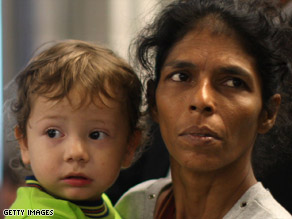
But I found my righteous outrage and sadness at this evil , and my wonder rekindled afresh upon hearing the story of Sandra Samuel, one of many stories beginning to emerge from the three day hell the terrorists created. Sandra, an Indian nanny, and two-year-old Moshe Holtzberg, her charge, were the only ones to make it out of the Chabad House alive after gunmen stormed the house, killing the Chabad House directors Rabbi Gavriel Holtzberg and his wife, Rivka, parents of Moshe, and four others.
In the midst of that tragedy I thank God for Sandra who retained enough presence of mind and courage to leave her place of relative safety in the Chabad house even as the gunmen were searching and killing room to room. She unlocked her door and dared the gunmen to stop her, ran upstairs to find the Holtzbergs shot dead, lying on the ground with their son crying over them. She picked up the boy and ran out, past the gunmen and fled with him to safety.
As parents, faced with imminent death, if there is a chance to save the children, that becomes paramount. My wife and I have a clear understanding that in any situation where our children can be saved only by sacrificing one or both of us, the children are to be saved. As a parent, I know that the Holtzbergs would have wanted their son to survive and would have been profoundly grateful for Sandra's devotion and courage, risking her life to save their son. A regular woman braved murder and terror everywhere around her, to save the life of a child not her own. Surrounded by evil killers and with a chance to flee to safety on her own, she chose to walk into the danger for Moshe. His mother was murdered and Sandra stepped into the breach to save him. I'm very humbled by the immense courage and love that act required.

The AP: The cries of little Moshe wounded hearts…”Mommy, mommy, mommy!” he wailed, clutching a toy basketball while squirming in the arms of mourners at the synagogue.
Look at his face. Consider his anguish. Still fresh in his barely comprehending mind the terrible memories of mommy and daddy killed before his eyes. I don't have adequate words for the sadness I feel at the breaking of a baby's heart in this way.
Nieither do I have adequate words for the outrage, horror and revulsion I feel towards the people who did it. There is a special place in Hell reserved for those responsible for the look on this child's face.
Mumbai is a reminder that the terrorists are willing to commit nearly any outrage to advance their goal to create a world full of chaos and the cries of a thousand Moshe's which they can dominate. They can be given no quarter.
October 22, 2008
The United States, Europe and Bretton Woods II
By George Friedman and Peter Zeihan French President Nicolas Sarkozy and U.S. President George W. Bush met Oct. 18 to discuss the possibility of a global financial summit. The meeting ended with an American offer to host a global summit in December modeled on the 1944 Bretton Woods system that founded the modern economic system.
The Bretton Woods framework is one of the more misunderstood developments in human history. The conventional wisdom is that Bretton Woods crafted the modern international economic architecture, lashing the trading and currency systems to the gold standard to achieve global stability. To a certain degree, that is true. But the form that Bretton Woods took in the public mind is only a veneer. The real implications and meaning of Bretton Woods are a different story altogether.
Conventional Wisdom: The Depression and Bretton Woods
The origin of Bretton Woods lies in the Great Depression. As economic output dropped in the 1930s, governments worldwide adopted a swathe of protectionist, populist policies — import tariffs were particularly in vogue — that enervated international trade. In order to maintain employment, governments and firms alike encouraged ongoing production of goods even though mutual tariff walls prevented the sale of those goods abroad. As a result, prices for these goods dropped and deflation set in. Soon firms found that the prices they could reasonably charge for their goods had dropped below the costs of producing them.
The reduction in profitability led to layoffs, which reduced demand for products in general, further reducing prices. Firms went out of business en masse, workers in the millions lost their jobs, demand withered, and prices followed suit. An effort designed originally to protect jobs (the tariffs) resulted in a deep, self-reinforcing deflationary spiral, and the variety of measures adopted to combat it — the New Deal included — could not seem to right the system.
Economically, World War II was a godsend. The military effort generated demand for goods and labor. The goods part is pretty straightforward, but the labor issue is what really allowed the global economy to turn the corner. Obviously, the war effort required more workers to craft goods, whether bars of soap or aircraft carriers, but “workers” were also called upon to serve as soldiers. The war removed tens of millions of men from the labor force, shipping them off to — economically speaking — nonproductive endeavors. Sustained demand for goods combined with labor shortages raised prices, and as expectations for inflation rather than deflation set in, consumers became more willing to spend their money for fear it would be worth less in the future. The deflationary spiral was broken; supply and demand came back into balance.
Policymakers of the time realized that the prosecution of the war had suspended the depression, but few were confident that the war had actually ended the conditions that made the depression possible. So in July 1944, 730 representatives from 44 different countries converged on a small ski village in New Hampshire to cobble together a system that would prevent additional depressions and — were one to occur — come up with a means of ending it shy of depending upon a world war.
When all was said and done, the delegates agreed to a system of exchangeable currencies and broadly open rules of trade. The system would be based on the gold standard to prevent currency fluctuations, and a pair of institutions — what would become known as the International Monetary Fund (IMF) and the World Bank — would serve as guardians of the system’s financial and fiduciary particulars.
The conventional wisdom is that Bretton Woods worked for a time, but that since the entire system was linked to gold, the limited availability of gold put an upper limit on what the new system could handle. As postwar economic activity expanded — but the supply of gold did not — that problem became so mammoth that the United States abandoned the gold standard in 1971. Most point to that period as the end of the Bretton Woods system. In fact, we are still using Bretton Woods, and while nothing that has been discussed to this point is wrong exactly, it is only part of the story.
A Deeper Understanding: World War II and Bretton Woods
Think back to July 1944. The Normandy invasion was in its first month. The United Kingdom served as the staging ground, but with London exhausted, its military commitment to the operation was modest. While the tide of the war had clearly turned, there was much slogging ahead. It had become apparent that launching the invasion of Europe — much less sustaining it — was impossible without large-scale U.S. involvement. Similarly, the balance of forces on the Eastern Front radically favored the Soviets. While the particulars were, of course, open to debate, no one was so idealistic to think that after suffering at Nazi hands, the Soviets were simply going to withdraw from territory captured on their way to Berlin.
The shape of the Cold War was already beginning to unfold. Between the United States and the Soviet Union, the rest of the modern world — namely, Europe — was going to either experience Soviet occupation or become a U.S. protectorate.
At the core of that realization were twin challenges. For the Europeans, any hope they had of rebuilding was totally dependent upon U.S. willingness to remain engaged. Issues of Soviet attack aside, the war had decimated Europe, and the damage was only becoming worse with each inch of Nazi territory the Americans or Soviets conquered. The Continental states — and even the United Kingdom — were not simply economically spent and indebted but were, to be perfectly blunt, destitute. This was not World War I, where most of the fighting had occurred along a single series of trenches. This was blitzkrieg and saturation bombings, which left the Continent in ruins, and there was almost nothing left from which to rebuild. Simply avoiding mass starvation would be a challenge, and any rebuilding effort would be utterly dependent upon U.S. financing. The Europeans were willing to accept nearly whatever was on offer.
For the United States, the issue was one of seizing a historic opportunity. Historically, the United States thought of the United Kingdom and France — with their maritime traditions — as more of a threat to U.S. interests than the largely land-based Soviet Union and Germany. Even World War I did not fully dispel this concern. (Japan, for its part, was always viewed as a hostile power.) The United States entered World War II late and the war did not occur on U.S. soil. So — uniquely among all the world’s major powers of the day — U.S. infrastructure and industrial capacity would emerge from the war larger (far, far larger) than when it entered. With its traditional rivals either already greatly weakened or well on their way to being so, the United States had the opportunity to set itself up as the core of the new order.
In this, the United States faced the challenges of defending against the Soviet Union. The United States could not occupy Western Europe as it expected the Soviets to occupy Eastern Europe; it lacked the troops and was on the wrong side of the ocean. The United States had to have not just the participation of the Western Europeans in holding back the Soviet tide, it needed the Europeans to defer to American political and military demands — and to do so willingly. Considering the desperation and destitution of the Europeans, and the unprecedented and unparalleled U.S. economic strength, economic carrots were the obvious way to go.
Put another way, Bretton Woods was part of a broader American effort to extend the wartime alliance — sans the Soviets — beyond Germany’s surrender. After all wars, there is the hope that alliances that have defeated a common enemy will continue to function to administer and maintain the peace. This happened at the Congress of Vienna and Versailles as well. Bretton Woods was more than an attempt to shape the global economic system, it was an effort to grow a military alliance into a broader U.S.-led and -dominated bloc to counter the Soviets.
At Bretton Woods, the United States made itself the core of the new system, agreeing to become the trading partner of first and last resort. The United States would allow Europe near tariff-free access to its markets, and turn a blind eye to Europe’s own tariffs so long as they did not become too egregious — something that at least in part flew in the face of the Great Depression’s lessons. The sale of European goods in the United States would help Europe develop economically, and, in exchange, the United States would receive deference on political and military matters: NATO — the ultimate hedge against Soviet invasion — was born.
The “free world” alliance would not consist of a series of equal states. Instead, it would consist of the United States and everyone else. The “everyone else” included shattered European economies, their impoverished colonies, independent successor states and so on. The truth was that Bretton Woods was less a compact of equals than a framework for economic relations within an unequal alliance against the Soviet Union. The foundation of Bretton Woods was American economic power — and the American interest in strengthening the economies of the rest of the world to immunize them from communism and build the containment of the Soviet Union.
Almost immediately after the war, the United States began acting in ways that indicated that Bretton Woods was not — for itself at least — an economic program. When loans to fund Western Europe’s redevelopment failed to stimulate growth, those loans became grants, aka the Marshall Plan. Shortly thereafter, the United States — certainly to its economic loss — almost absentmindedly extended the benefits of Bretton Woods to any state involved on the American side of the Cold War, with Japan, South Korea and Taiwan signing up as its most enthusiastic participants.
And fast-forwarding to when the world went off of the gold standard and Bretton Woods supposedly died, gold was actually replaced by the U.S. dollar. Far from dying, the political/military understanding that underpinned Bretton Woods had only become more entrenched. Whereas before, the greatest limiter was on the availability of gold, now it became — and remains — the whim of the U.S. government’s monetary authorities.
Toward Bretton Woods II
For many of the states that will be attending what is already being dubbed Bretton Woods II, having this American centrality as such a key pillar of the system is the core of the problem.
The fundamental principle of Bretton Woods was national sovereignty within a framework of relationships, ultimately guaranteed not just by American political power but by American economic power. Bretton Woods was not so much a system as a reality. American economic power dwarfed the rest of the noncommunist world, and guaranteed the stability of the international financial system.
What the September financial crisis has shown is not that the basic financial system has changed, but what happens when the guarantor of the financial system itself undergoes a crisis. When the economic bubble in Japan — the world’s second-largest economy — burst in 1990-1991, it did not infect the rest of the world. Neither did the East Asian crisis in 1997, nor the ruble crisis of 1998. A crisis in France or the United Kingdom would similarly remain a local one. But a crisis in the U.S. economy becomes global. The fundamental reality of Bretton Woods remains unchanged: The U.S. economy remains the largest, and dysfunctions there affect the world. That is the reality of the international system, and that is ultimately what the French call for a new Bretton Woods is about.
There has been talk of a meeting at which the United States gives up its place as the world’s reserve currency and primacy of the economic system. That is not what this meeting will be about, and certainly not what the French are after. The use of the dollar as world reserve currency is not based on an aggrandizing fiat, but the reality that the dollar alone has a global presence and trust. The euro, after all, is only a decade old, and is not backed either by sovereign taxing powers or by a central bank with vast authority. The European Central Bank (ECB) certainly steadies the European financial system, but it is the sovereign countries that define economic policies. As we have seen in the recent crisis, the ECB actually lacks the authority to regulate Europe’s banks. Relying on a currency that is not in the hands of a sovereign taxing power, but dependent on the political will of (so far) 15 countries with very different interests, does not make for a reliable reserve currency.
The Europeans are not looking to challenge the reality of American power, they are looking to increase the degree to which the rest of the world can influence the dynamics of the American economy, with an eye toward limiting the ability of the Americans to accidentally destabilize the international financial system again. The French in particular look at the current crisis as the result of a failure in the U.S. regulatory system.
And the Europeans certainly have a point. If fault is to be pinned, it is on the United States for letting the problem grow and grow until it triggered a liquidity crisis. The Bretton Woods institutions — specifically the IMF, which is supposed to serve the role of financial lighthouse and crisis manager — proved irrelevant to the problems the world is currently passing through. Indeed, all multinational institutions failed or, more precisely, have little to do with the financial system that was operating in 2008. The 64-year-old Bretton Woods agreement simply didn’t have anything to do with the current reality.
Ultimately, the Europeans would like to see a shift in focus in the world of international economic interactions from strengthening the international trading system to controlling the international financial system. In practical terms, they want an oversight body that can guarantee that there won’t be a repeat of the current crisis. This would involve everything from regulations on accounting methods, to restrictions on what can and cannot be traded and by whom (offshore financial havens and hedge funds would definitely find their worlds circumscribed), to frameworks for global interventions. The net effect would be to create an international bureaucracy to oversee global financial markets.
Fundamentally, the Europeans are not simply hoping to modernize Bretton Woods, but instead to Europeanize the American financial markets. This is ultimately not a financial question, but a political one. The French are trying to flip Bretton Woods from a system where the United States is the buttress of the international system to a situation where the United States remains the buttress but is more constrained by the broader international system. The European view is that this will help everybody. The American position is not yet framed and won’t be until the new president is in office.
But it will be a very tough sell. For one, at its core the American problem is “simply” a liquidity freeze and one that is already thawing. Europe’s and East Asia’s recessions are bound to be deeper and longer lasting. So the United States is sure — no matter who takes over in January — to be less than keen about revamps of international processes in general. Far more important, any international system that oversees aspects of American finance would, by definition, not be under full American control, but under some sort of quasi-Brussels-like organization. And no American president is going to engage gleefully on that sort of topic.
Unless something else is on offer.
Bretton Woods was ultimately about the United States trading access to its economic might for political and military deference. The reality of American economic might remains. The question, then, is simple: What will the Europeans bring to the table with which to bargain?
September 9, 2008
Israeli Strategy After the Russo-Georgian War
The Russo-Georgian war continues to resonate, and it is time to expand our view of it. The primary players in Georgia, apart from the Georgians, were the Russians and Americans. On the margins were the Europeans, providing advice and admonitions but carrying little weight. Another player, carrying out a murkier role, was Israel. Israeli advisers were present in Georgia alongside American advisers, and Israeli businessmen were doing business there. The Israelis had a degree of influence but were minor players compared to the Americans.
More interesting, perhaps, was the decision, publicly announced by the Israelis, to end weapons sales to Georgia the week before the Georgians attacked South Ossetia. Clearly the Israelis knew what was coming and wanted no part of it. Afterward, unlike the Americans, the Israelis did everything they could to placate the Russians, including having Israeli Prime Minister Ehud Olmert travel to Moscow to offer reassurances. Whatever the Israelis were doing in Georgia, they did not want a confrontation with the Russians.
It is impossible to explain the Israeli reasoning for being in Georgia outside the context of a careful review of Israeli strategy in general. From that, we can begin to understand why the Israelis are involved in affairs far outside their immediate area of responsibility, and why they responded the way they did in Georgia.
We need to divide Israeli strategic interests into four separate but interacting pieces:
- The Palestinians living inside Israel’s post-1967 borders.
- The so-called “confrontation states” that border Israel, including Lebanon, Syria, Jordan and especially Egypt.
- The Muslim world beyond this region.
- The great powers able to influence and project power into these first three regions.
The Palestinian Issue
The most important thing to understand about the first interest, the Palestinian issue, is that the Palestinians do not represent a strategic threat to the Israelis. Their ability to inflict casualties is an irritant to the Israelis (if a tragedy to the victims and their families), but they cannot threaten the existence of the Israeli state. The Palestinians can impose a level of irritation that can affect Israeli morale, inducing the Israelis to make concessions based on the realistic assessment that the Palestinians by themselves cannot in any conceivable time frame threaten Israel’s core interests, regardless of political arrangements. At the same time, the argument goes, given that the Palestinians cannot threaten Israeli interests, what is the value of making concessions that will not change the threat of terrorist attacks? Given the structure of Israeli politics, this matter is both substrategic and gridlocked.
The matter is compounded by the fact that the Palestinians are deeply divided among themselves. For Israel, this is a benefit, as it creates a de facto civil war among Palestinians and reduces the threat from them. But it also reduces pressure and opportunities to negotiate. There is no one on the Palestinian side who speaks authoritatively for all Palestinians. Any agreement reached with the Palestinians would, from the Israeli point of view, have to include guarantees on the cessation of terrorism. No one has ever been in a position to guarantee that — and certainly Fatah does not today speak for Hamas. Therefore, a settlement on a Palestinian state remains gridlocked because it does not deliver any meaningful advantages to the Israelis.
The Confrontation States
The second area involves the confrontation states. Israel has formal peace treaties with Egypt and Jordan. It has had informal understandings with Damascus on things like Lebanon, but Israel has no permanent understanding with Syria. The Lebanese are too deeply divided to allow state-to-state understandings, but Israel has had understandings with different Lebanese factions at different times (and particularly close relations with some of the Christian factions).
Jordan is effectively an ally of Israel. It has been hostile to the Palestinians at least since 1970, when the Palestine Liberation Organization attempted to overthrow the Hashemite regime, and the Jordanians regard the Israelis and Americans as guarantors of their national security. Israel’s relationship with Egypt is publicly cooler but quite cooperative. The only group that poses any serious challenge to the Egyptian state is The Muslim Brotherhood, and hence Cairo views Hamas — a derivative of that organization — as a potential threat. The Egyptians and Israelis have maintained peaceful relations for more than 30 years, regardless of the state of Israeli-Palestinian relations. The Syrians by themselves cannot go to war with Israel and survive. Their primary interest lies in Lebanon, and when they work against Israel, they work with surrogates like Hezbollah. But their own view on an independent Palestinian state is murky, since they claim all of Palestine as part of a greater Syria — a view not particularly relevant at the moment. Therefore, Israel’s only threat on its border comes from Syria via surrogates in Lebanon and the possibility of Syria’s acquiring weaponry that would threaten Israel, such as chemical or nuclear weapons.
The Wider Muslim World
As to the third area, Israel’s position in the Muslim world beyond the confrontation states is much more secure than either it or its enemies would like to admit. Israel has close, formal strategic relations with Turkey as well as with Morocco. Turkey and Egypt are the giants of the region, and being aligned with them provides Israel with the foundations of regional security. But Israel also has excellent relations with countries where formal relations do not exist, particularly in the Arabian Peninsula.
The conservative monarchies of the region deeply distrust the Palestinians, particularly Fatah. As part of the Nasserite Pan-Arab socialist movement, Fatah on several occasions directly threatened these monarchies. Several times in the 1970s and 1980s, Israeli intelligence provided these monarchies with information that prevented assassinations or uprisings.
Saudi Arabia, for one, has never engaged in anti-Israeli activities beyond rhetoric. In the aftermath of the 2006 Israeli-Hezbollah conflict, Saudi Arabia and Israel forged close behind-the-scenes relations, especially because of an assertive Iran — a common foe of both the Saudis and the Israelis. Saudi Arabia has close relations with Hamas, but these have as much to do with maintaining a defensive position — keeping Hamas and its Saudi backers off Riyadh’s back — as they do with government policy. The Saudis are cautious regarding Hamas, and the other monarchies are even more so.
More to the point, Israel does extensive business with these regimes, particularly in the defense area. Israeli companies, working formally through American or European subsidiaries, carry out extensive business throughout the Arabian Peninsula. The nature of these subsidiaries is well-known on all sides, though no one is eager to trumpet this. The governments of both Israel and the Arabian Peninsula would have internal political problems if they publicized it, but a visit to Dubai, the business capital of the region, would find many Israelis doing extensive business under third-party passports. Add to this that the states of the Arabian Peninsula are afraid of Iran, and the relationship becomes even more important to all sides.
There is an interesting idea that if Israel were to withdraw from the occupied territories and create an independent Palestinian state, then perceptions of Israel in the Islamic world would shift. This is a commonplace view in Europe. The fact is that we can divide the Muslim world into three groups.
First, there are those countries that already have formal ties to Israel. Second are those that have close working relations with Israel and where formal ties would complicate rather than deepen relations. Pakistan and Indonesia, among others, fit into this class. Third are those that are absolutely hostile to Israel, such as Iran. It is very difficult to identify a state that has no informal or formal relations with Israel but would adopt these relations if there were a Palestinian state. Those states that are hostile to Israel would remain hostile after a withdrawal from the Palestinian territories, since their issue is with the existence of Israel, not its borders.
The point of all this is that Israeli security is much better than it might appear if one listened only to the rhetoric. The Palestinians are divided and at war with each other. Under the best of circumstances, they cannot threaten Israel’s survival. The only bordering countries with which the Israelis have no formal agreements are Syria and Lebanon, and neither can threaten Israel’s security. Israel has close ties to Turkey, the most powerful Muslim country in the region. It also has much closer commercial and intelligence ties with the Arabian Peninsula than is generally acknowledged, although the degree of cooperation is well-known in the region. From a security standpoint, Israel is doing well.
The Broader World
Israel is also doing extremely well in the broader world, the fourth and final area. Israel always has needed a foreign source of weapons and technology, since its national security needs outstrip its domestic industrial capacity. Its first patron was the Soviet Union, which hoped to gain a foothold in the Middle East. This was quickly followed by France, which saw Israel as an ally in Algeria and against Egypt. Finally, after 1967, the United States came to support Israel. Washington saw Israel as a threat to Syria, which could threaten Turkey from the rear at a time when the Soviets were threatening Turkey from the north. Turkey was the doorway to the Mediterranean, and Syria was a threat to Turkey. Egypt was also aligned with the Soviets from 1956 onward, long before the United States had developed a close working relationship with Israel.
That relationship has declined in importance for the Israelis. Over the years the amount of U.S. aid — roughly $2.5 billion annually — has remained relatively constant. It was never adjusted upward for inflation, and so shrunk as a percentage of Israeli gross domestic product from roughly 20 percent in 1974 to under 2 percent today. Israel’s dependence on the United States has plummeted. The dependence that once existed has become a marginal convenience. Israel holds onto the aid less for economic reasons than to maintain the concept in the United States of Israeli dependence and U.S. responsibility for Israeli security. In other words, it is more psychological and political from Israel’s point of view than an economic or security requirement.
Israel therefore has no threats or serious dependencies, save two. The first is the acquisition of nuclear weapons by a power that cannot be deterred — in other words, a nation prepared to commit suicide to destroy Israel. Given Iranian rhetoric, Iran would appear at times to be such a nation. But given that the Iranians are far from having a deliverable weapon, and that in the Middle East no one’s rhetoric should be taken all that seriously, the Iranian threat is not one the Israelis are compelled to deal with right now.
The second threat would come from the emergence of a major power prepared to intervene overtly or covertly in the region for its own interests, and in the course of doing so, redefine the regional threat to Israel. The major candidate for this role is Russia.
During the Cold War, the Soviets pursued a strategy to undermine American interests in the region. In the course of this, the Soviets activated states and groups that could directly threaten Israel. There is no significant conventional military threat to Israel on its borders unless Egypt is willing and well-armed. Since the mid-1970s, Egypt has been neither. Even if Egyptian President Hosni Mubarak were to die and be replaced by a regime hostile to Israel, Cairo could do nothing unless it had a patron capable of training and arming its military. The same is true of Syria and Iran to a great extent. Without access to outside military technology, Iran is a nation merely of frightening press conferences. With access, the entire regional equation shifts.
After the fall of the Soviet Union, no one was prepared to intervene in the Middle East the way the Soviets had. The Chinese have absolutely no interest in struggling with the United States in the Middle East, which accounts for a similar percentage of Chinese and U.S. oil consumption. It is far cheaper to buy oil in the Middle East than to engage in a geopolitical struggle with China’s major trade partner, the United States. Even if there was interest, no European powers can play this role given their individual military weakness, and Europe as a whole is a geopolitical myth. The only country that can threaten the balance of power in the Israeli geopolitical firmament is Russia.
Israel fears that if Russia gets involved in a struggle with the United States, Moscow will aid Middle Eastern regimes that are hostile to the United States as one of its levers, beginning with Syria and Iran. Far more frightening to the Israelis is the idea of the Russians once again playing a covert role in Egypt, toppling the tired Mubarak regime, installing one friendlier to their own interests, and arming it. Israel’s fundamental fear is not Iran. It is a rearmed, motivated and hostile Egypt backed by a great power.
The Russians are not after Israel, which is a sideshow for them. But in the course of finding ways to threaten American interests in the Middle East — seeking to force the Americans out of their desired sphere of influence in the former Soviet region — the Russians could undermine what at the moment is a quite secure position in the Middle East for the United States.
This brings us back to what the Israelis were doing in Georgia. They were not trying to acquire airbases from which to bomb Iran. That would take thousands of Israeli personnel in Georgia for maintenance, munitions management, air traffic control and so on. And it would take Ankara allowing the use of Turkish airspace, which isn’t very likely. Plus, if that were the plan, then stopping the Georgians from attacking South Ossetia would have been a logical move.
The Israelis were in Georgia in an attempt, in parallel with the United States, to prevent Russia’s re-emergence as a great power. The nuts and bolts of that effort involves shoring up states in the former Soviet region that are hostile to Russia, as well as supporting individuals in Russia who oppose Prime Minister Vladimir Putin’s direction. The Israeli presence in Georgia, like the American one, was designed to block the re-emergence of Russia.
As soon as the Israelis got wind of a coming clash in South Ossetia, they — unlike the United States — switched policies dramatically. Where the United States increased its hostility toward Russia, the Israelis ended weapons sales to Georgia before the war. After the war, the Israelis initiated diplomacy designed to calm Russian fears. Indeed, at the moment the Israelis have a greater interest in keeping the Russians from seeing Israel as an enemy than they have in keeping the Americans happy. U.S. Vice President Dick Cheney may be uttering vague threats to the Russians. But Olmert was reassuring Moscow it has nothing to fear from Israel, and therefore should not sell weapons to Syria, Iran, Hezbollah or anyone else hostile to Israel.
Interestingly, the Americans have started pumping out information that the Russians are selling weapons to Hezbollah and Syria. The Israelis have avoided that issue carefully. They can live with some weapons in Hezbollah’s hands a lot more easily than they can live with a coup in Egypt followed by the introduction of Russian military advisers. One is a nuisance; the other is an existential threat. Russia may not be in a position to act yet, but the Israelis aren’t waiting for the situation to get out of hand.
Israel is in control of the Palestinian situation and relations with the countries along its borders. Its position in the wider Muslim world is much better than it might appear. Its only enemy there is Iran, and that threat is much less clear than the Israelis say publicly. But the threat of Russia intervening in the Muslim world — particularly in Syria and Egypt — is terrifying to the Israelis. It is a risk they won’t live with if they don’t have to. So the Israelis switched their policy in Georgia with lightning speed. This could create frictions with the United States, but the Israeli-American relationship isn’t what it used to be.