Relentlessly Real. If it weren't for physics and law enforcement, I'd be unstoppable.
October 20, 2011
Obama's Shrinking Terrorist Hit List
August 2009
-- Tehrik e-Taliban Pakistan (TTP) leader Baitullah Mahsud killed in Pakistan
September 2009
-- JI operational planner Noordin Muhammad Top killed in Indonesia
-- Al-Qaeda in East Africa (AQEA) planner Saleh Ali Saleh Nabhan killed in Somalia
December 2009
-- AQ operational commanders Saleh al-Somali and 'Abdallah Sa'id killed in Pakistan
February 2010
-- Taliban deputy and military commander Abdul Ghani Berader captured in Pakistan
-- Haqqani network commander Muhammad Haqqani killed in Pakistan
-- Lashkar-e Jhangvi leader Qari Zafar killed in Pakistan
March 2010
-- AQ operative Hussein al-Yemeni killed in Pakistan
-- Senior JI operative Dulmatin, believed to have been involved in the 2002 bombings in Bali, was killed during a raid in Indonesia.
April 2010
-- AQI leaders Abu Ayyub al-Masri and Abu Omar al-Baghdadi killed in Iraq
May 2010
-- AQ senior leader Mustafa Abu al-Yazid aka Shakyh Sa'id al-Masri killed in Pakistan
June 2010
-- AQ commander Hamza al-Jawfi killed in Pakistan
May 2011
-- Death of AQ leader Osama bin Laden in Abbottabad, Pakistan
June 2011
-- AQ senior commander Ilyas Kashmiri killed in Pakistan.
-- AQAP senior operatives Ammar al-Wa'ili, Abu Ali al-Harithi, and Ali Saleh Farhan killed in Yemen.
-- Al-Qa'ida in East Africa senior leader Harun Fazul killed in Somalia.
August 2011
-- AQ senior leader 'Atiyah 'Abd al-Rahman killed in Pakistan.
September 2011
-- AQ external operations commander Yunis al-Mauritani arrested in Pakistan.
-- AQ chief operations officer Abu Hafs al Shahri killed in Pakistan
October 2011
--Deposed Libyan leader Moammar Gadhafi killed in Sirte
(For the nitpickers among you, yes, Obama gets the credit for the Gadhafi takedown. NATO's Libyan operations and the rebel forces efforts were not sustainable without massive and comprehensive US support in all phases of the combat operations.)
March 24, 2010
The Netanyahu-Obama Meeting in Strategic Context
Israeli Prime Minister Benjamin Netanyahu is scheduled to meet with U.S. President Barack Obama on March 23. The meeting follows the explosion in U.S.-Israeli relations after Israel announced it was licensing construction of homes in East Jerusalem while U.S. Vice President Joe Biden was in Israel. The United States wants Israel to stop all construction of new Jewish settlements. The Israelis argue that East Jerusalem is not part of the occupied territories, and hence, the U.S. demand doesn’t apply there. The Americans are not parsing their demand so finely and regard the announcement — timed as it was — as a direct affront and challenge. Israel’s response is that it is a sovereign state and so must be permitted to do as it wishes. The implicit American response is that the United States is also a sovereign state and will respond as it wishes.
The polemics in this case are not the point. The issue is more fundamental: namely, the degree to which U.S. and Israeli relations converge and diverge. This is not a matter of friendship but, as in all things geopolitical, of national interest. It is difficult to discuss U.S. and Israeli interests objectively, as the relationship is clouded with endless rhetoric and simplistic formulations. It is thus difficult to know where to start, but two points of entry into this controversy come to mind.
January 2, 2010
The Muslim World Needs Terrorist Qaulity Control
The horrific bombing in Pakistan once again has me shaking my head in a species of disbelief. This is an element of Islamic terrorism that I don't understand. For all the railing against the US and Western "infidel" culture in general, Islamic terrorists kill far more Muslims far more regularly than they do Westerners.
I have a hard time understanding how Muslim publics around the world tolerate these rabid, murderous dogs. Just from a purely pragmatic, practical point of view, what bloody good is it to have terrorists who target you far more than they target the "infidels" they claim to be out to destroy?
I guess I do understand some of it. Though its easy to think otherwise, with the exception of groups like Hamas and Hezbollah, most of these terror movements are not really about taking down the West (the Far Enemy) as they are about taking down their local governments (the Near Enemy). Its a measure of how repressive and dictatorial many middle eastern governments and societies are that their publics are apparently willing to stand for, tolerate, even sympathize with fundamentalist movements, though from where I sit, the cure seems worse than the disease.
But my God, if you're willing to tolerate these movements, isn't anyone interested in some form of quality control? Are there no rules? Is nothing off limits? Islamic radicals kill other fellow Muslims in mosques, on city streets and anywhere else. They kill children, including Muslim children; for crying out loud, that's not enough for societies to call timeout on? If you are gonna be in the terror business, using violence and murder for political ends, ought the rules be you gotta kill more of them than your own? I mean, you know somebody should be tallying up the numbers and at year end, if your us vs. them ratio is off, you should get your terrorist card pulled, or a citation or something.
But the lopsided kill stats, the Muslim on Muslim murder ongoing throughout the world really sends a message about this conflict. Contrary to popular belief, it isn't really a war with the West. The Muslim world is at war with itself.
December 2, 2009
Obama's Plan and the Key Battleground
U.S. President Barack Obama announced the broad structure of his Afghanistan strategy in a speech at West Point on Tuesday evening. The strategy had three core elements. First, he intends to maintain pressure on al Qaeda on the Afghan-Pakistani border and in other regions of the world. Second, he intends to blunt the Taliban offensive by sending an additional 30,000 American troops to Afghanistan, along with an unspecified number of NATO troops he hopes will join them. Third, he will use the space created by the counteroffensive against the Taliban and the resulting security in some regions of Afghanistan to train and build Afghan military forces and civilian structures to assume responsibility after the United States withdraws. Obama added that the U.S. withdrawal will begin in July 2011, but provided neither information on the magnitude of the withdrawal nor the date when the withdrawal would conclude. He made it clear that these will depend on the situation on the ground, adding that the U.S. commitment is finite.
In understanding this strategy, we must begin with an obvious but unstated point: The extra forces that will be deployed to Afghanistan are not expected to defeat the Taliban. Instead, their mission is to reverse the momentum of previous years and to create the circumstances under which an Afghan force can take over the mission. The U.S. presence is therefore a stopgap measure, not the ultimate solution.
The ultimate solution is training an Afghan force to engage the Taliban over the long haul, undermining support for the Taliban, and dealing with al Qaeda forces along the Pakistani border and in the rest of Afghanistan. If the United States withdraws all of its forces as Obama intends, the Afghan military would have to assume all of these missions. Therefore, we must consider the condition of the Afghan military to evaluate the strategy’s viability.
Afghanistan vs. Vietnam
Obama went to great pains to distinguish Afghanistan from Vietnam, and there are indeed many differences. The core strategy adopted by Richard Nixon (not Lyndon Johnson) in Vietnam, called “Vietnamization,” saw U.S. forces working to blunt and disrupt the main North Vietnamese forces while the Army of the Republic of Vietnam (ARVN) would be trained, motivated and deployed to replace U.S. forces to be systematically withdrawn from Vietnam. The equivalent of the Afghan surge was the U.S. attack on North Vietnamese Army (NVA) bases in Cambodia and offensives in northern South Vietnam designed to disrupt NVA command and control and logistics and forestall a major offensive by the NVA. Troops were in fact removed in parallel with the Cambodian offensives.
Nixon faced two points Obama now faces. First, the United States could not provide security for South Vietnam indefinitely. Second, the South Vietnamese would have to provide security for themselves. The role of the United States was to create the conditions under which the ARVN would become an effective fighting force; the impending U.S. withdrawal was intended to increase the pressure on the Vietnamese government to reform and on the ARVN to fight.
Many have argued that the core weakness of the strategy was that the ARVN was not motivated to fight. This was certainly true in some cases, but the idea that the South Vietnamese were generally sympathetic to the Communists is untrue. Some were, but many weren’t, as shown by the minimal refugee movement into NVA-held territory or into North Vietnam itself contrasted with the substantial refugee movement into U.S./ARVN-held territory and away from NVA forces. The patterns of refugee movement are, we think, highly indicative of true sentiment.
Certainly, there were mixed sentiments, but the failure of the ARVN was not primarily due to hostility or even lack of motivation. Instead, it was due to a problem that must be addressed and overcome if the Afghanistation war is to succeed. That problem is understanding the role that Communist sympathizers and agents played in the formation of the ARVN.
By the time the ARVN expanded — and for that matter from its very foundation — the North Vietnamese intelligence services had created a systematic program for inserting operatives and recruiting sympathizers at every level of the ARVN, from senior staff and command positions down to the squad level. The exploitation of these assets was not random nor merely intended to undermine moral. Instead, it provided the NVA with strategic, operational and tactical intelligence on ARVN operations, and when ARVN and U.S. forces operated together, on U.S. efforts as well.
In any insurgency, the key for insurgent victory is avoiding battles on the enemy’s terms and initiating combat only on the insurgents’ terms. The NVA was a light infantry force. The ARVN — and the U.S. Army on which it was modeled — was a much heavier, combined-arms force. In any encounter between the NVA and its enemies the NVA would lose unless the encounter was at the time and place of the NVA’s choosing. ARVN and U.S. forces had a tremendous advantage in firepower and sheer weight. But they had a significant weakness: The weight they bought to bear meant they were less agile. The NVA had a tremendous weakness. Caught by surprise, it would be defeated. And it had a great advantage: Its intelligence network inside the ARVN generally kept it from being surprised. It also revealed weakness in its enemies’ deployment, allowing it to initiate successful offensives.
All war is about intelligence, but nowhere is this truer than in counterinsurgency and guerrilla war, where invisibility to the enemy and maintaining the initiative in all engagements is key. Only clear intelligence on the enemy’s capability gives this initiative to an insurgent, and only denying intelligence to the enemy — or knowing what the enemy knows and intends — preserves the insurgent force.
The construction of an Afghan military is an obvious opportunity for Taliban operatives and sympathizers to be inserted into the force. As in Vietnam, such operatives and sympathizers are not readily distinguishable from loyal soldiers; ideology is not something easy to discern. With these operatives in place, the Taliban will know of and avoid Afghan army forces and will identify Afghan army weaknesses. Knowing that the Americans are withdrawing as the NVA did in Vietnam means the rational strategy of the Taliban is to reduce operational tempo, allow the withdrawal to proceed, and then take advantage of superior intelligence and the ability to disrupt the Afghan forces internally to launch the Taliban offensives.
The Western solution is not to prevent Taliban sympathizers from penetrating the Afghan army. Rather, the solution is penetrating the Taliban. In Vietnam, the United States used signals intelligence extensively. The NVA came to understand this and minimized radio communications, accepting inefficient central command and control in return for operational security. The solution to this problem lay in placing South Vietnamese into the NVA. There were many cases in which this worked, but on balance, the NVA had a huge advantage in the length of time it had spent penetrating the ARVN versus U.S. and ARVN counteractions. The intelligence war on the whole went to the North Vietnamese. The United States won almost all engagements, but the NVA made certain that it avoided most engagements until it was ready.
In the case of Afghanistan, the United States has far more sophisticated intelligence-gathering tools than it did in Vietnam. Nevertheless, the basic principle remains: An intelligence tool can be understood, taken into account and evaded. By contrast, deep penetration on multiple levels by human intelligence cannot be avoided.
Pakistan’s Role
Obama mentioned Pakistan’s critical role. Clearly, he understands the lessons of Vietnam regarding sanctuary, and so he made it clear that he expects Pakistan to engage and destroy Taliban forces on its territory and to deny Afghan Taliban supplies, replacements and refuge. He cited the Swat and South Waziristan offensives as examples of the Pakistanis’ growing effectiveness. While this is a significant piece of his strategy, the Pakistanis must play another role with regard to intelligence.
The heart of Obama’s strategy lies not in the surge, but rather in turning the war over to the Afghans. As in Vietnam, any simplistic model of loyalties doesn’t work. There are Afghans sufficiently motivated to form the core of an effective army. As in Vietnam, the problem is that this army will contain large numbers of Taliban sympathizers; there is no way to prevent this. The Taliban is not stupid: It has and will continue to move its people into as many key positions as possible.
The challenge lies in leveling the playing field by inserting operatives into the Taliban. Since the Afghan intelligence services are inherently insecure, they can’t carry out such missions. American personnel bring technical intelligence to bear, but that does not compensate for human intelligence. The only entity that could conceivably penetrate the Taliban and remain secure is the Pakistani Inter-Services Intelligence (ISI). This would give the Americans and Afghans knowledge of Taliban plans and deployments. This would diminish the ability of the Taliban to evade attacks, and although penetrated as well, the Afghan army would enjoy a chance ARVN never had.
But only the ISI could do this, and thinking of the ISI as secure is hard to do from a historical point of view. The ISI worked closely with the Taliban during the Afghan civil war that brought it to power and afterwards, and the ISI had many Taliban sympathizers. The ISI underwent significant purging and restructuring to eliminate these elements over recent years, but no one knows how successful these efforts were.
The ISI remains the center of gravity of the entire problem. If the war is about creating an Afghan army, and if we accept that the Taliban will penetrate this army heavily no matter what, then the only counter is to penetrate the Taliban equally. Without that, Obama’s entire strategy fails as Nixon’s did.
In his talk, Obama quite properly avoided discussing the intelligence aspect of the war. He clearly cannot ignore the problem we have laid out, but neither can he simply count on the ISI. He does not need the entire ISI for this mission, however. He needs a carved out portion — compartmentalized and invisible to the greatest possible extent — to recruit and insert operatives into the Taliban and to create and manage communication networks so as to render the Taliban transparent. Given Taliban successes of late, it isn’t clear whether he has this intelligence capability. Either way, we would have to assume that some Pakistani solution to the Taliban intelligence issue has been discussed (and such a solution must be Pakistani for ethnic and linguistic reasons).
Every war has its center of gravity, and Obama has made clear that the center of gravity of this war will be the Afghan military’s ability to replace the Americans in a very few years. If that is the center of gravity, and if maintaining security against Taliban penetration is impossible, then the single most important enabler to Obama’s strategy would seem to be the ability to make the Taliban transparent.
Therefore, Pakistan is important not only as the Cambodia of this war, the place where insurgents go to regroup and resupply, but also as a key element of the solution to the intelligence war. It is all about Pakistan. And that makes Obama’s plan difficult to execute. It is far easier to write these words than to execute a plan based on them. But to the extent Obama is serious about the Afghan army taking over, he and his team have had to think about how to do this.
"This report is republished with permission of STRATFOR"August 6, 2009
Qoute of the Day
"Radical Islam has overplayed its hand again, creating popular resentment escalating to political backlash. We're the ones winning this struggle across the board, and not only should Obama ignore the offer of a truce as we press forward in Afghanistan and Pakistan (it would only allow Asia to step in for the oil money) — he should make explicitly clear to Al Qaeda that we'll never acquiesce to their desire for civilizational apartheid between the West and the Arab world, even as isolationists and defeatists on our side would just as soon erect a fence around the whole Islamic world to let them fight it out amongst themselves. Why? Because the penetrating embrace of globalization is doing the truly profound damage to Al Qaeda, and we are globalization's bodyguard."Thomas PM Barnett - Contributing Editor, Esquire Magazine & author of Great Powers: America and the World After Bush.
May 29, 2009
Obama's 3 a.m. Call Moment May Be Fast Approaching
Meanwhile, in Pakistan, attacks by Taliban forces on government targets and civilians in Pakistan's major cities are a potent message to the government and the population that the Taliban can strike with impunity anywhere. The Pakistani army appears to have lost the initiative. After beginning a vigorous offensive against the Taliban that seemed to set them back on their heels, the bombings make it clear that the Taliban are regaining the offensive against government forces. As the attacks continue, its quite likely that the government will lose popular support for resisting the Taliban. The likelihood that the Taliban may successfully destabilize Pakistan and pose a real threat of nuclear weaponry falling into the hands of terrorists and the necessity of US action to insure that does not happen.
Obama's 3 am moment is upon us.
May 11, 2009
The Strategic Debate Over Afghanistan
After U.S. airstrikes killed scores of civilians in western Afghanistan this past week, White House National Security Adviser Gen. James L. Jones said the United States would continue with the airstrikes and would not tie the hands of U.S. generals fighting in Afghanistan. At the same time, U.S. Central Command chief Gen. David Petraeus has cautioned against using tactics that undermine strategic U.S. goals in Afghanistan — raising the question of what exactly are the U.S. strategic goals in Afghanistan. A debate inside the U.S. camp has emerged over this very question, the outcome of which is likely to determine the future of the region.
On one side are President Barack Obama, Defense Secretary Robert Gates and a substantial amount of the U.S. Army leadership. On the other side are Petraeus — the architect of U.S. strategy in Iraq after 2006 — and his staff and supporters. An Army general — even one with four stars — is unlikely to overcome a president and a defense secretary; even the five-star Gen. Douglas MacArthur couldn’t pull that off. But the Afghan debate is important, and it provides us with a sense of future U.S. strategy in the region.
Petraeus and U.S. Strategy in Iraq
Petraeus took over effective command of coalition forces in Iraq in 2006. Two things framed his strategy. One was the Republican defeat in the 2006 midterm congressional elections, which many saw as a referendum on the Iraq war. The second was the report by the Iraq Study Group, a bipartisan group of elder statesmen (including Gates) that recommended some fundamental changes in how the war was fought.
The expectation in November 2006 was that as U.S. President George W. Bush’s strategy had been repudiated, his only option was to begin withdrawing troops. Even if Bush didn’t begin this process, it was expected that his successor in two years certainly would have to do so. The situation was out of control, and U.S. forces did not seem able to assert control. The goals of the 2003 invasion, which were to create a pro-American regime in Baghdad, redefine the political order of Iraq and use Iraq as a base of operations against hostile regimes in the region, were unattainable. It did not seem possible to create any coherent regime in Baghdad at all, given that a complex civil war was under way that the United States did not seem able to contain.
Most important, groups in Iraq believed that the United States would be leaving. Therefore, political alliance with the United States made no sense, as U.S. guarantees would be made moot by withdrawal. The expectation of an American withdrawal sapped U.S. political influence, while the breadth of the civil war and its complexity exhausted the U.S. Army. Defeat had been psychologically locked in.
Bush’s decision to launch a surge of forces in Iraq was less a military event than a psychological one. Militarily, the quantity of forces to be inserted — some 30,000 on top of a force of 120,000 — did not change the basic metrics of war in a country of about 29 million. Moreover, the insertion of additional troops was far from a surge; they trickled in over many months. Psychologically, however, it was stunning. Rather than commence withdrawals as so many expected, the United States was actually increasing its forces. The issue was not whether the United States could defeat all of the insurgents and militias; that was not possible. The issue was that because the United States was not leaving, the United States was not irrelevant. If the United States was not irrelevant, then at least some American guarantees could have meaning. And that made the United States a political actor in Iraq.
Petraeus combined the redeployment of some troops with an active political program. At the heart of this program was reaching out to the Sunni insurgents, who had been among the most violent opponents of the United States during 2003-2006. The Sunni insurgents represented the traditional leadership of the mainstream Sunni tribes, clans and villages. The U.S. policy of stripping the Sunnis of all power in 2003 and apparently leaving a vacuum to be filled by the Shia had left the Sunnis in a desperate situation, and they had moved to resistance as guerrillas.
The Sunnis actually were trapped by three forces. First, there were the Americans, always pressing on the Sunnis even if they could not crush them. Second, there were the militias of the Shia, a group that the Sunni Saddam Hussein had repressed and that now was suspicious of all Sunnis. Third, there were the jihadists, a foreign legion of Sunni fighters drawn to Iraq under the banner of al Qaeda. In many ways, the jihadists posed the greatest threat to the mainstream Sunnis, since they wanted to seize leadership of the Sunni communities and radicalize them.
U.S. policy under former Defense Secretary Donald Rumsfeld had been unbending hostility to the Sunni insurgency. The policy under Gates and Petraeus after 2006 — and it must be understood that they developed this strategy jointly — was to offer the Sunnis a way out of their three-pronged trap. Because the United States would be staying in Iraq, it could offer the Sunnis protection against both the jihadists and the Shia. And because the surge convinced the Sunnis that the United States was not going to withdraw, they took the deal. Petraeus’ great achievement was presiding over the U.S.-Sunni negotiations and eventual understanding, and then using that to pressure the Shiite militias with the implicit threat of a U.S.-Sunni entente. The Shia subsequently and painfully shifted their position to accepting a coalition government, the mainstream Sunnis helped break the back of the jihadists and the civil war subsided, allowing the United States to stage a withdrawal under much more favorable circumstances.
This was a much better outcome than most would have thought possible in 2006. It was, however, an outcome that fell far short of American strategic goals of 2003. The current government in Baghdad is far from pro-American and is unlikely to be an ally of the United States; keeping it from becoming an Iranian tool would be the best outcome for the United States at this point. The United States certainly is not about to reshape Iraqi society, and Iraq is not likely to be a long-term base for U.S. offensive operations in the region.
Gates and Petraeus produced what was likely the best possible outcome under the circumstances. They created the framework for a U.S. withdrawal in a context other than a chaotic civil war, they created a coalition government, and they appear to have blocked Iranian influence in Iraq. But these achievements remain uncertain. The civil war could resume. The coalition government might collapse. The Iranians might become the dominant force in Baghdad. But these unknowns are enormously better than the outcomes expected in 2006. At the same time, snatching uncertainty from the jaws of defeat is not the same as victory.
Afghanistan and Lessons from Iraq
Petraeus is arguing that the strategy pursued in Iraq should be used as a blueprint in Afghanistan, and it appears that Obama and Gates have raised a number of important questions in response. Is the Iraqi solution really so desirable? If it is desirable, can it be replicated in Afghanistan? What level of U.S. commitment would be required in Afghanistan, and what would this cost in terms of vulnerabilities elsewhere in the world? And finally, what exactly is the U.S. goal in Afghanistan?
In Iraq, Gates and Petraeus sought to create a coalition government that, regardless of its nature, would facilitate a U.S. withdrawal. Obama and Gates have stated that the goal in Afghanistan is the defeat of al Qaeda and the denial of bases for the group in Afghanistan. This is a very different strategic goal than in Iraq, because this goal does not require a coalition government or a reconciliation of political elements. Rather, it requires an agreement with one entity: the Taliban. If the Taliban agree to block al Qaeda operations in Afghanistan, the United States will have achieved its goal. Therefore, the challenge in Afghanistan is using U.S. power to give the Taliban what they want — a return to power — in exchange for a settlement on the al Qaeda question.
In Iraq, the Shia, Sunnis and Kurds all held genuine political and military power. In Afghanistan, the Americans and the Taliban have this power, though many other players have derivative power from the United States. Afghan President Hamid Karzai is not Iraqi Prime Minister Nouri al-Maliki; where al-Maliki had his own substantial political base, Karzai is someone the Americans invented to become a focus for power in the future. But the future has not come. The complexities of Iraq made a coalition government possible there, but in many ways, Afghanistan is both simpler and more complex. The country has a multiplicity of groups, but in the end only one insurgency that counts.
Petraeus argues that the U.S. strategic goal — blocking al Qaeda in Afghanistan — cannot be achieved simply through an agreement with the Taliban. In this view, the Taliban are not nearly as divided as some argue, and therefore their factions cannot be played against each other. Moreover, the Taliban cannot be trusted to keep their word even if they give it, which is not likely.
From Petraeus’ view, Gates and Obama are creating the situation that existed in pre-surge Iraq. Rather than stunning Afghanistan psychologically with the idea that the United States is staying, thereby causing all the parties to reconsider their positions, Obama and Gates have done the opposite. They have made it clear that Washington has placed severe limits on its willingness to invest in Afghanistan, and made it appear that the United States is overly eager to make a deal with the one group that does not need a deal: the Taliban.
Gates and Obama have pointed out that there is a factor in Afghanistan for which there was no parallel in Iraq — namely, Pakistan. While Iran was a factor in the Iraqi civil war, the Taliban are as much a Pakistani phenomenon as an Afghan one, and the Pakistanis are neither willing nor able to deny the Taliban sanctuary and lines of supply. So long as Pakistan is in the condition it is in — and Pakistan likely will stay that way for a long time — the Taliban have time on their side and no reason to split, and are likely to negotiate only on their terms.
There is also a military fear. Petraeus brought U.S. troops closer to the population in Iraq, and he is doing this in Afghanistan as well. U.S. forces in Afghanistan are deployed in firebases. These relatively isolated positions are vulnerable to massed Taliban forces. U.S. airpower can destroy these concentrations, so long as they are detected in time and attacked before they close in on the firebases. Ominously for the United States, the Taliban do not seem to have committed anywhere near the majority of their forces to the campaign.
This military concern is combined with real questions about the endgame. Gates and Obama are not convinced that the endgame in Iraq, perhaps the best outcome that was possible there, is actually all that desirable for Afghanistan. In Afghanistan, this outcome would leave the Taliban in power in the end. No amount of U.S. troops could match the Taliban’s superior intelligence capability, their knowledge of the countryside and their willingness to take casualties in pursuing their ends, and every Afghan security force would be filled with Taliban agents.
And there is a deeper issue yet that Gates has referred to: the Russian experience in Afghanistan. The Petraeus camp is vehement that there is no parallel between the Russian and American experience; in this view, the Russians tried to crush the insurgents, while the Americans are trying to win them over and end the insurgency by convincing the Taliban’s supporters and reaching a political accommodation with their leaders. Obama and Gates are less sanguine about the distinction — such distinctions were made in Vietnam in response to the question of why the United States would fare better in Southeast Asia than the French did. From the Obama and Gates point of view, a political settlement would call for either a constellation of forces in Afghanistan favoring some accommodation with the Americans, or sufficient American power to compel accommodation. But it is not clear to Obama and Gates that either could exist in Afghanistan.
Ultimately, Petraeus is charging that Obama and Gates are missing the chance to repeat what was done in Iraq, while Obama and Gates are afraid Petraeus is confusing success in Iraq with a universal counterinsurgency model. To put it differently, they feel that while Petraeus benefited from fortuitous circumstances in Iraq, he quickly could find himself hopelessly bogged down in Afghanistan. The Pentagon on May 11 announced that U.S. commander in Afghanistan Gen. David McKiernan would be replaced, less than a year after he took over, with Lt. Gen. Stan McChrystal. McKiernan’s removal could pave the way for a broader reshuffling of Afghan strategy by the Obama administration.
The most important issues concern the extent to which Obama wants to stake his presidency on Petraeus’ vision in Afghanistan, and how important Afghanistan is to U.S. grand strategy. Petraeus has conceded that al Qaeda is in Pakistan. Getting the group out of Pakistan requires surgical strikes. Occupation and regime change in Pakistan are way beyond American abilities. The question of what the United States expects to win in Afghanistan — assuming it can win anything there — remains.
In the end, there is never a debate between U.S. presidents and generals. Even MacArthur discovered that. It is becoming clear that Obama is not going to bet all in Afghanistan, and that he sees Afghanistan as not worth the fight. Petraeus is a soldier in a fight, and he wants to win. But in the end, as Clausewitz said, war is an extension of politics by other means. As such, generals tend to not get their way.
May 7, 2009
Pakistan: This is Obama's 3 a.m. Moment
Taliban fighters now appear to have hit on a formula and an offering that will co-opt other sources of support to the Taliban cause. The Pakistani government which had recently made a deal with the Taliban ceding control of the Swat Valley to the insurgents, appears to be experiencing buyer's remorse on that deal after the invasion of neighboring Buner and is now pounding Taliban positions with helicopter gunships.
The situation on the ground in Pakistan is an urgent one that inspires nightmare scenarios of the Taliban gaining access to nuclear weapons by force or by co-opting sympathetic elements in the Pak military and intelligence services into helping them obtain them. President Obama met today with the president of Pakistan, President Asif Ali Zardari and Harmid Karzai of Afghanistan and pledged additional troops to Afghanistan and increased development aid to Pakistan.
Neither of these announcements is reassuring to the Season at this point. Both initiatives still appear to be action in need of a strategy. Sending additional troops to Afghanistan increases the availability of forces to take and hold territory, but this is not Iraq. The US and multinational forces may hold the cities, but not the country side and indeed cannot pacify all of the country. The administration thinks of it to some degree as a nation building exercise, but we would argue that after denying Afghanistan as a training ground for terrorists is done, there is not much reason to stay. Providing aid to Pakistan to improve development and opportunity for its people is a sound long term solution, perhaps even of some use in the short term, but will not result in the kinds of changes that will earn the wholesale confidence of the people and most certainly will not stem the advance of the Taliban in the short term.
The other element of the Pakistan appproach so far appears to be a return to heavy reliance on the Pak military to address the Taliban threat. After a series of peace deals, the most recent ceding the Swat Valley, the army appears ready to fight back against the existential threat. However, there is plenty of room to be skeptical. Relying largely on the military to combat a religious extremist insurgency in a country where the military has a history of collaboration with jihadi extremists, and violation of constitutional norms and corruption, is doomed to fail.
Obama's pledges of support to Karzai and Zardari and his calm assurances that he is satisfied that Pakistan's nukes are secure are not enough to allay the fears of the public or policymakers, with supporters like Dick Lugar calling on the President to take strong action to combat the threat to Pakistans' nuclear weapons.
The President in many ways is confronted with lose lose propositions all around and any confidence the American public has that the situation is under control regarding Pakistan's nukes is trusting to the Presidents pronouncements that he is satisfied that the nukes won't fall into the wrong hands. Since the President can't know that first hand, he's clearly relying on intelligence reports and the military's assessment of military contacts to reach that determination. However, we've already experienced one intelligence failure when it comes to WMD, in Iraq, an adventure we are still trying to extricate ourselves from. So it begs the question, can we rely on our intelligence estimates now? And if there is an uncertainty, how will Obama address it? The unstable, corrupt and weak government in Pakistan is largely to blame for this mess. It does such a poor job of meeting the needs of its people that the siren call of Sharia Law sounds attractive by comparison. Were Pakistan to fall to the Taliban, we may find ourselves heartily glad that we laid groundwork with India for greater coordination. In a Taliban controlled Pakistan, India becomes the best game in town.
Pakistan: this is Obama's 3 am moment.
December 3, 2008
No Quarter
The terror attack in Mumbai and its aftermath has been and will continue to be a major story in the news for at least another week or two. In a world where we have grown accustomed to the presence of the terror threat, as we did with the nuclear threat, it is becoming easier to be unshaken by these incidents. Particularly so here in America, as we enjoy the attack free security of the post 911 years. The Bush administration, with all its faults, has spared us the anguish of a second 911 thus far.So comes Mumbai and we observe the scale of this chaos and terror, multiple murders purposley visited upon the innocent in what is likely to prove an attempt to goad India into confrontation with Pakistan and destabilize it. As terrible as it all is, it seems easy to turn from our tv sets and in the turning, wipe the horror from the minds eye.
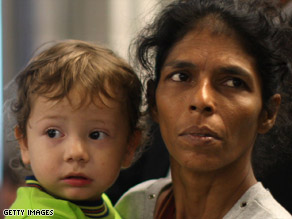
But I found my righteous outrage and sadness at this evil , and my wonder rekindled afresh upon hearing the story of Sandra Samuel, one of many stories beginning to emerge from the three day hell the terrorists created. Sandra, an Indian nanny, and two-year-old Moshe Holtzberg, her charge, were the only ones to make it out of the Chabad House alive after gunmen stormed the house, killing the Chabad House directors Rabbi Gavriel Holtzberg and his wife, Rivka, parents of Moshe, and four others.
In the midst of that tragedy I thank God for Sandra who retained enough presence of mind and courage to leave her place of relative safety in the Chabad house even as the gunmen were searching and killing room to room. She unlocked her door and dared the gunmen to stop her, ran upstairs to find the Holtzbergs shot dead, lying on the ground with their son crying over them. She picked up the boy and ran out, past the gunmen and fled with him to safety.
As parents, faced with imminent death, if there is a chance to save the children, that becomes paramount. My wife and I have a clear understanding that in any situation where our children can be saved only by sacrificing one or both of us, the children are to be saved. As a parent, I know that the Holtzbergs would have wanted their son to survive and would have been profoundly grateful for Sandra's devotion and courage, risking her life to save their son. A regular woman braved murder and terror everywhere around her, to save the life of a child not her own. Surrounded by evil killers and with a chance to flee to safety on her own, she chose to walk into the danger for Moshe. His mother was murdered and Sandra stepped into the breach to save him. I'm very humbled by the immense courage and love that act required.

The AP: The cries of little Moshe wounded hearts…”Mommy, mommy, mommy!” he wailed, clutching a toy basketball while squirming in the arms of mourners at the synagogue.
Look at his face. Consider his anguish. Still fresh in his barely comprehending mind the terrible memories of mommy and daddy killed before his eyes. I don't have adequate words for the sadness I feel at the breaking of a baby's heart in this way.
Nieither do I have adequate words for the outrage, horror and revulsion I feel towards the people who did it. There is a special place in Hell reserved for those responsible for the look on this child's face.
Mumbai is a reminder that the terrorists are willing to commit nearly any outrage to advance their goal to create a world full of chaos and the cries of a thousand Moshe's which they can dominate. They can be given no quarter.
December 1, 2008
Strategic Motivations for the Mumbai Attack
George Friedman ~ Honorary Political Season ContributorLast Wednesday evening, a group of Islamist operatives carried out a complex terror operation in the Indian city of Mumbai. The attack was not complex because of the weapons used or its size, but in the apparent training, multiple methods of approaching the city and excellent operational security and discipline in the final phases of the operation, when the last remaining attackers held out in the Taj Mahal hotel for several days. The operational goal of the attack clearly was to cause as many casualties as possible, particularly among Jews and well-to-do guests of five-star hotels. But attacks on various other targets, from railroad stations to hospitals, indicate that the more general purpose was to spread terror in a major Indian city.
While it is not clear precisely who carried out the Mumbai attack, two separate units apparently were involved. One group, possibly consisting of Indian Muslims, was established in Mumbai ahead of the attacks. The second group appears to have just arrived. It traveled via ship from Karachi, Pakistan, later hijacked a small Indian vessel to get past Indian coastal patrols, and ultimately landed near Mumbai.
Extensive preparations apparently had been made, including surveillance of the targets. So while the precise number of attackers remains unclear, the attack clearly was well-planned and well-executed.
Evidence and logic suggest that radical Pakistani Islamists carried out the attack. These groups have a highly complex and deliberately amorphous structure. Rather than being centrally controlled, ad hoc teams are created with links to one or more groups. Conceivably, they might have lacked links to any group, but this is hard to believe. Too much planning and training were involved in this attack for it to have been conceived by a bunch of guys in a garage. While precisely which radical Pakistani Islamist group or groups were involved is unknown, the Mumbai attack appears to have originated in Pakistan. It could have been linked to al Qaeda prime or its various franchises and/or to Kashmiri insurgents.
More important than the question of the exact group that carried out the attack, however, is the attackers’ strategic end. There is a tendency to regard terror attacks as ends in themselves, carried out simply for the sake of spreading terror. In the highly politicized atmosphere of Pakistan’s radical Islamist factions, however, terror frequently has a more sophisticated and strategic purpose. Whoever invested the time and took the risk in organizing this attack had a reason to do so. Let’s work backward to that reason by examining the logical outcomes following this attack.
An End to New Delhi’s Restraint
The most striking aspect of the Mumbai attack is the challenge it presents to the Indian government — a challenge almost impossible for New Delhi to ignore. A December 2001 Islamist attack on the Indian parliament triggered an intense confrontation between India and Pakistan. Since then, New Delhi has not responded in a dramatic fashion to numerous Islamist attacks against India that were traceable to Pakistan. The Mumbai attack, by contrast, aimed to force a response from New Delhi by being so grievous that any Indian government showing only a muted reaction to it would fall.
India’s restrained response to Islamist attacks (even those originating in Pakistan) in recent years has come about because New Delhi has understood that, for a host of reasons, Islamabad has been unable to control radical Pakistani Islamist groups. India did not want war with Pakistan; it felt it had more important issues to deal with. New Delhi therefore accepted Islamabad’s assurances that Pakistan would do its best to curb terror attacks, and after suitable posturing, allowed tensions originating from Islamist attacks to pass.
This time, however, the attackers struck in such a way that New Delhi couldn’t allow the incident to pass. As one might expect, public opinion in India is shifting from stunned to furious. India’s Congress party-led government is politically weak and nearing the end of its life span. It lacks the political power to ignore the attack, even if it were inclined to do so. If it ignored the attack, it would fall, and a more intensely nationalist government would take its place. It is therefore very difficult to imagine circumstances under which the Indians could respond to this attack in the same manner they have to recent Islamist attacks.
What the Indians actually will do is not clear. In 2001-2002, New Delhi responded to the attack on the Indian parliament by moving forces close to the Pakistani border and the Line of Control that separates Indian- and Pakistani-controlled Kashmir, engaging in artillery duels along the front, and bringing its nuclear forces to a high level of alert. The Pakistanis made a similar response. Whether India ever actually intended to attack Pakistan remains unclear, but either way, New Delhi created an intense crisis in Pakistan.
The U.S. and the Indo-Pakistani Crisis
The United States used this crisis for its own ends. Having just completed the first phase of its campaign in Afghanistan, Washington was intensely pressuring Pakistan’s then-Musharraf government to expand cooperation with the United States; purge its intelligence organization, the Inter-Services Intelligence (ISI), of radical Islamists; and crack down on al Qaeda and the Taliban in the Afghan-Pakistani border region. Former Pakistani President Pervez Musharraf had been reluctant to cooperate with Washington, as doing so inevitably would spark a massive domestic backlash against his government.
The crisis with India produced an opening for the United States. Eager to get India to stand down from the crisis, the Pakistanis looked to the Americans to mediate. And the price for U.S. mediation was increased cooperation from Pakistan with the United States. The Indians, not eager for war, backed down from the crisis after guarantees that Islamabad would impose stronger controls on Islamist groups in Kashmir.
In 2001-2002, the Indo-Pakistani crisis played into American hands. In 2008, the new Indo-Pakistani crisis might play differently. The United States recently has demanded increased Pakistani cooperation along the Afghan border. Meanwhile, President-elect Barack Obama has stated his intention to focus on Afghanistan and pressure the Pakistanis.
Therefore, one of Islamabad’s first responses to the new Indo-Pakistani crisis was to announce that if the Indians increased their forces along Pakistan’s eastern border, Pakistan would be forced to withdraw 100,000 troops from its western border with Afghanistan. In other words, threats from India would cause Pakistan to dramatically reduce its cooperation with the United States in the Afghan war. The Indian foreign minister is flying to the United States to meet with Obama; obviously, this matter will be discussed among others.
We expect the United States to pressure India not to create a crisis, in order to avoid this outcome. As we have said, the problem is that it is unclear whether politically the Indians can afford restraint. At the very least, New Delhi must demand that the Pakistani government take steps to make the ISI and Pakistan’s other internal security apparatus more effective. Even if the Indians concede that there was no ISI involvement in the attack, they will argue that the ISI is incapable of stopping such attacks. They will demand a purge and reform of the ISI as a sign of Pakistani commitment. Barring that, New Delhi will move troops to the Indo-Pakistani frontier to intimidate Pakistan and placate Indian public opinion.
Dilemmas for Islamabad, New Delhi and Washington
At that point, Islamabad will have a serious problem. The Pakistani government is even weaker than the Indian government. Pakistan’s civilian regime does not control the Pakistani military, and therefore does not control the ISI. The civilians can’t decide to transform Pakistani security, and the military is not inclined to make this transformation. (Pakistan’s military has had ample opportunity to do so if it wished.)
Pakistan faces the challenge, just one among many, that its civilian and even military leadership lack the ability to reach deep into the ISI and security services to transform them. In some ways, these agencies operate under their own rules. Add to this the reality that the ISI and security forces — even if they are acting more assertively, as Islamabad claims — are demonstrably incapable of controlling radical Islamists in Pakistan. If they were capable, the attack on Mumbai would have been thwarted in Pakistan. The simple reality is that in Pakistan’s case, the will to make this transformation does not seem to be present, and even if it were, the ability to suppress terror attacks isn’t there.
The United States might well want to limit New Delhi’s response. U.S. Secretary of State Condoleezza Rice is on her way to India to discuss just this. But the politics of India’s situation make it unlikely that the Indians can do anything more than listen. It is more than simply a political issue for New Delhi; the Indians have no reason to believe that the Mumbai operation was one of a kind. Further operations like the Mumbai attack might well be planned. Unless the Pakistanis shift their posture inside Pakistan, India has no way of knowing whether other such attacks can be stymied. The Indians will be sympathetic to Washington’s plight in Afghanistan and the need to keep Pakistani troops at the Afghan border. But New Delhi will need something that the Americans — and in fact the Pakistanis — can’t deliver: a guarantee that there will be no more attacks like this one.
The Indian government cannot chance inaction. It probably would fall if it did. Moreover, in the event of inactivity and another attack, Indian public opinion probably will swing to an uncontrollable extreme. If an attack takes place but India has moved toward crisis posture with Pakistan, at least no one can argue that the Indian government remained passive in the face of threats to national security. Therefore, India is likely to refuse American requests for restraint.
It is possible that New Delhi will make a radical proposal to Rice, however. Given that the Pakistani government is incapable of exercising control in its own country, and given that Pakistan now represents a threat to both U.S. and Indian national security, the Indians might suggest a joint operation with the Americans against Pakistan.
What that joint operation might entail is uncertain, but regardless, this is something that Rice would reject out of hand and that Obama would reject in January 2009. Pakistan has a huge population and nuclear weapons, and the last thing Bush or Obama wants is to practice nation-building in Pakistan. The Indians, of course, will anticipate this response. The truth is that New Delhi itself does not want to engage deep in Pakistan to strike at militant training camps and other Islamist sites. That would be a nightmare. But if Rice shows up with a request for Indian restraint and no concrete proposal — or willingness to entertain a proposal — for solving the Pakistani problem, India will be able to refuse on the grounds that the Americans are asking India to absorb a risk (more Mumbai-style attacks) without the United States’ willingness to share in the risk.
Setting the Stage for a New Indo-Pakistani Confrontation
That will set the stage for another Indo-Pakistani confrontation. India will push forces forward all along the Indo-Pakistani frontier, move its nuclear forces to an alert level, begin shelling Pakistan, and perhaps — given the seriousness of the situation — attack short distances into Pakistan and even carry out airstrikes deep in Pakistan. India will demand greater transparency for New Delhi in Pakistani intelligence operations. The Indians will not want to occupy Pakistan; they will want to occupy Pakistan’s security apparatus.
Naturally, the Pakistanis will refuse that. There is no way they can give India, their main adversary, insight into Pakistani intelligence operations. But without that access, India has no reason to trust Pakistan. This will leave the Indians in an odd position: They will be in a near-war posture, but will have made no demands of Pakistan that Islamabad can reasonably deliver and that would benefit India. In one sense, India will be gesturing. In another sense, India will be trapped by making a gesture on which Pakistan cannot deliver. The situation thus could get out of hand.
In the meantime, the Pakistanis certainly will withdraw forces from western Pakistan and deploy them in eastern Pakistan. That will mean that one leg of the Petraeus and Obama plans would collapse. Washington’s expectation of greater Pakistani cooperation along the Afghan border will disappear along with the troops. This will free the Taliban from whatever limits the Pakistani army had placed on it. The Taliban’s ability to fight would increase, while the motivation for any of the Taliban to enter talks — as Afghan President Hamid Karzai has suggested — would decline. U.S. forces, already stretched to the limit, would face an increasingly difficult situation, while pressure on al Qaeda in the tribal areas would decrease.
Now, step back and consider the situation the Mumbai attackers have created. First, the Indian government faces an internal political crisis driving it toward a confrontation it didn’t plan on. Second, the minimum Pakistani response to a renewed Indo-Pakistani crisis will be withdrawing forces from western Pakistan, thereby strengthening the Taliban and securing al Qaeda. Third, sufficient pressure on Pakistan’s civilian government could cause it to collapse, opening the door to a military-Islamist government — or it could see Pakistan collapse into chaos, giving Islamists security in various regions and an opportunity to reshape Pakistan. Finally, the United States’ situation in Afghanistan has now become enormously more complex.
By staging an attack the Indian government can’t ignore, the Mumbai attackers have set in motion an existential crisis for Pakistan. The reality of Pakistan cannot be transformed, trapped as the country is between the United States and India. Almost every evolution from this point forward benefits Islamists. Strategically, the attack on Mumbai was a precise blow struck to achieve uncertain but favorable political outcomes for the Islamists.
Rice’s trip to India now becomes the crucial next step. She wants Indian restraint. She does not want the western Pakistani border to collapse. But she cannot guarantee what India must have: assurance of no further terror attacks on India originating in Pakistan. Without that, India must do something. No Indian government could survive without some kind of action. So it is up to Rice, in one of her last acts as secretary of state, to come up with a miraculous solution to head off a final, catastrophic crisis for the Bush administration — and a defining first crisis for the new Obama administration. Former U.S. Defense Secretary Donald Rumsfeld once said that the enemy gets a vote. The Islamists cast their ballot in Mumbai.
November 28, 2008
Possible Geopolitical Consequences of the Mumbai Attacks
Stratfor.Com Red Alert
If the Nov. 26 attacks in Mumbai were carried out by Islamist militants as it appears, the Indian government will have little choice, politically speaking, but to blame them on Pakistan. That will in turn spark a crisis between the two nuclear rivals that will draw the United States into the fray.
At this point the situation on the ground in Mumbai remains unclear following the militant attacks of Nov. 26. But in order to understand the geopolitical significance of what is going on, it is necessary to begin looking beyond this event at what will follow. Though the situation is still in motion, the likely consequences of the attack are less murky.
We will begin by assuming that the attackers are Islamist militant groups operating in India, possibly with some level of outside support from Pakistan. We can also see quite clearly that this was a carefully planned, well-executed attack.
Given this, the Indian government has two choices. First, it can simply say that the perpetrators are a domestic group. In that case, it will be held accountable for a failure of enormous proportions in security and law enforcement. It will be charged with being unable to protect the public. On the other hand, it can link the attack to an outside power: Pakistan. In that case it can hold a nation-state responsible for the attack, and can use the crisis atmosphere to strengthen the government’s internal position by invoking nationalism. Politically this is a much preferable outcome for the Indian government, and so it is the most likely course of action. This is not to say that there are no outside powers involved — simply that, regardless of the ground truth, the Indian government will claim there were.
That, in turn, will plunge India and Pakistan into the worst crisis they have had since 2002. If the Pakistanis are understood to be responsible for the attack, then the Indians must hold them responsible, and that means they will have to take action in retaliation — otherwise, the Indian government’s domestic credibility will plunge. The shape of the crisis, then, will consist of demands that the Pakistanis take immediate steps to suppress Islamist radicals across the board, but particularly in Kashmir. New Delhi will demand that this action be immediate and public. This demand will come parallel to U.S. demands for the same actions, and threats by incoming U.S. President Barack Obama to force greater cooperation from Pakistan.
If that happens, Pakistan will find itself in a nutcracker. On the one side, the Indians will be threatening action — deliberately vague but menacing — along with the Americans. This will be even more intense if it turns out, as currently seems likely, that Americans and Europeans were being held hostage (or worse) in the two hotels that were attacked. If the attacks are traced to Pakistan, American demands will escalate well in advance of inauguration day.
There is a precedent for this. In 2002 there was an attack on the Indian parliament in Mumbai by Islamist militants linked to Pakistan. A near-nuclear confrontation took place between India and Pakistan, in which the United States brokered a stand-down in return for intensified Pakistani pressure on the Islamists. The crisis helped redefine the Pakistani position on Islamist radicals in Pakistan.
In the current iteration, the demands will be even more intense. The Indians and Americans will have a joint interest in forcing the Pakistani government to act decisively and immediately. The Pakistani government has warned that such pressure could destabilize Pakistan. The Indians will not be in a position to moderate their position, and the Americans will see the situation as an opportunity to extract major concessions. Thus the crisis will directly intersect U.S. and NATO operations in Afghanistan.
It is not clear the degree to which the Pakistani government can control the situation. But the Indians will have no choice but to be assertive, and the United States will move along the same line. Whether it is the current government in India that reacts, or one that succeeds doesn’t matter. Either way, India is under enormous pressure to respond. Therefore the events point to a serious crisis not simply between Pakistan and India, but within Pakistan as well, with the government caught between foreign powers and domestic realities. Given the circumstances, massive destabilization is possible — never a good thing with a nuclear power.
This is thinking far ahead of the curve, and is based on an assumption of the truth of something we don’t know for certain yet, which is that the attackers were Muslims and that the Pakistanis will not be able to demonstrate categorically that they weren’t involved. Since we suspect they were Muslims, and since we doubt the Pakistanis can be categorical and convincing enough to thwart Indian demands, we suspect that we will be deep into a crisis within the next few days, very shortly after the situation on the ground clarifies itself.
January 2, 2008
Pakistan, Bhutto and the U.S.-Jihadist Endgame
By Dr. George Friedman @ Friedman Writes Back (honorary Political Season contributor) The endgame of the U.S.-jihadist war always had to be played out in Pakistan. There are two reasons that could account for this. The first is simple: Osama bin Laden and the al Qaeda command cell are located in Pakistan. The war cannot end while the command cell functions or has a chance of regenerating. The second reason is more complicated. The United States and NATO are engaged in a war in Afghanistan. Where the Soviets lost with 300,000 troops, the Americans and NATO are fighting with less than 50,000. Any hope of defeating the Taliban, or of reaching some sort of accommodation, depends on isolating them from Pakistan. So long as the Taliban have sanctuary and logistical support from Pakistan, transferring all coalition troops in Iraq to Afghanistan would have no effect. And withdrawing from Afghanistan would return the situation to the status quo before Sept. 11. If dealing with the Taliban and destroying al Qaeda are part of any endgame, the key lies in Pakistan.
U.S. strategy in Pakistan has been to support Pakistani President Pervez Musharraf and rely on him to purge and shape his country’s army to the extent possible to gain its support in attacking al Qaeda in the North, contain Islamist radicals in the rest of the country and interdict supplies and reinforcements flowing to the Taliban from Pakistan. It was always understood that this strategy was triply flawed.
First, under the best of circumstances, a completely united and motivated Pakistani army’s ability to carry out this mission effectively was doubtful. And second, the Pakistani army was — and is — not completely united and motivated. Not only was it divided, one of its major divisions lay between Taliban supporters sympathetic to al Qaeda and a mixed bag of factions with other competing interests. Distinguishing between who was on which side in a complex and shifting constellation of relationships was just about impossible. That meant the army the United States was relying on to support the U.S. mission was, from the American viewpoint, inherently flawed.
It must be remembered that the mujahideen’s war against the Soviets in Afghanistan shaped the current Pakistani army. Allied with the Americans and Saudis, the Pakistani army — and particularly its intelligence apparatus, the Inter-Services Intelligence (ISI) — had as its mission the creation of a jihadist force in Afghanistan to fight the Soviets. The United States lost interest in Afghanistan after the fall of the Soviet Union, but the Pakistanis did not have that option. Afghanistan was right next door. An interesting thing happened at that point. Having helped forge the mujahideen and its successor, the Taliban, the Pakistani army and ISI in turn were heavily influenced by their Afghan clients’ values. Patron and client became allies. And this created a military force that was extremely unreliable from the U.S. viewpoint.
Third, Musharraf’s intentions were inherently unpredictable. As a creature of the Pakistani army, Musharraf reflects all of the ambivalences and tensions of that institution. His primary interest was in holding on to power. To do that, he needed to avoid American military action in Pakistan while simultaneously reassuring radical Islamists he was not a mere tool of the United States. Given the complexity of his position, no one could ever be certain of where Musharraf stood. His position was entirely tactical, shifting as political necessity required. He was constantly placating the various parties, but since the process of placation for the Americans meant that he take action against the jihadists, constant ineffective action by Musharraf resulted. He took enough action to keep the Americans at bay, not enough to force his Islamist enemies to take effective action against him.
Ever since Sept. 11, Musharraf has walked this tightrope, shifting his balance from one side to the other, with the primary aim of not falling off the rope. This proved unsatisfactory to the United States, as well as to Musharraf’s Islamist opponents. While he irritated everybody, the view from all factions — inside and outside Pakistan — was that, given the circumstances, Musharraf was better than the alternative. Indeed, that could have been his campaign slogan: “Vote for Musharraf: Everything Else is Worse.”
From the U.S. point of view, Musharraf and the Pakistani army might have been unreliable, but any alternative imaginable would be even worse. Even if their actions were ineffective, some actions were taken. At the very least, they were not acting openly and consistently against the United States. Were Musharraf and the Pakistani army to act consistently against U.S. interests as Russian logistical support for U.S. operations in Afghanistan waned, the U.S./NATO position in Afghanistan could simply crack.
Therefore, the U.S. policy in Pakistan was to do everything possible to make certain Musharraf didn’t fall or, more precisely, to make sure the Pakistani army didn’t fragment and its leadership didn’t move into direct and open opposition to the United States. The United States understood that the more it pressed Musharraf and the more he gave, the less likely he was to survive and the less certain became the Pakistani army’s cohesion. Thus, the U.S. strategy was to press for action, but not to the point of destabilizing Pakistan beyond its natural instability. The priority was to maintain Musharraf in power, and failing that, to maintain the Pakistani army as a cohesive, non-Islamist force.
In all of this, there was one institution that, on the whole, had to support him. That was the Pakistani army. The Pakistani army was the one functioning national institution in Pakistan. For the senior leaders, it was a vehicle to maintain their own power and position. For the lowest enlisted man, the army was a means for upward mobility, an escape from the grinding poverty of the slums and villages. The Pakistani army obviously was factionalized, but no faction had an interest in seeing the army fragment. Their own futures were at stake. And therefore, so long as Musharraf kept the army together, they would live with him. Even the less radical Islamists took that view.
A single personality cannot maintain a balancing act like this indefinitely; one of three things will happen. First, he can fall off the rope and become the prisoner of one of the factions. Second, he can lose credibility with all factions — with the basic political configuration remaining intact but with the system putting forth a new personality to preside. Third, he can build up his power, crush the factions and start calling the shots. This last is the hardest strategy, because in this case, it would be converting a role held due to the lack of alternatives into a position of power. That is a long reach.
Nevertheless, that is why Musharraf decided to declare a state of emergency. No one was satisfied with him any longer, and pressure was building for him to “take off his uniform” — in other words, to turn the army over to someone else and rule as a civilian. Musharraf understood that it was only a matter of time before his personal position collapsed and the army realized that, given the circumstances, the collapse of Musharraf could mean the fragmentation of the army. Musharraf therefore tried to get control of the situation by declaring a state of emergency and getting the military backing for it. His goal was to convert the state of emergency — and taking off his uniform — into a position from which to consolidate his power.
It worked to an extent. The army backed the state of emergency. No senior leader challenged him. There were no mutinies among the troops. There was no general uprising. He was condemned by everyone from the jihadists to the Americans, but no one took any significant action against him. The situation was precarious, but it appeared he might well emerge from the state of emergency in a politically enhanced position. Enhanced was the best he could hope for. He would not be able to get off the tightrope, but at the same time, simply calling a state of emergency and not triggering a massive response would enhance his position.
Parliamentary elections were scheduled for Jan. 8 and are now delayed until Feb. 18. Given the fragmentation of Pakistani society, the most likely outcome was a highly fragmented parliament, one that would be hard-pressed to legislate, let alone to serve as a powerbase. In the likely event of gridlock, Musharraf’s position as the indispensable — if disliked — man would be strengthened. By last week, Musharraf must have been looking forward to the elections. Elections would confirm his position, which was that the civil institutions could not function and that the army, with or without him as official head, had to remain the center of the Pakistani polity.
Then someone killed Benazir Bhutto and changed the entire dynamic of Pakistan. Though Bhutto’s Pakistan People’s Party probably would have gained a substantial number of seats, it was unlikely to sweep the election and seriously threaten the military’s hold on power. Bhutto was simply one of the many forces competing for power. As a woman, representing an essentially secular party, she was unlikely to be a decisive winner. In many ways, she reminds us of Mikhail Gorbachev, who was much more admired by Westerners than he ever was by Russians. She was highly visible and a factor in Pakistani politics, but if Musharraf were threatened, the threat would not come from her.
Therefore, her murder is a mystery. It is actually a mystery on two levels. First, it is not clear who did it. Second, it is not clear how the deed was done. The murder of a major political leader is always hard to unravel. Confusion reigns from the first bullet fired in a crowd. The first account of events always turns out to be wrong, as do the second through fifth accounts, too. That is how conspiracy theories are spawned. Getting the facts straight in any murder is tough. Getting them straight in a political assassination is even harder. Paradoxically, more people witnessing such incidents translates into greater confusion, since everyone has a different perspective and a different tale. Conspiracy theorists can have a field day picking and choosing among confused reports by shocked and untrained observers.
Nevertheless, the confusion in this case appears to be way beyond the norm. Was there a bomber and a separate shooter with a pistol next to her car? If this were indeed a professional job, why was the shooter inappropriately armed with a pistol? Was Bhutto killed by the pistol-wielding shooter, shrapnel from the bomb, a bullet from a third assassin on a nearby building or even inside her car, or by falling after the bomb detonated? How did the killer or killers know Bhutto would stand up and expose herself through her armored vehicle’s sunroof? Very few of the details so far make sense.
And that reflects the fact that nothing about the assassination makes sense. Who would want Bhutto dead? Musharraf had little motivation. He had enemies, and she was one of them, but she was far from the most dangerous of them. And killing her would threaten an election that did not threaten him or his transition to a new status. Ordering her death thus would not have made a great deal of sense for Musharraf.
Whoever ordered her death would have had one of two motives. First, they wanted to destabilize Pakistan, or second, they wanted to kill her in such a way as to weaken Musharraf’s position by showing that the state of emergency had failed. The jihadists certainly had every reason to want to kill her — along with a long list of Pakistani politicians, including Musharraf. They want to destabilize Pakistan, but if they can do so and implicate Musharraf at the same time, so much the sweeter.
The loser in the assassination was Musharraf. He is probably too canny a politician to have planned the killing without anticipating this outcome. Whoever did this wanted to do more than kill Bhutto. They wanted to derail Musharraf’s attempt to retain his control over the government. This was a complex operation designed to create confusion.
Our first suspect is al Qaeda sympathizers who would benefit from the confusion spawned by the killing of an important political leader. The more allegations of complicity in the killing are thrown against the regime, the more the military regime is destabilized — thus expanding opportunities for jihadists to sow even more instability. Our second suspects are elements in the army wanting to use the assassination to force Musharraf out, replace him with a new personality and justify a massive crackdown.
Two parties we cannot imagine as suspects in the killing are the United States and Musharraf; neither benefited from the killing. Musharraf now faces the political abyss and the United States faces the destabilization of Pakistan as the Taliban is splintering and various jihadist leaders are fragmenting. This is the last moment the United States would choose to destabilize Pakistan. Our best guess is that the killing was al Qaeda doing what it does best. The theory that it was anti-Musharraf elements in the army comes in at a very distant second.
But the United States now faces its endgame under far less than ideal conditions. Iraq is stabilizing. That might reverse, but for now it is stabilizing. The Taliban is strong, but it is under pressure and has serious internal problems. The endgame always was supposed to come in Pakistan, but this is far from how the Americans wanted to play it out. The United States is not going to get an aggressive, anti-Islamist military in Pakistan, but it badly needs more than a Pakistani military that is half-heartedly and tenuously committed to the fight. Salvaging Musharraf is getting harder with each passing day. So that means that a new personality, such as Pakistani military chief Gen. Ashfaq Kayani, must become Washington’s new man in Pakistan. In this endgame, all that the Americans want is the status quo in Pakistan. It is all they can get. And given the way U.S. luck is running, they might not even get that.
August 20, 2007
It's Not a Question of Experience

Do you need to know the name of Pakistan's leader to be a good president? - By Anne Applebaum - Slate Magazine
Candidate Obama recently said that he would not hesitate to order a strike against Osama Bin Laden on Pakistani soil if he had credible, actionable intelligence. This was shortly after one of the televised debates where he indicated he would talk to foreign dictators, a position that brought him under fire from most of the other candidates. Seeking to show that he could be a strong leader, he made these comments about Pakistan. His opponents have spun his statements about meeting foreign leaders as an issue of whether or not he has the experience to be President. Hillary uses it to highlight her "experience", which she regards as a major element that makes her the superior candidate. She however mirrored his comments about striking against Bin Laden on Pakistan soil, not to be outdone.
But this is not about experience. And what Obama's campaign trail pandering statement, the spin efforts of his rivals and the "me too" response of Sen. Clinton betrays is not a lack of experience but of analysis.
The relationship with Pakistan and its role in the fight against the Osama terror network is a complicated one. Obama says he would strike against Osama there if we had actionable intelligence. Duh. So would the Bush administration and in fact they have hit targets on Pak soil in the past. But they have done so without acknowledging such strikes, preserving plausible deniability to leave Musharaf room to maneuver. You can bet U.S. Special Forces have an ongoing presence in the tribal areas outside of government control hunting Osama and his top leadership. But we don't advertise it in order to preserve the political relationship that facilitates that hunt.
The point is that there is a balance that must be struck in the war on terror and the different fronts in that war are connected. Actions taken on one front can have serious consequences on another. What made Obama's statement noteworthy was that it was "war" talk coming from a democrat and certainly not what the left wing of his party would say, not because it was indicative of some comprehensive world view. Hillary had to follow suit to avoid being painted into a lefty corner. But in both cases, the response indicates that they have not taken their analysis of the global war on terror and American tactics for fighting it far enough. They are hardly alone in this failing within the Democratic party. There are a variety of views represented within the Democratic party. In most cases, they all betray the same lack of a complete world view or analysis based thereon, and the party itself has no dominant consensus on Iraq or its geopolitical anti-terror strategy. The top candidates exemplify this weakness.