 Today, this blog is participating in In Solidarity: Global Day for Darfur called by Modern Musings and supported by Black and Missing But Not Forgotten, BlackPerspective.net, Black Women Vote, CEO Mum, Darfur: An Unforgivable Hell on Earth, Eddie G. Griffin, Electronic Village, Musings of the Night, My African Diaspora, Regina's Family Seasons, Slant Truth, Take Political Action, The Jose Vilson, Trav’s Thoughts, UltraViolet Underground, Vanessa Unplugged, What About Our Daughters and others.
Analysis courtesy of Strategic Forecasting. Also, be sure to watch the Featured Video on Darfur.
Fidelity Investments has sold off more than 90 percent of its holdings in Chinese state-owned oil giant PetroChina, Fidelity announced in May 16, 2007. Although the company declined to explain the sale, it almost certainly is related to pressure from human rights and religious activists.
Activists argue that, as the primary oil field operator in Sudan, PetroChina is propping up the Khartoum regime responsible for the genocide in
Darfur, so putting pressure on PetroChina is viewed as a way to pressure the Sudanese government indirectly. Fidelity's move marks an important strategic turning point in the battle between human rights groups and China over the
Darfur region, and sets the stage for a far more powerful strategic thrust that will emerge during the summer -- one in which
Darfur activists move from a financial divestment campaign to one focused on the 2008 Olympic Games.
Activists have long sought effective pressure points on China, and the Olympics look to be the answer. More specifically, activists are eyeing the list of Western corporate sponsors that are investing tens of millions of dollars in the Olympics and in companion marketing campaigns designed to run before and during the Olympics.
Olympic sponsorship in 2008 means more than in most past years. For Beijing, giants such as Kodak, Coca-Cola, McDonald's and General Electric are not simply the means to put on a good show; they are integral to its efforts to radically change international perceptions of China and establish its new place in the world. Beijing can control most of the variables that come its way -- the protesters, media investigations into corruption and other potential public relations problems that usually come with hosting the Olympics. And, with the sites chosen and no backup available, it can largely ignore the International Olympic Committee. What Beijing cannot control, however, are the decisions of the games' sponsors and the pressures placed upon these companies in the West.
Through the Olympic sponsors, activists have determined that the year leading up to the Olympics offers a unique opportunity to use market mechanisms to change Beijing's policies. The first Western movement to begin to capitalize on this vulnerability is the Save
Darfur Coalition, which turned Sudan into a pariah state with which no Western company will do business only to have its efforts undermined by Chinese state-owned enterprises. Many other issues could have taken this mantle, but it appears that
Darfur-focused activists have taken the lead on exploiting Olympics-related vulnerabilities -- and will manage the most effective Western campaign to change China's policies.
The coming year will determine whether activists can actually make Beijing blink. Moreover, it will determine how groups active on issues other than
Darfur deal with the likelihood that the more focused
Darfur coalition will overshadow their use of this golden opportunity.
Olympic SponsorshipThe decision to become an Olympic sponsor is a strategic one for companies. The price of sponsorship is steep -- estimated at roughly $55 million -- but that pales in comparison to the broader investment these companies make. The largest and most familiar sponsors have attached their most valuable asset, their brands, to the games, and have built long-term marketing plans in which the Olympics play an integral part.
With so much invested, Olympic sponsorship has always brought tension. The 2004 Athens games, which were twice threatened with a move to an alternate city due to poor organization, created stress among investors. Sponsors now have established offices in future Olympic cities, where they work as closely as possible with municipal authorities to ensure that the logistics and setup are on track.
In the years since 2001, when the 2008 games were awarded to Beijing, the games have carried an added political dimension for sponsors. Beijing recruited sponsors not just as sources of money, but as partners, and for large multinational corporations trying to learn how to operate in China the opportunity to work with Beijing was tempting. Those who signed on as sponsors see the success of these games not only as an opportunity to build their market share in the West, but also as a way to increase their presence in China. Beijing also subtly offered improved market access and other preferential treatment to companies that threw in behind the 2008 games.
Beijing, in order to assert itself on the international stage, has spent billions of dollars preparing for the games. It brought in the best stadium architects to build venues and hired Stephen Spielberg to choreograph the opening and closing ceremonies. In addition, the Chinese have razed entire neighborhoods to ease transportation and shuttered industries to clean Beijing's air. If it can be bought, Beijing is buying.
The support and presence of high-profile Western companies provided one thing that Beijing could not buy: legitimacy. The thinking is that the participation of major corporate icons will give a degree of continuity with previous Olympics, and that by extension China will be seen as a modern country rather than a developing one or, more negatively, as the killer of Tiananmen Square, the violator of human rights and the repressor of basic freedoms.
Activists who succeed in portraying corporate sponsors of Beijing's Olympics as supporters of China's behavior would undermine not only the companies' marketing efforts, but also Beijing's plan to use the games as a coming-out party
DarfurThe human rights controversy surrounding the civil war in
Darfur has been growing since 1998. Khartoum's operations in
Darfur mostly target Christians, and the issue surfaced from the concerns of evangelical Christian organizations active in Africa. By 1999,
Darfur had emerged as a mainstream human rights concern, and organizations such as Amnesty International and Human Rights Watch joined religious groups in calling for the United States and other Western governments to impose sanctions on the regime in Sudan.
Sudan essentially was a pariah state by the late 1990s, so it was obvious even at the beginning of the movement that diplomatic pressure on Sudan would be of limited value. Instead, recognizing the country's dependence on its southern oil production -- and on the companies that turn the resource into revenues for the regime -- activists focused on the corporations. With the flight of most Western companies in the first half of this decade, Khartoum, rather than lose its oil revenue, turned to China. Thus, through PetroChina the Asian giant has managed Sudan's oil operations and kept the money flowing into Khartoum.
Beyond the funding aspect, however, PetroChina's entry into Sudan has stood as a major symbol for Western human rights activists, who have come to view state-owned oil and resources companies as the most significant barrier to their ability to use market campaign pressure to change policies in developing countries.
In response to the globalization of corporations' operations and the rise of the World Trade Organization, human rights groups have come to rely increasingly on
codes of conduct and other marketplace initiatives, such as the Extractive Industry Transparency Initiative, to hold corporations accountable for their activities in developing countries. Western companies in particular are sensitive to allegations that they are complicit in human rights violations. State-owned enterprises abroad, on the other hand, are insulated from these pressures, and have begun to thrive in those places that Western companies dare not operate.
In human rights discussions, this is termed the "parastatal problem." It is the chief unsolvable barrier to successful efforts by nongovernmental organizations (NGOs) to use corporations as instruments of change in developing countries.
'Genocide Olympics'Bumping up against the parastatal problem, the Save
Darfur Coalition has begun to build toward using Olympic sponsors as leverage against Beijing. In a Wall Street Journal op-ed article published in late March, actor and activist Mia Farrow and her husband called for a boycott of the Beijing Olympics. The threat will fall on deaf ears, as the vogue of boycotting Olympics -- started by U.S. President Jimmy Carter in 1980 and re-tried in 1984 by the Soviets -- had no diplomatic effect and only made the boycotters' citizens angry.
The Farrow op-ed, however, contained a more serious threat: As long as China's state-owned enterprises remain in Sudan, the coalition aims to attack Olympic sponsors directly and rebrand the 2008 games as the "Genocide Olympics" (a term first used by Amnesty International to describe China's internal human rights record and the human rights implications of its foreign policy). More sensationally, the coalition threatened to name Stephen Spielberg the "Leni Riefenstahl of the Beijing games," a reference to the German filmmaker whose documentary of the 1936 Berlin games glorified the Nazi regime in the broader context of the Olympics. Spielberg now publicly calls for China to change its policy toward Sudan.
The threat to boycott is idle talk, but the threat to change the perception of the games is not. The Save
Darfur Coalition includes many of the most talented corporate campaign groups in the world, and the realistic opportunity to change the situation in
Darfur is attractive to Western activists of almost all stripes. In addition, the public has a high level of awareness of
Darfur as a controversial issue, and most U.S. consumers recognize that China has a controversial human rights record. Sponsors are likely to be sensitive to allegations that they are supporting a "Genocide Olympics" and will take their complaints to Beijing. Given these factors, then, the campaign has an excellent chance of attaining at least some degree of success.
That said, defining "success" is a difficult task. China cannot simply stop the genocide in
Darfur with a wave, and it must make a move that simultaneously satisfies its critics, has a chance of changing what is happening on the ground in
Darfur and results in China's continued presence in Sudan. (Sudan supplies more than 5 percent of China's oil.) One problem is that China remains one of the last countries with any leverage against Sudan, so it is valuable to activists and governments alike as a point of communication with Khartoum. If pushed too hard, Khartoum could simply open to another state-owned company immune to Western public condemnation, kicking China out. Ultimately, China has few options. It could agree to try to convince Sudan to allow more U.N. and Africa Union peacekeepers into
Darfur, but that would end the campaign only if the Save
Darfur Coalition agreed that such a deal was sufficient.
In focusing the "Genocide Olympics" campaign squarely on
Darfur, however, human rights groups are using a one-time opportunity to achieve a relatively modest goal -- and are passing up a unique moment to effect major change in China.
Falun Gong is another group that appears to recognize the unique opportunity the Olympics offer. This summer, Falun Gong is planning a wave of protests and actions that will bring world attention directly to China's human rights record. Other organizations -- labor, environmental, religious -- also could try to swoop in and use the Olympic moment.
China might be able to manage activist campaigns effectively and relatively peacefully. However, should pressure on internal fronts -- from Falun Gong or other human rights, democracy or free-expression activists -- get too high for Beijing to handle temperately, it could consider using
Darfur as a public relations safety valve. Giving in and basically agreeing to work with NGOs on
Darfur would satisfy critics by addressing what is for Beijing a third-tier issue.
Here are some things you can do, courtesy of
Modern Musings and
Dream for Darfur.
All actions sponsored by Dream for Darfur
1. Write to the ambassadors of the US, the UK, Russia and France to the UN. Urge them to help China insist that Khartoum stop its obstruction.
2. Email or call the Olympic Corporate Sponsors.
Send a letter to companies sponsoring the 2008 Olympics, hosted by China. (Dream for Darfur’s email system will let you do this with the touch of a button.)
3. Pledge to turn off the commercials of Olympic Sponsors during the Games. Olympic corporate sponsors have been silent about China’s financing of the Darfur genocide, even as the sponsors are spending billions to enhance China’s image as Olympic host. If sponsors continue to ignore China’s complicity in the Darfur genocide, we will ignore their million-dollar ad campaigns.
4. Write to the UN Special Adviser on Sport for Development and Peace.
Mr. Adolf Ogi represents the UN Secretary-General in contacts with international sports bodies. Tell him you are concerned that the world will gather for the Olympics while the people of Darfur are being slaughtered.
5. Petition the International Olympic Committee.
Urge the IOC to work with the international community to ensure that China uses its leverage with the government of Sudan to help stop the genocide in Darfur, and avoids tarnishing the 2008 Games in Beijing.
Organizations dedicated to ending the genocide in Darfur
 Lolo Jones, interviewed after her disappointing finish out of the medals in the 100m hurdles, said she could almost feel the gold medal around her neck. That feeling was the closest she would ever come to the Olympic glory she sought in Beijing. Jones was in the lead and pulling away when she hooked her right foot on the ninth hurdle and broke stride, falling from first place to seventh place, from gold medalist to also ran, in a split second. She fell to her knees at the finish line in obvious and understandable misery at this turn of events. She gave a very gracious and even cheerful interview to the NBC sportscaster upon leaving the track, smiling gamely and explaining the facts of life as a hurdler. "It was like racing a car at max velocity. When you hit a curve, you either maintain control or you crash and burn," Jones said. "Today, I crashed and burned. I'm shocked and sad. But I'm happy for the girls." She was the portrait of sportsmanship and dignity during her interview, smiling and hugging the winners as they passed by. Later, the NBC cameras would find her, alone under the bleachers, leaning against the wall, head thrown back, eyes closed tight in frustration and grief, tears streaming down her face. But for the world, she was gracious.
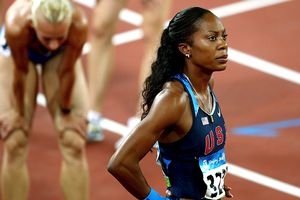 turn. With only 80 meters left, Richards hamstring tightened on her and she dropped out of gear, quickly passed by two other runners and dropped from first to third, again in a mere matter of seconds. Crossing the finish line, she dropped to her knees with the realization that the gold medal was lost. "I don't want to tell you what I'm thinking right now, because it's not positive. I feel so betrayed by my body once again and it's just such a tough break for me. "I have a really strong faith and I know that everything happens for a reason. I just don't know what this one is for. I don't know what lesson I have left to learn."


