Showing posts with label diplomacy. Show all posts

September 21, 2009

The BMD Decision and the Global System

By George Friedman ~ Honorary Political Season Contributor

The United States announced late Sept. 17 that it would abandon a plan for placing ballistic missile defense (BMD) installations in Poland and the Czech Republic. Instead of the planned system, which was intended to defend primarily against a potential crude intercontinental ballistic missile (ICBM) threat from Iran against the United States, the administration chose a restructured system that will begin by providing some protection to Europe using U.S. Navy ships based on either the North or Mediterranean seas. The Obama administration has argued that this system will be online sooner than the previously planned system and that follow-on systems will protect the United States. It was also revealed that the latest National Intelligence Estimate finds that Iran is further away from having a true intercontinental missile capability than previously thought, meaning protecting Europe is a more pressing concern than protecting the United States.

Poland and the Czech Republic responded with a sense of U.S. betrayal, while Russia expressed its satisfaction with the decision. Russian envoy to NATO Dmitri Rogozin said Moscow welcomes the decision and sees it as an appropriate response to Russia’s offer to allow U.S. supplies to flow into Afghanistan through Russia. Later, the Russians added another reward: They tentatively announced the cancellation of plans to deploy short-range ballistic missiles in Kaliningrad, which they previously had planned as a response to the components of the U.S. BMD system planned for Poland and the Czech Republic.

Polish Despair and Russian Delight

Polish despair (and Warsaw seemed far more upset than Prague) and Russian satisfaction must be explained to begin to understand the global implications. To do this, we must begin with an odd fact: The planned BMD system did not in and of itself enhance Polish national security in any way even if missiles had actually targeted Warsaw, since the long-range interceptors in Poland were positioned there to protect the continental United States; missiles falling on Poland would likely be outside the engagement envelope of the original Ground-based Midcourse Defense interceptors. The system was designed to handle very few missiles originating from the Middle East, and the Russians obviously have more than a few missiles.

Given that even small numbers of missiles easily could overwhelm the system, the BMD system in no way directly affected Russian national security: The Russian strike capability — against both Poland and the continental United States — was not affected at all. Indeed, placing the system on ships is no less threatening than placing them on land. So, if it was the BMD system the Russians were upset with, they should be no less upset by the redeployment at sea. Yet Moscow is pleased by what has happened — which means the BMD system was not really the issue.


For Poland, the BMD system was of little importance. What was important was that in placing the system in Poland, the United States obviously was prepared to defend the system from all threats. Since the system could not be protected without also protecting Poland, the BMD installation — and the troops and defensive systems that would accompany it — was seen as a U.S. guarantee on Polish national security even though the system itself was irrelevant to Polish security.

The Russians took the same view. They cared little about the BMD system itself; what they objected to was the presence of a U.S. strategic capability in Poland because this represented an American assertion that Poland was actively under the defense of the United States. Of particular note from the Russian point of view was that such a guarantee would be independent of NATO. The NATO alliance has seen better days, and the Russians (and Poles) perceive an implicit American security guarantee as more threatening than an explicit one from NATO.

This whole chain of events was an exercise in the workings of the Post-Post-Cold War World, in which Russia is a strong regional power seeking to protect its influence in the former Soviet Union (FSU) and to guarantee its frontiers as well — something that in the West has often been misinterpreted as a neurotic need for respect. Poland is the traditional route through which Russia is invaded, and the Russian view is that governments and intentions change but capabilities do not. Whatever Washington intends now, it is asserting dominance in a region that has been the route for three invasions over the last two centuries. By the Russian logic, if the United States has no interest in participating in such an invasion, it should not be interested in Poland. If the United States chooses Poland of all places to deploy its BMD when so many other locations were willing and possible, the Russians are not prepared to regard this choice as merely coincidence.

Overall, the Russians desire a new map of the region, one with two layers. First, Russia must be recognized as the dominant power in the former Soviet Union. The United States and Europe must shape bilateral relations with other former Soviet states within the framework of this understanding. Second, Central Europe — and particularly Poland — must not become a base for U.S. power. The United States and Europe must accept that Russia has no aggressive intent, but more to the point, Poland in particular must become a neutral buffer zone between Russia and Germany. It can sign whatever treaties it wants, attend whatever meetings it wishes and so forth, but major military formations of other great powers must remain out of Poland. Russia sees the BMD system as the first step in militarizing Poland, and the Russians have acted accordingly.

From the standpoint of the Bush administration and the Obama administration early on, the Russian claims to great power status, rights in the former Soviet Union and interests in Poland represented a massive overreach. The perception of both administrations derived from an image developed in the 1990s of Russia as crippled. The idea of Russia as a robust regional power, albeit with significant economic problems, simply didn’t register. There were two generations at work. The older Cold War generation did not trust Russian intentions and wanted to create a cordon around Russia — including countries like Georgia, Ukraine and, most important, Poland — because Russia could become a global threat again. The newer post-Cold War generation — which cut its teeth in the 1990s — wanted to ignore Russia and do what it wished both in Central Europe and the former Soviet Union because Russia was no longer a significant power, and the generation saw the need to develop a new system of relationships. In the end, all this congealed in the deployments in Poland and the Czech Republic.

For Russia, Poland mattered in ways the United States could not grasp given its analytic framework. But the United States had its own strategic obsession: Iran.

Iran: The U.S. Strategic Obsession

The Islamic world has been the focus of the United States since 9/11. In this context, the development of an Iranian nuclear capability was seen as a fundamental threat to U.S. national interests. The obvious response was a military strike to destroy Iranian power, but both the Bush and Obama administrations hesitated to take the step.

First, a strike on Iran’s nuclear facilities would be no one-day affair. Intelligence on precise locations had uncertainty built into it, and any strike would consist of multiple phases: destroying Iran’s air force and navy, destroying Iran’s anti-aircraft capability to guarantee total command of the skies, the attacks on the nuclear facilities themselves, analysis of the damage, perhaps a second wave, and of course additional attacks to deal with any attempted Iranian retaliation. The target set would be considerable, and would extend well beyond the targets directly related to the nuclear program, making such an operation no simple matter.

Second, Iran has the ability to respond in a number of ways. One is unleashing terrorist attacks worldwide via Hezbollah. But the most significant response would be blocking the Strait of Hormuz using either anti-ship missiles or naval mines. The latter are more threatening largely because the clearing operation could take a considerable period and it would be difficult to know when you had cleared all of the mines. Tankers and their loads are worth about $170 million at current prices, and that uncertainty could cause owners to refuse the trip. Oil exports could fall dramatically, and the effect on the global economy — particularly now amid the global financial crisis — could be absolutely devastating. Attacking Iran would be an air-sea battle, and could even include limited ground forces inserted to ensure that the nuclear facilities were destroyed.

The country most concerned with all of this is Israel. The Iranians had given every indication that they plan to build a nuclear capability and use it against Israel. Israel’s vulnerability to such a strike is enormous, and there are serious questions about Israel’s ability to use the threat of a counterstrike as a deterrent to such a strike. In our view, Iran is merely creating a system to guarantee regime survival, but given the tenor of Tehran’s statements, Israel cannot afford to take this view complacently.

Israel could unilaterally draw the United States into an airstrike on Iran. Were Israel to strike Iran by any means, it most likely would lack the ability to conduct an extended air campaign. And the United States could not suffer the consequences of airstrikes without the benefits of taking out Iran’s nuclear program. Apart from the political consequences, the U.S. Navy would be drawn into the suppression of Iranian naval capabilities in the Persian Gulf whether it wanted to or not simply to keep the Strait of Hormuz open. Even if Iran didn’t act to close off the strait, Washington would have to assume that it might, an eventuality it could not afford. So an Israeli attack would likely draw in the United States against Iran one way or another. The United States has had no appetite for such an eventuality, particularly since it considers a deliverable Iranian nuclear weapon a ways off. The U.S. alternative — in both administrations — was diplomatic.
Israel and Complications to the Diplomatic Alternative

Washington wanted to create a coalition of powers able to impose sanctions on Iran. At meetings over the summer, the Obama administration appears to have promised Israel “crippling” sanctions to prevent any unilateral Israel action. At an April G-8 meeting, it was decided that Iran must engage in serious negotiations on its nuclear program prior to the next G-8 meeting — on Sept. 24 — or face these sanctions.

The crippling sanctions foreseen were some sort of interruption of the flow of gasoline into Iran, which imports 40 percent of its supply despite being a net exporter of crude. Obviously, in order for this to work, all of the G-8 nations (and others) must participate, particularly Russia. Russia has the capacity to produce and transport all of Iran’s needs, not just its import requirements. If the Russians don’t participate, there are no sanctions.

The Russians announced weeks ago that they opposed new sanctions on Iran and would not participate in them. Moreover, they seemed to flout the ineffectiveness of any U.S. sanctions. With that, the diplomatic option on Iran was off the table. Russia is not eager to see Iran develop nuclear weapons, but it sees the United States as the greater threat at the moment. Moscow’s fundamental fear is that the United States — and Israel — will dramatically strengthen Ukraine, Georgia and other states in the FSU and on its periphery, and that Russia’s strategic goal of national security through pre-eminence in the region will be lost.

From the Russian point of view, the U.S. desire for Russian help with Iran is incompatible with the U.S. desire to pursue its own course in the FSU and countries like Poland. From the U.S. point of view, these were two entirely different matters that should be handled in a different venue. But Washington didn’t get to choose in this matter. This was a Russian decision. The Russians faced what they saw as an existential threat, believing that the U.S. strategy threatened the long-term survival of the Russian Federation. The Russians were not prepared to support a U.S. solution for Iran without American support on Russian concerns. The Americans ultimately did not understand that the Russians had shifted out of the era in which the United States could simply dictate to them. Now, the United States had to negotiate with the Russians on terms Moscow set, or the United States would have to become more directly threatening to Russia. Becoming more threatening was not an option with U.S. forces scattered all over the Middle East. Therefore, the United States had to decide what it wanted.

American attention in the run-up to the Oct. 1 talks with Iran was focused by Israel. The Obama administration had adopted an interesting two-tier position on Israel. On the one hand, it was confronting Israel on halting settlement activity in the West Bank; on the other hand, it was making promises to Israel on Iran. The sense in Israel was that the Obama administration was altering Washington’s traditional support for Israel. Since Iran was a critical threat to Israel, and since Israel might not have a better chance to strike than now, the Obama administration began to realize that its diplomatic option had failed, and that the decision on war and peace with Iran was not in its hands but in Israel’s, since Israel was prepared to act unilaterally and draw the United States into a war. Given that the Obama diplomatic initiative had failed and that the administration’s pressure on Israel had created a sense of isolation in Israel, the situation could now well spiral out of control.

Although all of these things operated in different bureaucratic silos in Washington, and participants in each silo could suffer under the illusion that the issues were unrelated, the matters converged hurriedly last week. Uncertain what leverage it had over Israel, the United States decided to reach out to the Russians. Washington sought a way to indicate to the Russians that it was prepared to deal with Russia in a different way while simultaneously giving away as little as possible. That little was the redeployment of BMD components originally planned for Poland and the Czech Republic to ships. (Money already has been allocated to upgrade additional Atlantic-based Aegis warships to BMD capability.) Whatever the military and engineering issues involved, whatever the desire not to conflate U.S. strategic relations with Israel with pressure on the settlement issue, whatever the desire to “reset” relations without actually giving the Russians anything, the silos collapsed and a gesture was made.

From the Russian point of view, the gesture is welcome but insufficient. They are not going to solve a major strategic problem for the United States simply in return for moving the BMD. For that, the United States got access to Afghanistan through Russia if desired, and the removal of missiles in Kaliningrad. The Americans also got a different atmosphere at meetings between U.S. President Barack Obama and Russian President Dmitri Medvedev at the United Nations next week. But the sine qua non for Russian help on Iran is Russia’s sphere of influence in the FSU. The public relations aspect of how this sphere is announced is not critical. That the U.S. agrees to it is.

This is the foreign policy test all U.S. presidents face. Obama now has three choices.

1. He can make the deal with Russia. But every day that passes, Russia is creating the reality of domination in the FSU, so its price for a deal will continue to rise from simply recognizing their sphere of influence to extending it to neutralizing Poland.

2. He can select the military option of an air campaign against Iran. But this means accepting the risk to maritime traffic in the Persian Gulf and the potentially devastating impact on the global economy if oil exports through the Strait of Hormuz are impacted significantly.

3. He can wait to see how things unfold, and place overwhelming pressure on Israel not to attack. But this means finding a way to place the pressure: Israel in 2009 does not have the dependence on the United States it had in 1973.
The Importance of Poland

Ultimately, the question of Iran is secondary. The question of U.S.-Russian relations is now paramount. And ultimately, policymakers don’t really have as much freedom to make choices as they would like. Under any of these scenarios, the United States doesn’t have the power to stop Russian dominance in the FSU, but it does have the ability to block further Russian expansion on the North European Plain. Preventing an amalgamation between Russia and Europe is a fundamental interest to the United States; neutralizing Poland and depending on Germany as the Russian-European frontier is not inviting — especially as Germany has no interest in reprising the role it played from 1945 to 1991.

The United States has an Iran crisis, but it is not its fundamental geopolitical problem. Interestingly, the Iran crisis is highlighting the real issue, which is Russia. It is Russia that is blocking a solution to Iran because Russian and American interests have profoundly diverged. What is emerging from Iran is the issue of Russia. And obviously, when Russia becomes an issue, so does Poland. If the United States acts to limit Russia, it will act in Poland, and not with BMD systems.

The Obama administration’s decision to withdraw BMD is insufficient to entice Russia into assisting with Iran. An agreement to respect Russian rights in the FSU would be sufficient (and in a way would merely recognize what is already in place). Obama might quietly give that assurance. But if he does, the United States will not add Poland to the pile of concessions. The greater the concessions in the FSU, the more important Poland becomes. The idea of conceding both Russian hegemony in the FSU and the neutralization of Poland in exchange for Russian pressure on Iran is utterly disproportionate.

The United States has already completed delivery of 48 late-model F-16C/Ds with advanced offensive capabilities to Poland. That matters far more to Polish national security than BMD. In the U.S. tradition with allies — particularly allies with strong lobbies in the United States, where the Polish lobby is immense — disappointment on one weapon system usually results in generosity with other, more important systems (something the Poles must learn).

As the United States has a strong military option in Iran, redrawing the map of Europe to avoid using that option — regardless of Polish fears at the moment — is unlikely. Moreover, Washington also could decide to live with an Iranian nuclear capability without redrawing the map of Europe. Ultimately, the United States has made a gesture with little content and great symbolic meaning. It is hoping that the Russians are overwhelmed by the symbolism. They won’t be.

For their part, the Russians are hoping the Americans panic over Iran. The fact is that while Russia is a great regional power, it is not that great, and its region is not that critical. The Russians may be betting that Obama will fold. They made the same bet on John F. Kennedy. Obama reads the same reports that we do about how the Russians believe him to be weak and indecisive. And that is a formula for decisive — if imprudent — action.
Political Season Response: This is turning into a real game of geopolitical chicken and the question of the day is...will Obama blink?

June 11, 2009

An Ahmadinejad Loss to a Reformer Will Be Vindication of Obama's Change of Tone

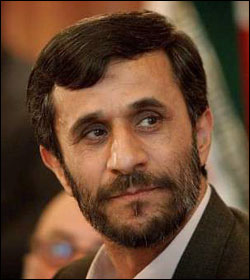
There are four candidates for the 10th presidential elections to be held in Iran on 12 June 2009. (from left to right)Former Revolutionary Guard Commander and Secretary of Expediency Council Mohsen Rezaei, Incumbent President Mahmoud Ahmadinejad, two-times Parliament (Majlis) Speaker and cleric Mehdi Karroubi and war-time Prime Minister Mir-Hossein Mousavi.

The frontrunner candidate appears to be Mousavi, who was prime minister during the Iran-Iraq war. Ahmadinejad is under fierce criticism from his opponents for his handling of foreign policy and the economy. Should he lose tomorrow, the change in diplomatic tone of the Obama administration will be due some of the credit. Obama's repeated statement that he is willing to talk to regimes we disagree with, and his recent speech to the Muslim world, have undercut the rhetorical value of provocative talk from leaders like Ahmadinejad.

The Iranian public is on the receiving end of Obama's charm offensive and I suspect they are perceiving that perhaps there is a better way than
Ahmadinejad's confrontational approach. This despite the fact that for the most part, Obama's foreign policy is largely Bush's foreign policy. What's different is how its being communicated and lets face it, the simple fact that Obama isn't Bush.

A change in direction relative to the US by Iran, a country with a serious role to play in the smooth withdrawal of US forces from Iraq and the Af-Pak theatre of operations, would be a major step forward. Should Ahmadinejad be replaced by a reformer candidate tomorrow, the Obama administration's change of diplomatic tone will have scored its first tangible win.

March 10, 2009

Obama's Diplomatic Offensive and the Reality of Geopolitics

via Stratfor.com

The Obama administration is only one and a half months into the job, but between pressing “reset buttons” with the Russians, reaching out to the Europeans, talking about reconciling with the Taliban, extending invitations to the Iranians and rubbing elbows with the Syrians, this is already one of the most diplomatically active U.S. administrations in quite some time.

During the campaign, now-President Barack Obama made the controversial statement that he was prepared to speak to adversaries, including countries like Iran. This position was part of a general critique by Obama of the Bush administration, which Obama said enclosed itself diplomatically, refusing to engage either adversaries or allies critical of the United States. Now, Obama is sending emissaries across the globe to restart dialogue everywhere from Europe to the Middle East to South Asia to Russia. For Obama, these conversations are the prelude to significant movement in the international arena.

From a geopolitical perspective, that people are talking is far less important than what they are saying, which in turn matters far less than what each side is demanding and willing to concede. Engagement can be a prelude to accommodation, or an alternative to serious bargaining. At the moment, it is far too early to tell which the present U.S. diplomatic flurry will turn out to be. And of course, some of the diplomatic initiatives might succeed while others fail.

Nevertheless, as the global diplomatic offensive takes place, we must consider whether Obama is prepared to make substantive shifts in U.S. policy or whether he will expect concessions in exchange for a different diplomatic atmosphere alone. Since Obama and his foreign policy team are too sophisticated to expect the latter, we must examine the details of the various conversations. In this case more than others, the devil is very much in the details.

Russia

The Obama administration has made clear to Russia its desire to reset its relations with Russia, with Clinton even presenting a red “reset button” as a gift to her counterpart, Sergei Lavrov, on March 6 at a NATO summit in Geneva. But the Russians want to clarify how far the Americans really intend to rewind the tape. The 2004 Orange Revolution and NATO’s reach to the Baltics crystallized Moscow’s fears that the United States intends to encircle and destabilize Russia in its former Soviet periphery through NATO expansion and support for the color revolutions. Since then, Russia has been resurgent. Moscow has worked aggressively to reclaim and consolidate its influence in the Russian near abroad for its long-term security while the United States remains preoccupied in its war with the jihadists.

The Russians are pushing for a grand deal that guarantees a rollback of NATO expansion to Georgia and Ukraine, scraps plans for U.S. ballistic missile defense (BMD), maintains some semblance of Russian nuclear parity in post-Cold War treaties, and ensures Western noninterference in a region that runs from the Baltics down through Eastern Europe and across the Caucasus and Central Asia — what Russia views as its rightful sphere of influence. Only then can Russia feel secure from the West, and confident it will remain a major player in Eurasia in the long run. In return, the Russians theoretically could make life easier for the Americans by cooperating with Washington against Iran and increasing support for U.S. operations in Afghanistan through the expansion of an alternate supply route — two key issues that address the most pressing threats to U.S. national security interests in the near term, but which may not be entirely worth the strategic concessions Moscow is demanding of Washington.

So far, the Obama administration has responded to Russia’s demands by restarting talks on the START I nuclear armaments treaty in exchange for Moscow allowing U.S. nonmilitary goods bound for Afghanistan to transit Russia and Central Asia. The Russians responded by permitting some supplies bound for Afghanistan to pass through the former Soviet Union as an opening toward broader talks. The United States then privately offered to roll back its plans for BMD in Central Europe i f Russia would pressure Iran into making concessions on Tehran’s nuclear program. But the Russians have signaled already that such piecemeal diplomacy will not cut it, and that the United States will need to make broader concessions that more adequately address Moscow’s core national security interests before the Russians can be expected to sacrifice a relationship with a strategic Middle East ally.

At the Geneva NATO summit, Clinton upped the offer to the Russians when she signaled that the United States might even be willing to throw in a halt to NATO expansion, thereby putting at risk a number of U.S. allies in the former Soviet Union that rely on the United States to protect them from a resurgent Russia. This gesture will set the stage for Obama’s upcoming trip to Russia to meet with Russian President Dmitri Medvedev, but the Russians will be watching closely to see if such gestures are being made for the sake of public diplomacy or if the United States really intends to get down to business.

Europe

In Europe, Obama is dealing with allies rather than adversaries, but even here his administration’s work does not get any easier. The willingness of Obama to talk with the Europeans far more than his predecessor is less important than what Obama intends to demand of NATO, and what those NATO members are capable of delivering.

A prime example is how Washington is requesting the Europeans to commit more NATO forces to the war in Afghanistan now that the United States feels ready to shift gears from Iraq. Despite their enthusiasm for Obama, the Europeans are not on the same page as the Americans on NATO, especially when it comes to Afghanistan. The U.S. argument for strengthening NATO’s commitment to Afghanistan is that failure to do so would recreate the conditions necessary for al Qaeda to rebuild its ability to carry out transcontinental attacks against the West, putting both European and American cities at risk. But the Europeans (for the most part) view a long-term war effort in Afghanistan without a clear strategy or realistic objectives as a futile drain on resources. After all, the British — who currently have the largest European contingent in Afghanistan — remember well their own ugly and drawn-out efforts to pacify the region in three brutal wars in the 19th and early 20th centuries, each won by Afghan tribesmen.

This disagreement goes beyond the question of Afghanistan to a long-standing debate over NATO’s intended security mission. NATO was formed during the Cold War as a U.S.-dominated security alliance designed to protect the European continent from internal and external Soviet aggression. Since the end of the Cold War, however, NATO’s scope has widened, with only limited agreement among members over whether the alliance should even be dealing with the broader 21st century challenges of counterterrorism, cyberattacks, climate change and energy security. More important, NATO has pushed up against Russia’s borders with its expansion to the Baltics and talk of integrating Georgia and Ukraine, worrying some states that they may need to bear the burden of Washington’s hardball tactics against the Russians. Germany, which is dependent on Russians for energy, has no interest in restarting another Cold War. The French have more room to maneuver than the Germans in dealing with a powerful player like Russia. But the French can only work effectively with the Russians as long as Paris avoids getting (permanently) on Moscow’s bad side, something U.S.-dominated policy of trying to resurrect NATO as a major military force could bring about.

Before taking any further steps in Afghanistan, the Europeans, including those Central and Eastern Europeans who mostly take a hard-line stance against Moscow, first want to know how Obama intends to deal with the Russians. Even with the Poles going one way in trying to boost NATO security and the Germans going the other in trying to bargain with Russia, none of the European states can really move until U.S. policy toward Russia comes into focus. The last thing the Poles would want to do is to take an unflinching stance against Moscow only to have the United States cancel BMD plans, for example. Conversely, the United States is unable to formul ate a firm policy on Afghanistan or Russia until it knows where the Europeans will end up standing on NATO, their commitment to Afghanistan and their relationship with Russia. Add to this classic chicken-and-egg dilemma a financial crisis that has left Europe much worse off than the United States, and the gap between U.S. and European interests starts to look as wide as the Atlantic itself.

Iran

Talking to Iran was a major theme of Obama’s campaign, and the first big step in following through with this pledge was made March 5 when Clinton extended an invitation to Iran to participate in a multilateral conference on Afghanistan, thereby recognizing Iran’s influential role in the region. There is also an expectation that after Iran gets through elections in June, the United States could move beyond the multilateral setting to engage the Iranians bilaterally.

The idea of the United States talking to Iran is not a new concept. In fact, the United States and Iran were talking a great deal behind the scenes in 2001 in the lead-up to the war in Afghanistan that toppled the Taliban and in 2003 during the precursor to the war in Iraq that toppled Saddam Hussein. In both of these cases, core mutual interests brought the two rivals to the negotiating table. Iran, facing hostile Sunni powers to its west and east, had a golden opportunity to address its historical security dilemma in one fell swoop and then use the emerging political structures in Iraq and Afghanistan to spread Persian power in the wider region. The United States, knocked off balance by 9/11, needed Iranian cooperation to facilitate the Iraq and Afghanistan invasions to uproot al Qaeda and intimidate al Qaeda state-sponsors into working with Washington.

U.S.-Iranian relations have been rocky (to say the least), but have reached a point where it is now politically acceptable for both openly to discuss U.S.-Iranian cooperation on issues related to Iraq and Afghanistan, where the Iranians hold influence and where the United States is still engaged militarily.

Iran knows that even with the United States drawing down from Iraq, Washington will still maintain a strategic agreement with Baghdad that could be used as a launchpad for U.S. designs in the region as it works to protect Sunni Arabs from Iranian expansionist goals. At the same time, Washington has come to realize that its influence in Baghdad will have to be shared with the Iranians given their geographic proximity and clout among large segments of the Iraqi Shia.

Though U.S. and Iranian interests overlap enough to the point that the two cannot avoid working with each other, negotiating a power-sharing agreement has not come easily. In Iraq, Tehran needs to consolidate Shiite influence, contain Sunni power and prevent the country from posing a future security threat to Iran’s western frontier. In addition, the Iranians are looking for the United States to recognize its regional sphere of influence and accept the existence of an Iranian nuclear program. The United States, on the other hand, needs to defend the interests of Israel and its Sunni allies and wants Iran to give up its nuclear ambitions (or at least place real curbs on its nuclear program) and end its support for militant proxies. Though Washington and Tehran have made some progress in their diplomatic dialogue, the demands of each remain just as intractable. As a result, the U.S.-Iranian negotiations start and stop in spurts without any real willingness on either si de to follow through in addressing the other’s respective core demands.

In reaching out to Iran over Afghanistan, the Obama administration is now trying to inject more confidence into the larger negotiations by recognizing Iran as a player in Kabul in return for intelligence sharing and potential logistical cooperation in supporting the U.S. war effort in Afghanistan. But as much as Iran enjoys the recognition and shares an interest in preventing jihadist spillover into its territory, the Iranian regime is not about to offer its full cooperation on an issue as big as Afghanistan as long as the United States avoids addressing issues that the Iranians deem more central to their national security interests (e.g., Iraq.) Complicating matters further at this juncture is Iranian displeasure over U.S. talk of speaking to the Taliban, a long-time enemy of Tehran that the Ir anians will fight to keep contained, but with which the United States needs to engage if it has any hope of settling Afghanistan.

The Taliban

Obama told the New York Times in a March 6 interview that the United States is not winning the war in Afghanistan, and that in addition to sending more troops, his strategy for the war might include approaching elements of the Afghan Taliban. While he acknowledged that the situation in Afghanistan is more complex, he related the idea to the successful U.S. strategy of reaching out to Iraqi Sunni nationalists to undercut the al Qaeda presence in Iraq.

The idea of negotiating with the Taliban to split the insurgency has been thrown around for some time now, but just talking about talking to the Taliban raises a number of issues. First, the United States is fighting a war of perception as much as it is fighting battles against die-hard jihadists. So far, Obama has approved 17,000 additional U.S. troops to be deployed to Afghanistan, but even double that number is unlikely to convince Taliban insurgents that the United States is willing or even capable of fighting this war in the long run. The Taliban and their allies in al Qaeda and various other radical Islamist groups are pursuing a strategy o f exhaustion where success is not measured in the number of battles won, but rather the ability to outlast the occupier. Considering that Afghanistan’s mountainous, barren terrain, sparse population centers and lack of governance have historically denied every outside occupier success in pacifying the country, the prospects for the United States are not good in this war.

Talk of reconciliation with the Taliban from a U.S. position of weakness raises the question of how the United States can actually parse out those Taliban members who can be reconciled. It also raises the question of whether those members will be willing to put their personal security on the line by accepting an offer to start talks when the United States itself is admitting it is on the losing side of the war. Most important, it is unclear to us what the United States can actually offer these Taliban elements, especially as Washington simultaneously attempts to negotiate with the Iranians and the Russians, neither of which want to live next door to a revived Taliban and both of which must cooperate with the United States if Washington is to be able to fight the war in the first place.

Syria

After exchanging a few words with Syrian Foreign Minister Walid al-Moallem in Egypt on March 2, U.S. Secretary of State Hillary Clinton dispatched two emissaries in what was the highest-level U.S. delegation to Syria in four years. The March 7 visit came on the heels of a British announcement that London will be resuming talks with Hezbollah’s political wing — a move likely made in close coordination with the Americans.

The Americans want Syria to end its support for militant proxies like Hezbollah and stop interfering in Lebanese affairs. But Syrian dominance over Lebanon is non-negotiable from the Syrian point of view. Lebanon historically has been Syria’s economic, political and military outlet to the Mediterranean basin, allowing Syria to play a prominent role in the region. If Damascus is not in control of Lebanon, then Syria is poor and isolated. Even though the Americans and the Syrians are holding talks again, it is still unclear that Washington is willing to accept Syrian demands regarding Lebanon. And unless the United States is, these talks are guaranteed to remain in limbo.

That said, there may be more to these talks then meets the eye. Instead of rushing to cater to Syrian demands over Lebanon, the United States is probably more interested in using the Syrian talks (largely a Turkish-backed initiative) to send a positive signal to Turkey — a resurgent regional power with the ability to influence matters in the Middle East, the Caucasus, Central Asia and the Balkans. Turkey is beginning to throw its weight in the region around again, and will have a major say in how the United States interacts with states that Ankara perceives are in the Turkish sphere of influence (Syria and Iraq, for example). The United States will need Turkish cooperation in the months and years ahead, particularly as it reduces its military presence in Iraq and attempts to deal with another resurgent power, Russia. It comes as litt le surprise, then, that one of Obama’s first major trips abroad will be to Ankara. Rather than revealing any true U.S. interest to accommodate the Syrians, the U.S. diplomatic opening to Syria is more likely a gesture to the Turks, whose agenda for the Middle East includes reshaping Damascus’s behavior through negotiations with the United States and Israel and containing Iran’s regional ambitions.

Back to Reality

Obama has put into motion a global diplomatic offensive fueled by a dizzying array of special envoys designed to change the dynamic of its relations with key allies like the Europeans and adversaries like the Russians, the Taliban, the Iranians and the Syrians. This diplomatic blitzkrieg may spin the press into a frenzy. But once we look beyond the handshakes, press conferences and newspaper headlines and drill down into the core, unadulterated demands of each player in question, it becomes clear that such a diplomatic offensive actually could end up yielding very little of substance if it fails to address the real issues.

This is not a fault of the administration, but the reality of geopolitics. The ability of any political leader to effect change is not principally determined by his or her own desires, but by external factors. In dealing with any one of these adversaries individually, the administration is bound to hit walls. In trying to balance the interests between adversaries and allies, the walls only become reinforced. Add to that additional constraints in dealing with Congress and the need to maintain approval ratings — not to mention trying to manage a global recession — and the space to maneuver becomes much tighter. We must also remember that this is an administration that has not even been in power for two months. Formulating policy on issues of this scale takes several months at the least, and more likely years before the United States actually figures out what it wants and what it can actually do. No amount of power delegation to special envoys will change that. In fact, it could even confuse matters when bureaucratic rivalries kick in and the chain of command begins to blur.

Whether the policymakers are sitting in an Afghan cave or in the Kremlin, they will not find this surprising. As is widely known, presidential transitions take time, and diplomatic engagements to feel out various positions are a natural part of the process. Tacit offers can be made, bits of negotiations will be leaked, but as long as each player questions the ability of Washington to follow through in any sort of “grand bargain,” these talks are unlikely to result in any major breakthroughs. So far, Obama has demonstrated that he can talk the diplomatic talk. The real question is whether he can walk the geopolitical walk.

December 4, 2007

The NIE Report: Solving a Geopolitical Problem with Iran

By George Friedman (honorary Political Season contributor)

The United States released a new National Intelligence Estimate (NIE) on Dec. 3. It said, "We judge with high confidence that in the fall of 2003, Tehran halted its nuclear weapons program." It went on to say, "Tehran's decision to halt its nuclear weapons program suggests it is less determined to develop nuclear weapons than we have been judging since 2005." It further said, "Our assessment that Iran halted the program in 2003 primarily in response to international pressure indicates Tehran's decisions are guided by a cost-benefit approach rather than a rush to a weapon irrespective of the political, economic and military costs."

With this announcement, the dynamics of the Middle Eastern region, Iraq and U.S.-Iranian relations shift dramatically. For one thing, the probability of a unilateral strike against Iranian nuclear targets is gone. Since there is no Iranian nuclear weapons program, there is no rationale for a strike. Moreover, if Iran is not engaged in weapons production, then a broader air campaign designed to destabilize the Iranian regime has no foundation either.

The NIE release represents a transformation of U.S. policy toward Iran. The Bush administration made Iran's nuclear weapons program the main reason for its attempt to create an international coalition against Iran, on the premise that a nuclear-armed Iran was unacceptable. If there is no Iranian nuclear program, then what is the rationale for the coalition? Moreover, what is the logic of resisting Iran's efforts in Iraq, rather than cooperating?

In looking at the report, a number of obvious questions come up. First, how did the intelligence community reach the wrong conclusion in the spring of 2005, when it last released an NIE on Iran, and what changed by 2007? Also, why did the United States reach the wrong conclusions on Iran three years after its program was halted? There are two possible answers. One is intelligence failure and the other is political redefinition. Both must be explored.

Let's begin with intelligence failure. Intelligence is not an easy task. Knowing what is going on inside of a building is harder than it might seem. Regardless of all the technical capabilities -- from imagery in all spectra to sensing radiation leakage at a distance -- huge uncertainties always remain. Failing to get a positive reading does not mean the facility is not up and running. It might just have been obscured, or the technical means to discover it are insufficient. The default setting in technical intelligence is that, while things can be ruled in, they cannot simply be ruled out by lack of evidence.

You need to go into the building. Indeed, you need to go into many buildings, look around, see what is happening and report back. Getting into highly secure buildings may be easy in the movies. It is not easy in real life. Getting someone into the building who knows what he is seeing is even harder. Getting him out alive to report back, and then repeating the process in other buildings, is even harder. It can be done -- though not easily or repeatedly.

Recruiting someone who works in the building is an option, but at the end of the day you have to rely on his word as to what he saw. That too, is a risk. He might well be a double agent who is inventing information to make money, or he could just be wrong. There is an endless number of ways that recruiting on-site sources can lead you to the wrong conclusion.

Source-based intelligence would appear to be the only way to go. Obviously, it is better to glean information from someone who knows what is going on, rather than to guess. But the problem with source-based intelligence is that, when all is said and done, you can still be just as confused -- or more confused -- than you were at the beginning. You could wind up with a mass of intelligence that can be read either way. It is altogether possible to have so many sources, human and technical, that you have no idea what the truth is. That is when an intelligence organization is most subject to political pressure. When the intelligence could go either way, politics can tilt the system. We do not know what caused the NIE to change its analysis. It could be the result of new, definitive intelligence, or existing intelligence could have been reread from a new political standpoint.

Consider the politics. The assumption was that Iran wanted to develop nuclear weapons -- though its motivations for wanting to do so were never clear to us. First, the Iranians had to assume that, well before they had an operational system, the United States or Israel would destroy it. In other words, it would be a huge effort for little profit. Second, assume that it developed one or two weapons and attacked Israel, for example. Israel might well have been destroyed, but Iran would probably be devastated by an Israeli or U.S. counterstrike. What would be the point?

For Iran to be developing nuclear weapons, it would have to have been prepared to take extraordinary risks. A madman theory, centered around the behavior of President Mahmoud Ahmadinejad, was essential. But as the NIE points out, Iran was "guided by a cost-benefit approach." In simple terms, the Iranians weren't nuts. That is why they didn't build a nuclear program.

That is not to say Iran did not benefit from having the world believe it was building nuclear weapons. The United States is obsessed with nuclear weapons in the hands of states it regards as irrational. By appearing to be irrational and developing nuclear weapons, the Iranians created a valuable asset to use in negotiating with the Americans. The notion of a nuclear weapon in Iranian hands appeared so threatening that the United States might well negotiate away other things -- particularly in Iraq -- in exchange for a halt of the program. Or so the Iranians hoped. Therefore, while they halted development on their weapons program, they were not eager to let the Americans relax. They swung back and forth between asserting their right to operate the program and denying they had one. Moreover, they pushed hard for a civilian power program, which theoretically worried the world less. It drove the Americans up a wall -- precisely where the Iranians wanted them.

As we have argued, the central issue for Iran is not nuclear weapons. It is the future of Iraq. The Iran-Iraq war of 1980-1988 was the defining moment in modern Iranian history. It not only devastated Iran, but also weakened the revolution internally. Above all, Tehran never wants to face another Iraqi regime that has the means and motivation to wage war against Iran. That means the Iranians cannot tolerate a Sunni-dominated government that is heavily armed and backed by the United States. Nor, for that matter, does Tehran completely trust Iraq's fractured Shiite bloc with Iran's national security. Iran wants to play a critical role in defining the nature, policies and capabilities of the Iraqi regime.

The recent U.S. successes in Iraq, however limited and transitory they might be, may have caused the Iranians to rethink their view on dealing with the Americans on Iraq. The Americans, regardless of progress, cannot easily suppress all of the Shiite militias. The Iranians cannot impose a regime on Iraq, though they can destabilize the process. A successful outcome requires a degree of cooperation -- and recent indications suggest that Iran is prepared to provide that cooperation.

That puts the United States in an incredibly difficult position. On the one hand, it needs Iran for the endgame in Iraq. On the other, negotiating with Iran while it is developing nuclear weapons runs counter to fundamental U.S. policies and the coalition it was trying to construct. As long as Iran was building nuclear weapons, working with Iran on Iraq was impossible.

The NIE solves a geopolitical problem for the United States. Washington cannot impose a unilateral settlement on Iraq, nor can it sustain forever the level of military commitment it has made to Iraq. There are other fires starting to burn around the world. At the same time, Washington cannot work with Tehran while it is building nuclear weapons. Hence, the NIE: While Iran does have a nuclear power program, it is not building nuclear weapons.

Perhaps there was a spectacular and definitive intelligence breakthrough that demonstrated categorically that the prior assessments were wrong. Proving a negative is tough, and getting a definitive piece of intelligence is hard. Certainly, no matter how definitive the latest intelligence might have been, a lot of people want Iran to be building a nuclear weapon, so the debate over the meaning of this intelligence would have roared throughout the intelligence community and the White House. Keeping such debate this quiet and orderly is not Washington's style.

Perhaps the Iranians are ready to deal, and so decided to open up their facility for the Americans to see. Still, regardless of what the Iranians opened up, some would have argued that the United States was given a tour only of what the Iranians wanted them to see. There is a mention in the report that any Iranian program would be covert rather than overt, and that might reflect such concerns. However, all serious nuclear programs are always covert until they succeed. Nothing is more vulnerable than an incomplete nuclear program.

We are struck by the suddenness of the NIE report. Explosive new intelligence would have been more hotly contested. We suspect two things. First, the intelligence on the Iranian nuclear program consisted of a great number of pieces, many of which were inherently ambiguous and could be interpreted in multiple ways. Second, the weight of evidence for there being an Iranian nuclear program was shaded by the political proclivities of the administration, which saw the threat of a U.S. strike as intimidating Iran, and the weapons program discussion as justifying it. Third, the change in political requirements on both sides made a new assessment useful. This last has certainly been the case in all things Middle Eastern these past few days on issues ranging from the Palestinians to Syria to U.S. forces in Iraq -- so why should this issue be any different?

If this thesis is correct, then we should start seeing some movement on Iraq between the United States and Iran. Certainly the major blocker from the U.S. side has been removed and the success of U.S. policies of late should motivate the Iranians. In any case, the entire framework for U.S.-Iranian relations would appear to have shifted, and with it the structure of geopolitical relations throughout the region.

Intelligence is rarely as important as when it is proven wrong.

© Copyright 2007 Strategic Forecasting, Inc. All rights reserved.