Showing posts with label education. Show all posts

April 9, 2010

We Need Education, Not Integration


Mike, writing at the Big Stick, makes the argument that conservatives ought to support socio-economic integration as a strategy for producing better educational outcomes by poor students. His argument for this?

exposure to students from higher income backgrounds has a profound effect on achievement.

He continues, quoting a Democracy Now article:

And it’s not just money that matters; it’s the people in and around a school. Every school community has three sets of actors: children; teachers and administrators; and parents. Middle-class schools tend to provide positive, well-disciplined peer role models, good teachers, and an active parent volunteer community, which benefit all the students in a school. This is an important key feature of integration. In districts where busing creates more socio-economically integrated schools, parents from middle and upper class incomes become advocates not just for their own children but for their childrens’ low-income classmates.

This is where his analysis goes off the rails. Parental involvement is the single biggest determinant of what happens with a child's learning. I'm willing to bet money that poor kids attending more affluent schools are doing so because they have more engaged parents who took action to get them into those schools. For example, in the suburb where I live, there are a significant number of families living in subsidized housing (Section 8 recipients). Those families made conscious decisions to get housing in an area where the school system is better performing to give their kids a better chance. Those kids underperform the district, but it would not surprise me to learn that they outperform the public school city kids. Its not the exposure to kids with a higher socio-economic status, its the decisions parents make about where their kids go to school and how they support their academics at home that is the key. Socio-economic status is merely a proxy for parental engagement or the lack thereof and that's why its predictive. I don't for one second believe that the people who carried out the civil rights battles that resulted in busing for the purpose of integration were actually seeking integration as a goal. Those people were simply trying to bust black kids out of the educational ghetto and get them into the better equipped and resourced schools whites attended. They made the best arguments they could using the law to accomplish that result. You would find few blacks today who would argue for busing for integration purposes, racial or socio-economic, as a method for creating better educational outcomes. They simply want to get their kids into a better school. Integration was the proxy that got black kids into better resourced white school systems and people fought to maintain that rationale in order to maintain the access of black kids to those schools. Over time, the real purpose of the effort, getting a better education for black kids, has gotten lost.

The social engineering exercise proposed by this blogger focuses on the wrong issue. If you want to improve the quality of education poor children receive, improving the quality of the school they attend is the answer, not shuffling kids around based on their socio-economic status (a status which is variable and can be changed by any number of factors). Before we embark on wide scale social engineering based on socio-economic status, why don't we try getting the basic stuff right, like making sure schools and teachers are calling students to perform to high standards. Lets make sure kids in poor areas have outstanding school facilities. Let's make sure we have an educational system in which the incentives for school performance are properly aligned, as opposed to the current system where teachers fight against measurement based on student outcomes and accountability for parents has to be mediated through unresponsive school bureaucracies.


The conservative policy answer isn't social engineering. Charter schools is the superior conservative policy answer here, but its not pushed as it should be because the GOP, the party of conservatives, doesn't view the major political constituency that benefits from charters (blacks) as necessary or essential to their aspirations for governance.

December 28, 2009

Charter Schools: Why Republicans Can’t Make This Issue A Winner ......

Thats the answer that Vladimir posits a question to in a post at Redstate (the conservative blog that would swiftly ban me for this point of view...if they hadn't already). Vladimir asks a question that really should be examined by the GOP as a party and conservatives as a movement, namely why don't we make any headway with this issue with blacks? He points out....

The conservative solution is demonstrably the better solution. And it doesn’t take a generation to prove it. Republicans do a lot of hand wringing, trying to figure out how to make the Republican Party and conservative governance relevant to the minority community.  Charter schools are a way to do it without pandering.


I completely agree with the above statement. Nonetheless, conservatives get nowhere with the black community on this.  Commenters on the issue at Redstate respond with a variety of excuses: its because the constituency that benefits most (poor and working class urban blacks) are not swing voters, or the GOP is made up of moderates with no passion for the issue and some other equally lame ideas.

As is depressingly the case when talking about the GOP and blacks, everybody keeps ducking the real issue and consequently, it never gets addressed. Republicans make no traction with minority communities with charter school initiatives because as a party, the GOP has not made a decision that it considers blacks a necessary or essential political constituency to its aspirations for governance.


The political constituency that most benefits from pushing charter schools as a political strategy are urban, black voters and the GOP has demonstrated no true interest in making inroads with this group. The GOP would be hard pressed to reconcile its manifest disinterest in this group politically with an agressive effort to advance a charter school education agenda, because it would mean championing the interests of blacks.

The GOP certainly has the conservative platform from which to do this, with education and charter schools being an excellent launch point. But we get no value or traction from this excellent advantage we have because as a party, we have yet to decide that we are serious about engaging blacks as a political constituency. Its like fighting with one hand behind your back and its stupid.

July 15, 2009

Charter Schools: Let Me Try Explaining It This Way....


If you live in a state which has laws permitting the establishment of charter schools, this means that you can establish a high performing school that educates our kids correctly and does everything that our failing public schools do not, and the state will pay the tuition for children to go there. 

All over the country, blacks give charter schools little support or actively fight to limit or eliminate them.  What is it about the above that we don't understand?

March 5, 2009

The End Game is Not Diversity, Its Education

Brother KMyles at the Wichita NAACP blog sends out an impassioned plea to resist the movement back to neighborhood schools in Wichita without concurrent redistricting.

"Saying that neighborhood schools "may not be as diverse as we'd like", but they will be "equitable" is essentially no different than saying that the races of children will be "separated" into different, "but equal" schools. That battle has already been fought and the very notion discredited."

In his view, permitting resegregation into neighborhood schools again will produce a host of enumerated bad outcomes;

  • a return to practically single race schools
  • a gradual migration of highly qualified and experienced teachers from the predominantly African American Schools to the predominantly White and suburban schools (which is a feature of teachers union contracts that allow them to move with seniority)
  • the replacement of those highly qualified and experienced teachers with newly minted and inexperienced teachers
  • a precipitous decline in test scores
Leading to:
  • adapted curriculums (more block hours on NCLB testable disciplines to the exclusion of civics, the humanities, and some science courses)
  • increased focus on basic proficiency and a decreased focus on high achievement
  • a 'hardening' of the achievement gap
To put it bluntly, I think he's all wet on this. There is an underlying assumption in his discussion, namely the idea that securing educational achievement for black children is synonymous with diversity, where diversity = the presence of white children in their classrooms. What are we saying; that the presence of white children in the classroom apparently flips an educational switch in the brains of black youth and they have better educational outcomes? This is really an absurd way to secure educational excellence and achievement for our children, and I'm stunned that in 2009, we fail to see it. KMyles cites the distressing results of the 2007 replications of the Kenneth Clark Doll tests as proof of the urgency of the issue.


It is indeed sad and distressing to watch these tests that seem to indicate a crushing lack of self worth or esteem on the part of these children. But for the love of Mike, will someone explain to me how the remedy for that is ensuring they are educated in a classroom with white children!!? How does doing that cure this? More to the point, why is a desegregation strategy pursued to address things such as migration of experienced teachers or deficiencies in curriculum? Why not attack those problems directly, which are not caused by a lack of diversity, but by the deficiencies of centralized, bureaucratic school systems.

Diversity has now become an end in and of itself, ferociously pursued on the faulty assumption that it is an appropriate proxy for educational quality. It....is....not. Its quite ironic that local chapters of the NAACP of 2009 continue to pursue this strategy. Ironic because I do not for one second believe that the architects of the legal strategy that over turned segregation pursued a desegregation course because they believed being educated in a diverse classroom was the route to better educational outcomes. They pursued that course to break out of a separate but equal regime that was only separate. In order to gain the equal part of the equation, they knew they had to be able to send black children to the schools white children went to, because those schools were better resourced and provided for. It wasn't about diversity or being educated with white children, it was about escaping the shoddy conditions of the schools black children were confined to.

Look at the history of the cases which were consolidated and argued before the Supreme Court by the NAACP's legal team. Every one of them was about getting black kids out of crap schools that were purposely maintained that way. This is the historical backdrop against which KMyles makes his argument for resisting movement back towards neighborhood schools without redistricting that would presumably ensure substantial numbers of white and black children would be educated together. What is the theory here, that the presence of white children equates to a better school? If the school is all black, by default its children will recieve an inferior education? If thats our approach to education for our children, is it any wonder that a 2007 replication of the Kenneth Clark doll tests produces such horrific results? We are telling the kids that they are less when we behave this way.

Diversity does not equal quality education and should not be pursued as a primary, secondary or tertiary strategy for delivering better schools to black children, but it has become an end in itself.
It doesn't appear that anyone is really being critical about the issue and recognizing that the integration strategy pursued in Brown vs. Board of Education was really about getting black kids out of inferior schools and into the better schools whites maintained for themselves. This was the real point of the battle. Black kids were forced to attend poorly supplied and resourced schools and denied access to the well resourced and supplied schools of whites. I'm quite certain that Thurgood Marshall didn't think we needed to attend white schools because diversity was so wonderful and necessary for black children. He fought to reverse the forced denial of education to our kids and get them better schools. The doll tests and the self esteem arguments were simply emotional sweetners for their arguments, essentially filling the same role that WMD did in making the case for the war in Iraq. That was the point then and it should be the point now. To deliver better schools to our kids.

But its not. We fight tooth and nail for integration as an end in itself. But we are missing the forest for the trees. We should be fighting to get our kids educated well, not whether or not they can attend a school with white students and achieving the latter does not assure the former. Its not a necessary fight in the modern age, because we can attend most any school if we can afford it or if we live in its attendance zone if its a public school.

But we are wasting time with diversity while our kids are falling further and further behind, refusing to face facts, one of them being that centralized public school systems lack the management and educational fire power to address the educational needs of urban populations stressed by a variety of socioeconomic conditions. Like the auto companies, they are saddled with legacy labor costs they cannot shed and union structures that are part of the problem, not the solution. These centralized bureaucratic systems are not nimble enough to deal with whats happening to our kids in and out of school. Furthermore, they are expensive and inefficient. We are spending two or three times what we should because these systems allocate their resources for education poorly and our money is not doing the work it should.

I'd also argue that far from being a detriment, neighborhood schools, properly implemented, are a benefit not only to the educational outcomes of black children, but also to the value of our neighborhoods. Anybody who's left the hood to live in the suburbs knows that quality of schools has a material impact on the value of homes in a given area and its a major attractor for people to invest in a home in a particular locale. If we pursued excellence in neighborhood schools, we would have not only better educational outcomes, but the value of home assets owned by the people in that neighborhood would rise because the presence of a high quality neighborhood school makes that neighborhood more desirable.

I'm not just long on critique. I've got the big gun answer - charter schools. Why are they the answer? Because when properly implemented, a charter school system drives accountability for performance down to the school level, is driven by market forces such that the good ones will thrive and the bad ones will fail, is open to a variety of configurations and approaches and does it all for about a third of what public schools do it for, particularly with regard to physical plant.

Lots of places in the US have charter schools, but there are only a few that get it right. The one that has the best system in place in my view is Indianapolis. The mayor of Indianapolis is the only mayor in the country currently with the power to charter schools. In nearly all big cities, Mayors are confronted with failing public school systems, but since they don't hire the superintendent and they are not on the school board, they have little ability to actually affect how school systems run. However, they have to deal with the consequences of a failing system such as aversion to homeownership investment in the city and poor workforce preparation.

Why are charters better? In my view, all of the accountability for performance is right at the school level. You don't have to mediate accountability for performance through superintendents, school boards or teachers unions. Charters must exercise care to serve the needs of their students and their families or lose their enrollment to another. Secondly, the charter approach permits tremendous variation in educational approach and philosophy. It is far more flexible in responding to the needs of students.

Sadly though, the charter approach is often hotly protested in the cities where its needed the most. We fight tooth and nail to preserve a public school system that consistently under performs for our kids, that promises to improve and rarely if ever does. We fight to preserve centralized bureaucratic school systems as though they have a right to exist, as though they are the only way to do education. I have conversations with people about education and they argue strenuously for more propping up of centralized bureaucratic education systems, but they are never very clear about why it can't be or should not be done any other way. Case in point Detroit. In 2003, Michigan millionaire and philanthropist Robert Thompson offered the city $200 million to build 15 Detroit charter high schools. His offer started a full scale war by the teachers unions on the Mayor and the Governor and when the dust had cleared, Thompson was run out of town along with his $200 million. Lest you think I'm just harshing on Detroit, I lived there for 8 years and I was around for that particular fiasco.

Education is an imperative for the African American community, but we are going to continue to lag in this area if we do not divorce ourselves from dependence on centralized bureaucratic public education systems in our urban centers. They don't work, have not worked for decades now. The charter approach, as exemplified by the Indianapolis model (which won a Harvard Innovation in Government award) should be speedily adopted by mayors of urban centers across the country. The black activists for education who fight to preserve these poor performing systems need to start championing what works, rather than what doesn't.


April 7, 2008

Black Accountability Resource: Scholarship Opportunities

There is an email circulating around that asserts that black students are leaving scholarship money for college on the table. I suspect there may indeed be some truth to that, so I thought I would recirculate the wonderfully actionable information about scholarship opportunities contained in the email. If you have a student or know a student in your family or someone else's that needs financial support for college (who doesn't), then please pass this along.


1)Bell Labs Fellowship for Underrepresented Minorities


2) Student Inventors Scholarships

3) Student Video Scholarships


4) Coca-Cola Two Year College Scholarships

5) Holocaust Remembrance Scholarships


6) Ayn Rand Essay Scholarships


7) Brand Essay Competition

8) Gates Millennlum Scholarships (major)

9) Xerox Scholarships for Students

10) Sports Scholarships and Internships

11) National Assoc. Of Black Journalists Scholarships (NABJ)

12) Saul T. Wilson Scholarships (Veterinary)

13) Thurgood Marshall Scholarship Fund

14) FinAid: The Smart Students Guide to Financial Aid scholarships)

15) Presidential Freedom Scholarships

16) Microsoft Scholarship Program

17) Wire dScholar Free Scholarship Search

18) Hope Scholarships &Lifetime Credits

19) William Randolph Hearst Endowed Scholarship for Minority Students

20) Multiple List of Minority Scholarships

21) Guaranteed Scholarships

22) BOEING scholarships (some HBCU connects)

23) Easley National Scholarship Program

24) Maryland Artists Scholarships

26) Jacki Tuckfield Memorial Graduate Business S cholarship (for AA students in South Florida )

27) Historically Black College & University Scholarships

28) Actuarial Scholarships for Minority Students

29) International Students Scholarships &Aid Help

30) College Board Scholarship Search

31) Burger King Scholarship Program

32) Siemens Westinghouse Competition

33) GE and LuLac Scholarship Funds

34) College Net Scholarship Database

35) Union Sponsored Scholarships and Aid

36) Federal Scholarships &Aid Gateways 25 Scholarship Gateways from Black Excel


37) Scholarship &Financial Aid Help

38) Scholarship Links (Ed Finance Group)

39) FAFSA On The Web (Your Key Aid Form &Info)

40) Aid &Resources For Re-Entry Students

41) Scholarships and Fellowships

42) Scholarships for Study in Paralegal Studies

43) HBCU Packard Sit Abroad Scholarships (for study around the world)

44) S cholarship and Fellowship Opportunities

45) INROADS internships

46) ACT-SO bEURoeOlympics of the Mind 'A Scholarships

47) Black Alliance for Educational Options Scholarships


48) ScienceNet Scholarship Listing

49) Graduate Fellowships For Minorities Nationwide

50) RHODES SCHOLARSHIPS AT OXFORD

51) The Roothbert Scholarship Fund

August 3, 2007

Black Child Left Behind


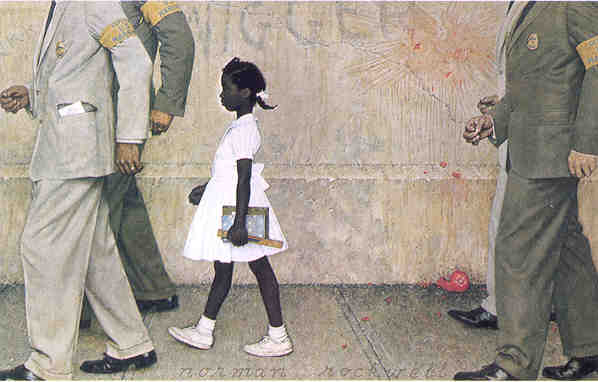
People wonder why so many black children are failing in school and what the heck is wrong with the educational system. Well, a lot of things and this Supreme Court decision in June of this year reflects one of them which is that "diversity" has become an end in itself in our schools. It doesn't appear that anyone is really being critical about the issue and recognizing that the integration approach created when Brown vs. Board of Education was really about getting black kids into the better white schools they were denied entry to. This was the real point of the battle. Black kids were forced to attend poorly supplied and resourced schools and denied access to the well resourced and supplied schools of whites. I'm quite certain that Thurgood Marshall didn't think we needed to attend white schools because diversity was so wonderful. He fought to reverse the forced denial of education to our kids and get them in to better schools. That was the point then and it should be the point now.

But its not. Now, we fight tooth and nail for integration as an end in itself. TV debates in the wake of the decision were all cast as a fight about whether or not achieving diversity was a compelling interest. But we are missing the forest for the trees. We should be fighting to get our kids educated well, not whether or not they can attend a white school and achieving the latter does not assure the former. Its not a necessary fight in the modern age, because we can attend most any school if we can afford it or if we live in its attendance zone if its a public school.

But we are wasting time with diversity while our kids are falling further and further behind, refusing to face facts, one of them being that centralized public school systems lack the management and educational fire power to address the educational needs of urban populations stressed by a variety of socioeconomic conditions. Like the auto companies, they are saddled with legacy labor costs they cannot shed and union structures that are part of the problem, not the solution. These centralized bureaucratic systems are not nimble enough to deal with whats happening to our kids in and out of school. Furthermore, they are expensive and inefficient. We are spending two or three times what we should because these systems allocate their resources for education poorly and our money is not doing the work it should.

I'm not just long on critique. I've got a big gun answer - charter schools. Why are they the answer? Because they drive accountability for performance down to the school level, they are driven by market forces such that the good ones will thrive and the bad ones will fail, they are open to a variety of configurations and approaches and they do it all for about a third of what public schools do it for.

Lots of places in the US have charter schools, but there are only a few that get it right. The one that has the best system in place in my view is Indianapolis. Bart Peterson, the mayor of Indianapolis is the only mayor in the country currently with the power to charter schools. In nearly all big cities, Mayors are confronted with failing public school systems, but since they don't hire the superintendent and they are not on the school board, they have little ability to actually affect how school systems run. However, they have to deal with the consequences of a failing system such as aversion to homeownership investment and poor workforce preparation. Bart Peterson's response? He obtained the power to charter schools and has essentially built a school system for which he has the power to require accountability. Charter applicants must pass through a rigorous examination to obtain a charter and perform to standards in order to retain it.

Why are charters better? In my view, all of the accountability for performance is right at the school level. You don't have to mediate accountability for performance through superintendents and school boards. Charters must exercise care to serve the needs of their students and their families or lose their enrollment to another. Secondly, the charter approach permits tremendous variation in educational approach and philosophy. It is far more flexible in responding to the needs of students.

Sadly though, the charter approach is often hotly protested in the cities where its needed the most. We fight tooth and nail to preserve a public school system that consistently under performs for our kids, that promises to improve and rarely if ever does. We fight to preserve centralized bureaucratic school systems as though they have a right to exist, as though they are the only way to do education. I have conversations with people about education and they argue strenuously for more propping up of centralized bureaucratic education systems, but they are never very clear about why it can't be or should not be done any other way. Case in point Detroit. In 2003, Michigan millionaire and philanthropist Robert Thompson offered the city $200 million to build 15 Detroit charter high schools. His offer started a full scale war by the unions on the Mayor and the Governor and when the dust had cleared, Thompson had been run out of town along with his $200 million. Lest you think I'm just harshing on Detroit, I lived there for 8 years and I was around for that particular fiasco.

Education is an imperative for the African American community, but we are going to continue to lag in this area if we do not divorce ourselves from dependence on centralized bureaucratic public education systems in our urban centers. They don't work, have not worked for decades now. The charter approach, as exemplified by the Indianapolis model (which won a Harvard Innovation in Government award) should be speedily adopted by mayors of urban centers across the country. The black activists for education who fight to preserve these poor performing systems need to start championing what works, rather than what doesn't.